A renewed political confrontation over language policy has erupted in Tamil Nadu, with M. K. Stalin launching a direct challenge to the BJP-led NDA to publicly declare its stance on implementing the three-language formula in the state. The issue, deeply rooted in Tamil Nadu’s long-standing resistance to Hindi imposition, has once again taken center stage ahead of the 2026 Assembly elections, transforming a policy debate into a high-stakes political battleground.
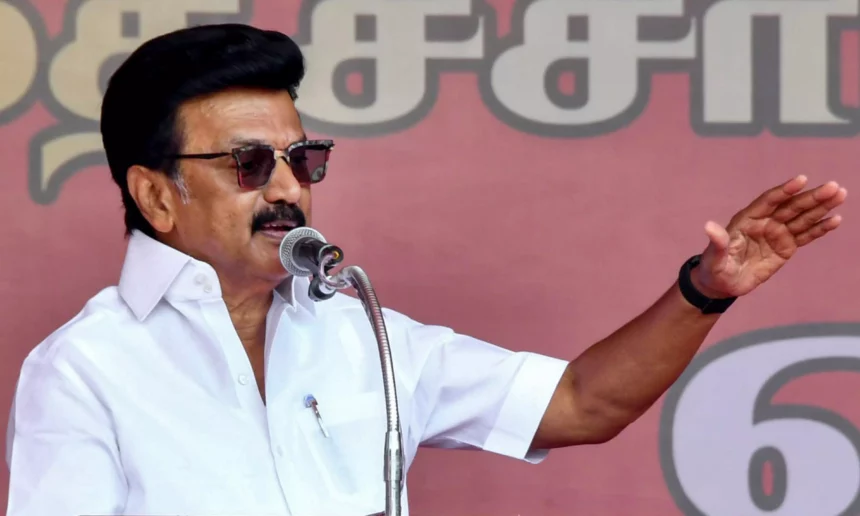
At a recent public rally, Stalin questioned whether leaders like Narendra Modi and Amit Shah would openly state their intention to enforce the three-language policy in Tamil Nadu. His remarks were not merely rhetorical; they were aimed at exposing what he described as a hidden agenda to impose Hindi under the framework of the National Education Policy.
The controversy has gained momentum following the Centre’s push to implement the three-language formula in line with NEP recommendations from the 2026–27 academic year. Under this framework, students are expected to learn three languages, with at least two being Indian languages. While the policy is presented as a tool to promote multilingualism, it has been met with strong resistance in Tamil Nadu, where linguistic identity is closely tied to political ideology.
Language Policy Becomes Flashpoint in Centre-State Tensions
The clash between the state government and the Centre reflects deeper concerns about federalism and cultural autonomy. Stalin has consistently argued that the three-language formula is not a neutral educational reform but a “covert mechanism” to expand Hindi influence in non-Hindi-speaking regions. His stance resonates with a broader sentiment in Tamil Nadu, where the two-language system—Tamil and English—has been in place for decades.
Historically, Tamil Nadu has resisted attempts to introduce Hindi as a compulsory language, dating back to the anti-Hindi agitations of the 1960s. This legacy continues to shape political discourse, making language policy a highly sensitive issue. Stalin’s remarks tap into this historical context, framing the debate as a defense of Tamil identity rather than a mere disagreement over education policy.
The Centre, however, has defended the three-language formula as a flexible and inclusive approach that does not mandate Hindi. Union Education Minister Dharmendra Pradhan has rejected claims of linguistic imposition, arguing that the policy is designed to expand opportunities and promote linguistic diversity.
Despite these assurances, the perception of coercion persists in Tamil Nadu. Stalin has even alleged that central education funds are being withheld to pressure the state into adopting the policy, further intensifying the dispute. This accusation adds an आर्थिक dimension to the debate, linking language policy to fiscal federalism.
Political use of language in electoral strategy
As Tamil Nadu heads toward a crucial election, the language issue has become a powerful political tool. Stalin’s challenge to the NDA is not just about policy clarity; it is a रणनीतिक move aimed at consolidating regional support and positioning the DMK as the defender of Tamil interests.
The BJP, on the other hand, faces a delicate balancing act. While it seeks to expand its presence in southern India, it must navigate the strong anti-Hindi sentiment that defines Tamil Nadu’s political landscape. The party’s response to Stalin’s challenge could significantly influence its electoral prospects in the state.
This confrontation also highlights the broader national debate over the role of language in education and governance. The three-language formula, first introduced in 1968 and later revised under the National Education Policy 2020, has long been a subject of contention. While intended to promote unity in a linguistically diverse country, its implementation has often been uneven and politically charged.
In Tamil Nadu, the issue transcends education, touching upon questions of identity, autonomy, and resistance to perceived centralisation. Stalin’s rhetoric reflects this complexity, framing the policy as part of a larger ideological battle rather than an isolated reform.
The timing of this debate, just weeks before the चुनाव, ensures that it will remain a dominant theme in political discourse. As both sides sharpen their positions, the outcome of this confrontation could have far-reaching implications not only for Tamil Nadu but also for the broader trajectory of language policy in India.