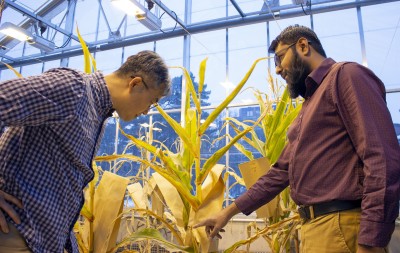
Newswise — AMES, Iowa — Baby corn, essentially unfertilized young ears of corn, is a specialty food gaining interest for its high nutrition and low calorie count. It also has significant economic value as a quick-turnaround cash crop with a global market. Currently, Thailand is the largest producer of baby corn, with an estimated annual value of $64 million.
Baby corn quality and taste are greatly reduced by pollination. To prevent pollination, farmers depend on labor- and cost-intensive detasseling to remove the male flowers from the plant early in its growth, before they shed pollen to fertilize the ears and develop seeds. A promising alternative to the bottleneck of detasseling has been discovered by Iowa State University researchers who study corn breeding.
The ‘stunt of stunted silks’
They developed a new genetic variant that resulted in “the stunt of stunted silks.” This novel genetic pollination control mechanism was recently reported in the journal Plant Physiology.
“While characterizing genes and their mutants for other reasons, we observed a mutation that led to greatly reduced silks. These short silks mainly developed inside the corn husks, reducing the opportunity for fertilization,” said Siddique Aboobucker, a scientist at Iowa State at the time of the research and now an assistant professor at the University of Kentucky. This unique trait of short, stunted silks was associated with deletion of a gene, ZmBMF2, using CRISPR/Cas9 gene editing.
The altered corn still had silks, though they were so short that they seldom extended beyond the husks. Over four years of the study, silks emerged from the husks in only one year, and not at a level sufficient for pollination and seed set. Their finding could pave the way for an alternative pollination control mechanism, especially relevant for baby corn production.
However, if the husks are removed, the plants can still be fertilized and produce seeds – an important factor for future breeding programs, according to the researchers. They also found the mutation did not affect other traits tied to productivity, such as the number of kernel rows or the ear length.
Biology of silk growth poorly explored
“The biology of corn silk growth remains a poorly explored area of research, despite its huge importance,” said Thomas Lübberstedt, K.J. Frey Professor in Agronomy, a co-author on the study. “Only two genetic mutants associated with maize silk growth and development have been identified. Now, we have found a gene related to minimal silk growth. This is exciting for its potential to benefit an alternative agricultural industry. It also has wider implications for maize breeding and plant biotechnology that deserve exploration.”
For example, the genetically altered corn also showed potentially delayed “senescence,” the process of cell growth and aging. “This could allow an avenue for more control of production timing, providing extra resilience to adapt management to environmental conditions in different growing regions,” Aboobucker said.
Unexpected discoveries
The researchers found the phenomenon of the “stunted silks” while they were studying haploid male fertility, an aspect of maize genetics associated with developing pure genetic lines for corn.
“Sometimes in research, you find intriguing results you didn’t expect, which can lead to something important,” Lübberstedt said. “It takes a creative approach, following your instincts and patience, as it almost always involves more digging and additional experiments. In this case, the discovery has real potential to lead to a new research avenue and new products.”
This project was partially funded by the National Science Foundation and Iowa State’s Plant Sciences Institute and Crop Bioengineering Center. Future research for testing the applicability of this short silk trait in Indian baby corn germplasm is jointly supported by awards from NSF and the Department of Biotechnology, Government of India.
“The process of exploration to open new doors and economic opportunities is very rewarding and interesting,” Aboobucker said. “We are fortunate that we have had funding that supports cutting-edge research that allows some flexibility to pursue unexpected findings.”
Other co-authors and team members on this research include:
- Sidramappa Talekar, Department of Agronomy, Iowa State (visiting scientist), and All India Coordinated Maize Improvement Project, Main Agricultural Research Station, University of Agricultural Sciences, Dharwad, India.
- Ursula Frei, Department of Agronomy, Iowa State.
- Bing Yang, Bond Life Sciences Center, University of Missouri, Columbia, and the Donald Danforth Plant Science Center, St. Louis, Missouri.
- Keunsub Lee, Department of Agronomy, Iowa State.
- Justin Walley, Department of Plant Pathology, Entomology and Microbiology, Iowa State.
- Rajashekhar M. Kachapur, University of Agricultural Sciences, Dharwad
- Jayant Subraya Bhat, Indian Agricultural Research Institute Regional Research Centre, Dharwad
https%3A%2F%2Fwww.newswise.com%2Farticles%2Funexpected-discovery-leads-to-potential-pollination-control-mechanism-for-baby-corn%2F%3Fsc%3Drsla