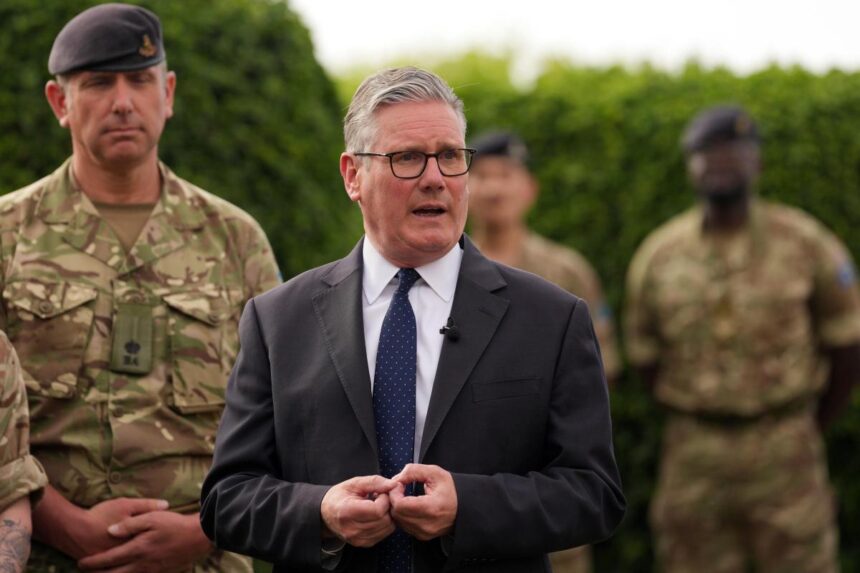
The United Kingdom has firmly rejected claims that it is supporting or participating in any blockade of Iran in the Strait of Hormuz, even as tensions in the region escalate sharply. Prime Minister Keir Starmer has made it clear that the UK’s priority remains the restoration of free and safe navigation through the strategically vital waterway, rather than engaging in military escalation. The clarification comes amid growing global concern over disruptions in oil supply routes and maritime trade due to ongoing conflict involving Iran and Western powers.
The situation in the Strait of Hormuz has become increasingly volatile following the imposition of a naval blockade targeting Iranian-linked shipping. However, UK officials have stressed that their military presence in the region is focused on ensuring maritime safety and stability, not enforcing restrictions. The government’s stance reflects a broader effort to avoid escalation while protecting global economic interests tied to the free flow of energy supplies.
UK rejects blockade participation, focuses on reopening shipping routes
The UK government has explicitly stated that it will not join any military blockade in the Strait of Hormuz, distancing itself from aggressive strategies being pursued by other nations. Keir Starmer emphasized that Britain’s objective is to ensure that the strait is “fully open” and accessible to international shipping.
Officials have highlighted that UK naval deployments, including minesweepers and surveillance systems, are aimed at maintaining safe passage rather than restricting it. The government has also underlined that any military involvement must have a clear legal basis and strategic objective, reinforcing its cautious approach to the crisis.
At the same time, the UK has been actively coordinating with European partners, particularly France, to develop diplomatic and security initiatives that can stabilize the region. Plans for joint efforts to safeguard shipping routes reflect a preference for multilateral solutions rather than unilateral military action.
Shipping restrictions linked to Iranian ports, not full Hormuz closure
While denying involvement in a blockade, UK-linked maritime authorities have acknowledged the presence of restrictions affecting vessels connected to Iranian ports. The United Kingdom Maritime Trade Operations has reported that certain maritime access limitations are being enforced on ships engaging with Iranian infrastructure, including ports and oil terminals.
These restrictions, however, do not amount to a complete closure of the Strait of Hormuz. Ships transiting the strait for non-Iranian destinations are still allowed to pass, although they may face increased inspections and security measures.
The distinction is critical, as the Strait of Hormuz is one of the world’s most important energy corridors, handling a significant portion of global oil trade. Any complete shutdown would have severe economic consequences worldwide. The current measures instead reflect targeted actions linked to the broader geopolitical conflict involving Iran.
Global tensions, oil markets and diplomatic efforts shape crisis response
The ongoing crisis has been fueled by escalating tensions between Iran and Western powers, including the United States, which has taken a more aggressive stance by imposing a naval blockade on Iranian ports. This move has contributed to rising oil prices and increased uncertainty in global markets.
The UK’s position highlights a divergence among Western allies on how to respond to the situation. While some countries have adopted military measures, others are prioritizing diplomatic engagement and international cooperation. The UK has warned that prolonged disruption of the Strait of Hormuz could have far-reaching consequences for global trade and energy security.
Efforts are underway to convene international discussions aimed at restoring stability in the region. The focus remains on ensuring uninterrupted shipping, reducing the risk of conflict escalation, and maintaining compliance with international maritime law.
The Strait of Hormuz continues to be a critical geopolitical flashpoint, with developments closely monitored by governments, energy markets, and shipping industries worldwide. The UK’s refusal to support a blockade underscores its emphasis on de-escalation and the protection of global economic stability.