In a sharp political exchange, the Shiv Sena (UBT) has launched a blistering attack on Mumbai BJP chief Ameet Satam over his controversial remark following Zohran Mamdani’s historic victory as New York City’s first Muslim-origin mayor. The remark, which appeared to caution against the “imposition of a Khan” in Mumbai, has drawn condemnation from the Uddhav Thackeray-led faction of the Shiv Sena, which accused Satam of spreading communal hatred and questioned his mental fitness. The controversy comes at a time when Maharashtra’s political climate is heating up ahead of the upcoming municipal elections, with both the Shiv Sena (UBT) and BJP trying to consolidate their respective vote bases.
Uddhav Sena’s Strong Rebuttal to Ameet Satam’s Remarks
Responding to Ameet Satam’s statements, senior Shiv Sena (UBT) leader Anand Dubey accused the Mumbai BJP chief of deliberately attempting to divide Mumbai’s voters along religious lines. Dubey launched a personal attack, questioning Satam’s mental state and sarcastically offering to fund his treatment at “Agra’s Pagal Khana.” His remarks underscored the rising tension between the Shiv Sena (UBT) and the Bharatiya Janata Party as both parties prepare for crucial civic elections in the financial capital.
“Ameet Satam’s mental condition has deteriorated. Ever since he became the Mumbai BJP president, he has realised that his party faces defeat in the coming municipal polls. That’s why he has been making bizarre and communal remarks to provoke people,” Dubey said while addressing the media. The Shiv Sena (UBT) leader alleged that Satam was trying to distract from the BJP’s failures by invoking religion and using inflammatory language.
Dubey further accused the BJP of resorting to what he called “Hindu-Muslim politics” to polarize the electorate before elections. He asserted that Mumbai’s identity could not be defined by religion but by its Marathi culture, local pride, and secular fabric. “The BJP wants to create a divide between communities for electoral gains. But the people of Mumbai are intelligent. They have seen through this politics of hatred and division,” Dubey remarked.
Despite his criticism of Satam, Dubey emphasized that the Shiv Sena (UBT) remained firm on its cultural and regional identity. “I confidently say that in the upcoming municipal elections, the saffron flag will fly high in Mumbai, and a Marathi Hindu will become the mayor,” he said. His statement was interpreted as a reaffirmation of the party’s Marathi-centric ideology — a core tenet since its inception — while simultaneously rejecting communal polarization.
Political Context: BJP’s ‘No Khan’ Remark and Sena’s Counterattack
The controversy began when Mumbai BJP chief Ameet Satam took to social media to comment on Zohran Mamdani’s victory in the New York mayoral elections. Satam’s tweet suggested that the political character of several international cities was changing and warned that a similar trend could emerge in Mumbai. “The way the political colour of some international cities is changing, after seeing the surnames of a few mayors and the ‘vote jihad’ of the Maha Vikas Aghadi, it feels necessary to stay alert regarding Mumbai. If anyone tries to impose a ‘Khan’ on Mumbai, it will not be tolerated. Wake up, Mumbaikars!” he posted.
The remark triggered a political uproar, with several opposition leaders calling it communal and irresponsible. The reference to “vote jihad” and “Khan” was widely seen as an attempt to stoke religious sentiments among voters ahead of the municipal elections. Opposition parties accused the BJP of attempting to communalize local politics, while the Shiv Sena (UBT) took particular offense, portraying the comment as an insult to Mumbai’s pluralistic ethos.
Anand Dubey was quick to respond, lambasting Satam for making such divisive remarks. In a scathing rebuttal, Dubey said Satam’s comment betrayed the BJP’s insecurity and desperation in the face of declining popularity in Mumbai. He also took a dig at the BJP’s Muslim outreach initiative, recalling the “Saugat-e-Modi” kits distributed earlier this year during Eid in Uttar Pradesh.
“I want to ask Ameet Satam whether PM Modi was sending the Saugat-e-Modi kits to Zohran Mamdani, Pakistan, or Bangladesh? He should not prove his own Prime Minister wrong,” Dubey said sarcastically. His reference to the “Saugat-e-Modi” kits — a program aimed at strengthening ties with Muslim voters — was meant to expose what he described as the BJP’s hypocrisy in simultaneously courting and vilifying Muslims depending on political convenience.
Dubey’s attack highlights how the Shiv Sena (UBT), under Uddhav Thackeray’s leadership, is seeking to position itself as both a protector of Marathi pride and a defender of secularism, contrasting itself with the BJP’s increasingly hardline Hindutva posture. Political analysts note that Dubey’s remarks reflect the Uddhav Sena’s attempt to appeal to both Marathi voters and moderate sections of society disillusioned with communal politics.
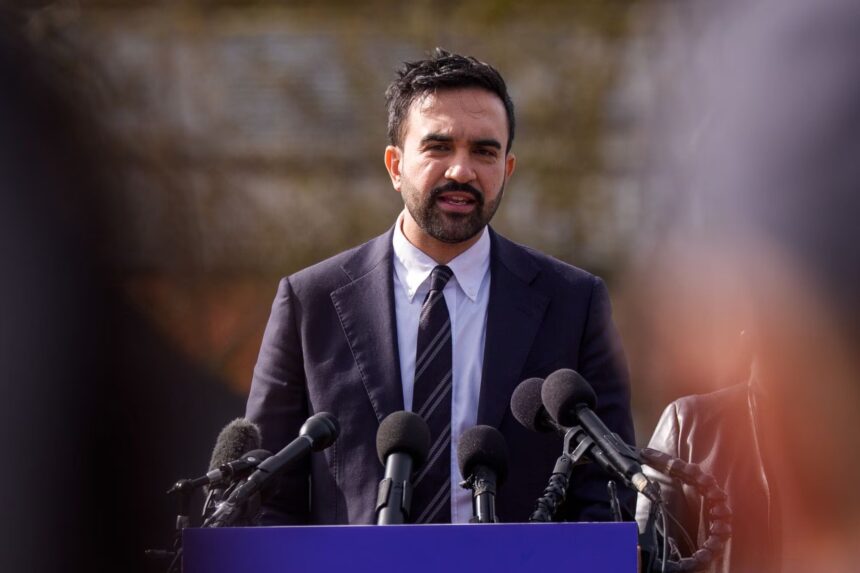
The controversy has also drawn attention to Zohran Mamdani’s landmark election in New York. Zohran Mamdani, an Indian-origin Muslim politician, defeated both Donald Trump-backed candidate Andrew Cuomo and Republican contender Curtis Sliwa, securing around 50 percent of the vote. His victory was celebrated internationally as a milestone for diversity and representation, though in India, it has unexpectedly sparked political debates about identity and leadership.
Municipal Elections and the Broader Political Landscape in Maharashtra
The row between the BJP and the Uddhav Sena comes at a crucial political juncture. Maharashtra Election Commissioner Dinesh Waghmare recently announced that polls for 246 municipal councils and 42 nagar panchayats across the state will be held on December 2, with results to be declared the following day. Among them, the Mumbai civic polls — governed by the Brihanmumbai Municipal Corporation (BMC) — are viewed as a major battleground between the BJP and the Uddhav faction of the Shiv Sena.
For decades, the Shiv Sena dominated the BMC, leveraging its strong Marathi identity and grassroots organization. However, since the 2019 split between Uddhav Thackeray and Eknath Shinde, the Sena’s voter base has fragmented, and the BJP has been making aggressive attempts to capture the civic body. Ameet Satam, known for his outspoken views, was appointed as the Mumbai BJP president earlier this year to strengthen the party’s campaign. His latest remarks, however, have sparked debate over whether such rhetoric will help or harm the BJP’s image in a cosmopolitan city like Mumbai.
Political observers suggest that the BJP is attempting to blend Hindutva messaging with nationalism to consolidate Hindu votes, while the Uddhav Sena is banking on Marathi regional pride and inclusive politics to regain lost ground. The BJP’s leadership, particularly under Prime Minister Narendra Modi and Home Minister Amit Shah, has frequently accused Uddhav Thackeray of abandoning Hindutva values after allying with the Congress and the Nationalist Congress Party (NCP) under the Maha Vikas Aghadi (MVA) banner.
By contrast, the Uddhav Sena argues that it represents a more authentic and inclusive version of Hindutva, rooted in the legacy of Bal Thackeray but devoid of religious hatred. The party’s leadership has repeatedly accused the BJP of twisting Hindutva for political gains and damaging the social harmony that Mumbai has long prided itself on.
In this political tug-of-war, Ameet Satam’s “no Khan” remark appears to have provided the Uddhav Sena with fresh ammunition to attack the BJP’s divisive politics. The timing of the remark, just weeks before the election, has ensured that it becomes a central talking point in the campaign.
As the verbal battle intensifies, the broader political narrative in Maharashtra continues to evolve around issues of identity, governance, and ideology. The BJP is likely to double down on its nationalist rhetoric, emphasizing the Modi government’s achievements, while the Uddhav Sena will attempt to rally Marathi voters around the idea of self-respect and local pride.
The controversy surrounding Ameet Satam and Anand Dubey’s exchange also reveals how political discourse in Maharashtra is increasingly shaped by social media, where a single tweet can trigger days of political sparring and news coverage. Leaders from both camps are using online platforms to mobilize supporters, attack opponents, and frame narratives before traditional campaigning begins in earnest.
The coming weeks are expected to see intensified campaigning across Mumbai and other urban centers in Maharashtra, with both the BJP and Shiv Sena (UBT) deploying their top leaders to rally support. While Ameet Satam’s remarks have polarized opinions, they have also reignited a deeper conversation about the nature of leadership and identity in a diverse and dynamic city like Mumbai — a conversation that will likely influence not just the outcome of the upcoming municipal polls but the state’s broader political future.