A reported decision by the United Arab Emirates to withdraw from plans to operate Islamabad International Airport has sparked diplomatic and political debate in Pakistan, particularly as the development coincided with UAE President Sheikh Mohammed bin Zayed Al Nahyan’s high-profile visit to India. While Pakistani media reports suggest that the UAE terminated a proposed airport operations agreement, the government led by Prime Minister Shehbaz Sharif has firmly denied that any such deal was ever finalised or existed in the first place. The episode has drawn attention to Pakistan’s economic vulnerabilities, its efforts to attract foreign investment, and the shifting regional dynamics shaped by deepening India-UAE ties.
Conflicting narratives emerge over airport deal as india-uae engagement intensifies
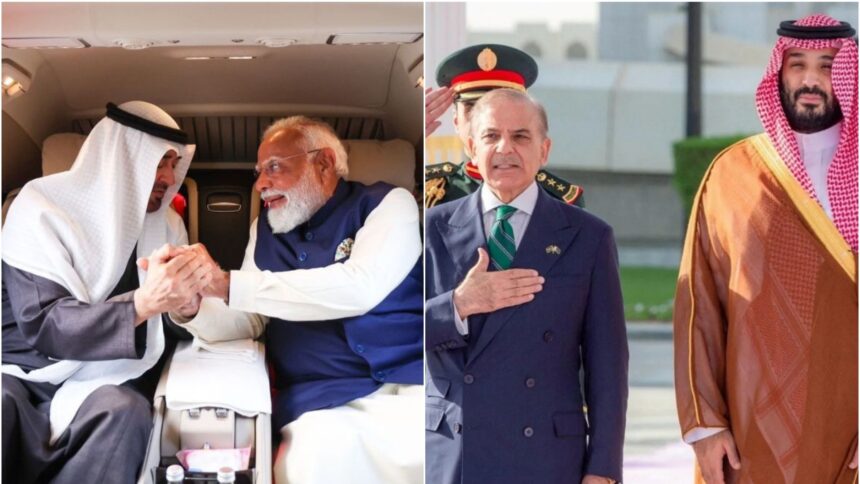
According to reports in Pakistan’s media, the UAE decided to revoke a plan to manage and operate Islamabad International Airport, a move that was widely interpreted as being linked to President Sheikh Mohammed bin Zayed Al Nahyan’s sudden visit to India. The visit, announced only a day in advance, took place on January 19 and lasted approximately two hours, yet carried significant diplomatic weight. Prime Minister Narendra Modi personally received the UAE President at the airport, a gesture viewed as a break from protocol and a strong signal of the closeness between the two countries.
During the brief visit, India and the UAE signed nine agreements spanning trade, defence cooperation, technology, and strategic partnership, reinforcing an already robust bilateral relationship. Indian officials described the engagement as highly significant despite its short duration, noting that the discussions reflected long-term strategic alignment. The presence of senior members of the Abu Dhabi and Dubai royal families, along with top ministers and officials, further underscored the importance the UAE attached to the visit.
In Pakistan, reports linking the India visit to the collapse of the Islamabad airport deal triggered swift official pushback. The government led by Shehbaz Sharif stated categorically that there was never any agreement with the UAE to lease, operate, or manage Islamabad International Airport. Officials described reports suggesting that Pakistan had cancelled or lost such a deal as misleading, emphasising that discussions, if any, never reached a formal or binding stage. This denial, however, contrasted with earlier indications from Pakistani officials that exploratory talks with UAE entities had taken place months earlier as part of broader efforts to attract foreign investment.
The contradictory narratives have fuelled speculation within Pakistan about diplomatic signalling, economic pressure, and the country’s shrinking room for manoeuvre as regional alliances evolve. Analysts note that while Pakistan denies the existence of a deal, the perception of a setback itself highlights Islamabad’s sensitivity to developments involving India and key Gulf partners. The episode also reflects how economic initiatives can become entangled with geopolitical realities, particularly when major regional players recalibrate their strategic priorities.
Islamabad airport’s strategic value and pakistan’s economic recalibration
Islamabad International Airport occupies a central place in Pakistan’s aviation and infrastructure landscape. As the country’s largest and most modern airport, it serves as the primary international gateway to the capital, replacing the older Benazir Bhutto International Airport. Construction of the facility began in 2007 and was completed after more than a decade, with costs running into billions of Pakistani rupees, making it one of the most expensive infrastructure projects in the nation’s history. Operational since May 2018, the airport was designed to accommodate rising domestic and international air traffic and to project a modern image of Pakistan to the world.
The airport currently handles an average of 40 to 50 flights daily, connecting Islamabad to major cities within Pakistan and to destinations across the Middle East, Europe, and Asia. Equipped with two long runways capable of handling wide-body aircraft, the facility is positioned as a key hub for international travel and cargo. However, despite its modern infrastructure, Pakistan’s aviation sector has struggled financially, with state-run entities facing persistent losses, operational inefficiencies, and mounting debt.
It was in this context that Pakistan explored partnerships with foreign investors, including potential UAE involvement in airport operations. The UAE’s global aviation expertise and the success of its carriers had been viewed as a possible solution to improve efficiency, service quality, and financial performance at Islamabad airport. Discussions reportedly began in August 2025 as part of Pakistan’s broader strategy to attract foreign capital amid a deepening economic crisis.
The reported withdrawal of the UAE, whether from formal negotiations or preliminary talks, comes at a time when Pakistan is undertaking difficult economic decisions. One of the most significant steps was the partial privatisation of Pakistan International Airlines, the country’s loss-making national carrier. In December, Pakistan sold a 75 percent stake in PIA to the Arif Habib Group, retaining a minority share while seeking to reduce fiscal burden and revive the airline’s fortunes. The sale followed years of financial losses and failed attempts at privatisation due to weak investor interest.
Together, these developments illustrate Pakistan’s ongoing struggle to stabilise its economy while navigating complex regional relationships. The Islamabad airport episode, regardless of whether a formal deal existed, has highlighted how closely Pakistan’s economic ambitions are intertwined with its diplomatic positioning. As India strengthens its strategic partnerships with Gulf nations such as the UAE, Pakistan faces increasing challenges in attracting similar levels of investment and political support, making infrastructure and reform initiatives more difficult to sustain.