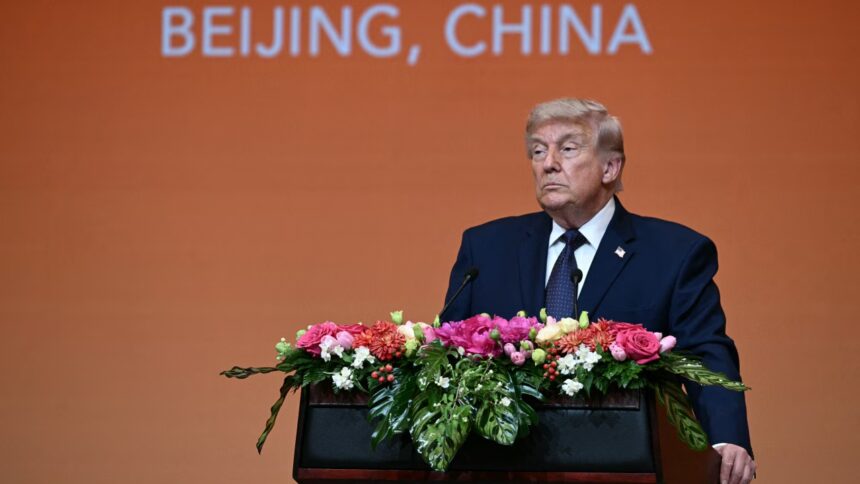
At a high-profile state banquet in Beijing, United States President Donald Trump described US-China relations as “the most consequential in world history” while emphasizing a renewed phase of engagement between the two global powers. The remarks came during his ongoing diplomatic visit to China, where he met Chinese President Xi Jinping for wide-ranging discussions covering trade, geopolitical tensions, and global security challenges.
The meeting marked one of the most closely watched diplomatic engagements in recent years, unfolding at a time when global markets and strategic alliances are already under pressure due to conflicts in West Asia and shifting economic priorities. The tone of the summit, however, reflected a deliberate effort by both leaders to project stability, cooperation, and mutual respect despite underlying strategic differences.
A key highlight of the evening was Trump’s formal invitation to Xi Jinping to visit the White House on September 24, signaling a continuation of high-level engagement between Washington and Beijing. The invitation was extended during the banquet, underscoring the symbolic importance of maintaining dialogue between the two largest economies in the world.
Strategic Reset Amid Global Uncertainty
The banquet and surrounding discussions took place against the backdrop of rising geopolitical uncertainty, including tensions in the Middle East and ongoing debates over global energy security. Both leaders acknowledged the importance of maintaining stable communication channels, particularly as global supply chains continue to face disruptions.
Trump’s characterization of the bilateral relationship as “most consequential” reflected an acknowledgment of the deep interdependence between the two nations. Despite years of trade disputes, technological restrictions, and strategic rivalry, both economies remain tightly connected through commerce, investment, and global financial systems.
Xi Jinping, in his remarks, also emphasized the importance of managing differences while expanding areas of cooperation. According to officials present at the meeting, discussions touched upon trade balances, technological competition, and regional security concerns, including the situation in the Indo-Pacific.
Taiwan and Strategic Sensitivities Remain Central
While the public tone of the summit remained cordial, sensitive geopolitical issues were not absent from the conversation. Reports indicate that Taiwan was discussed as a critical point of contention, with Xi reiterating China’s long-standing position that the issue remains central to its national sovereignty.
At the same time, both sides appeared to avoid escalating rhetoric, instead focusing on frameworks that could prevent misunderstandings and reduce the risk of direct confrontation. Analysts view this approach as part of a broader attempt to stabilize relations after years of heightened tension across multiple domains including technology, defense, and trade policy.
The presence of senior officials and business leaders at the banquet further highlighted the economic dimension of the visit, with both governments signaling openness to continued commercial engagement even amid strategic competition.
White House Invitation Signals Diplomatic Continuity
The invitation extended by Trump for Xi to visit Washington on September 24 adds a new chapter to the evolving US-China relationship. Such reciprocal visits are often seen as critical indicators of diplomatic health between rival powers, especially when accompanied by high-level economic and security discussions.
While details of the upcoming visit remain limited, the announcement itself has already drawn global attention, with observers interpreting it as a signal that both countries are willing to maintain structured dialogue despite ongoing disagreements.
The invitation also reflects a broader diplomatic strategy focused on managing competition rather than escalating confrontation. This approach aligns with recent efforts by both sides to stabilize relations after periods of tariff disputes and export restrictions.
Global Reactions and Strategic Implications
International reaction to the summit has been swift, with analysts highlighting both optimism and caution. On one hand, the renewed engagement between Washington and Beijing is seen as a positive step toward reducing global uncertainty. On the other, underlying strategic rivalries—particularly in technology and regional influence—remain unresolved.
Markets are also closely watching the developments, as US-China relations play a significant role in shaping global trade flows, investment decisions, and energy markets. Any shift toward cooperation or confrontation between the two powers has immediate ripple effects across Asia, Europe, and emerging economies.
For now, the tone emerging from Beijing suggests a temporary stabilization rather than a structural resolution of differences. Both sides appear committed to maintaining communication channels, even as competition continues in key strategic sectors.
Trump’s remarks at the Beijing banquet, combined with Xi Jinping’s diplomatic engagement, reflect a cautious but deliberate effort to reset the tone of US-China relations. By framing the partnership as “most consequential in world history,” the US leadership underscored the scale and importance of the relationship, even amid persistent tensions.
The invitation for a White House visit adds further momentum to this diplomatic phase, suggesting that both nations are prioritizing dialogue over confrontation at least in the near term. However, fundamental disagreements over security, trade, and geopolitical influence ensure that the relationship will remain complex and closely watched in the months ahead.