In 1947, when British colonial administrator Cyril John Radcliffe drew arbitrary lines to partition India, he unknowingly set the stage for the displacement, violence, and suffering that followed. The partition, dividing regions like Punjab and Bengal on religious lines, created a Muslim-majority Pakistan, forcing millions of Hindus, Sikhs, and Muslims to migrate across borders. This artificial division not only led to horrific communal violence but sowed the seeds for further persecution of minorities, especially in East Pakistan (now Bangladesh), over the following decades.
The 1946 Bengal Riots and Its Aftermath
The communal tensions in Bengal had already begun in August 1946 with the ‘Direct Action Day’ called by the Muslim League, led by Muhammad Ali Jinnah, demanding a separate Muslim country. What was supposed to be a peaceful protest turned into the “Great Calcutta Killings,” a brutal week of violence, leaving thousands dead and many more injured. The violence didn’t stop in Calcutta; it spread to other parts of Bengal, particularly in Noakhali, where Hindus were targeted with killings, rapes, and forced conversions. This violence foreshadowed the fate of the Hindu minority in East Pakistan.
The Persecution of Hindus in East Pakistan
After the partition, East Pakistan’s Hindu population, which had made up about 23% of the region’s population in 1951, began to face systemic discrimination and violence. The Pakistani government, much like its colonial predecessors, divided the Hindu community and implemented policies to marginalize them. The violence against Hindus escalated, with state-backed attacks like the 1950 riots, followed by massacres and forced conversions. In the 1960s, as East Pakistan’s political instability grew, the persecution of Hindus and other minorities worsened.
The 1971 Bangladesh Liberation War marked a particularly brutal chapter, with the Pakistani army carrying out large-scale atrocities against the Bengali population, especially Hindus. During the war, the Pakistani army systematically targeted Hindus, marking their shops with yellow ‘H’ signs and using them as scapegoats for political upheaval. The violence included widespread killings, rapes, and the destruction of Hindu homes and temples.
Post-Liberation Bangladesh: Continued Violence Against Minorities
After the creation of Bangladesh in 1971, the new country’s initial secular outlook soon gave way to the Islamization of its political and social structures. Religious minorities, particularly Hindus, Buddhists, and Christians, continued to face persecution. Hindu temples were targeted, and minority communities were subjected to violence during periods of political upheaval, such as in the 1989 riots and the 1990s violence following rumors about the Babri Masjid demolition.
In the 2000s, as political parties like the Bangladesh Nationalist Party and Jamaat-e-Islami gained power, communal violence against Hindus escalated. Hindu homes, businesses, and temples were attacked, and women were abducted and raped. The violence spread across various parts of Bangladesh, leaving thousands displaced and fearful for their safety.
Continued Persecution of Minorities in Recent Years
In recent years, attacks on religious minorities have continued, often sparked by political or social tensions. In 2012, a Muslim mob destroyed Buddhist temples in Ramu, following a fabricated accusation against a Buddhist youth. Similar attacks have targeted Christians, particularly converts from Islam, and the Ahmadiyya Muslim community. The economic exploitation of minorities has also continued through legal means, like the Vested Property Act, which has enabled the confiscation of land from Hindus and other minorities.
The 2024 Violence and Growing Radicalization
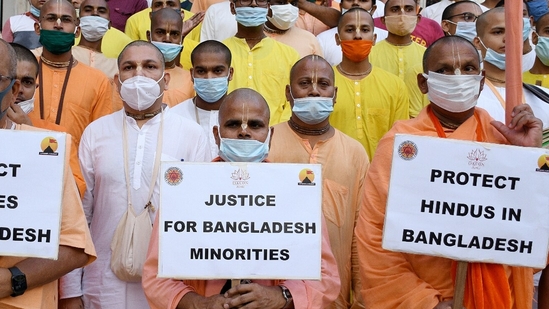
The political instability in Bangladesh in 2024, following the ousting of Prime Minister Sheikh Hasina, led to another wave of violence against Hindus and other religious minorities. Over 2,000 incidents of communal attacks were reported, with businesses, properties, and places of worship of minorities being targeted. Despite international condemnation, the Bangladesh government failed to intervene effectively.
The situation is further compounded by the ongoing persecution of the Pahari-Indigenous communities in the Chittagong Hill Tracts, where land and resources are being systematically taken from them and given to Bengali Muslims, resulting in their displacement.
International Attention and the Way Forward
The plight of minorities in Bangladesh, particularly Hindus, is a humanitarian crisis that has continued for decades. The government’s failure to protect its minority populations from violent attacks and systemic discrimination has led to the erosion of the country’s once-diverse cultural fabric. The state-sanctioned persecution of religious minorities, especially the Hindus, has reached alarming levels.
International pressure and diplomatic interventions are crucial to halting the cycle of violence and ensuring the protection of minorities in Bangladesh. The world must not ignore the suffering of these communities, as their fate is a stark reminder of the dangers of unchecked religious intolerance and state-sanctioned discrimination. Without meaningful reforms, legal protections, and political will, the future of these minorities remains bleak.