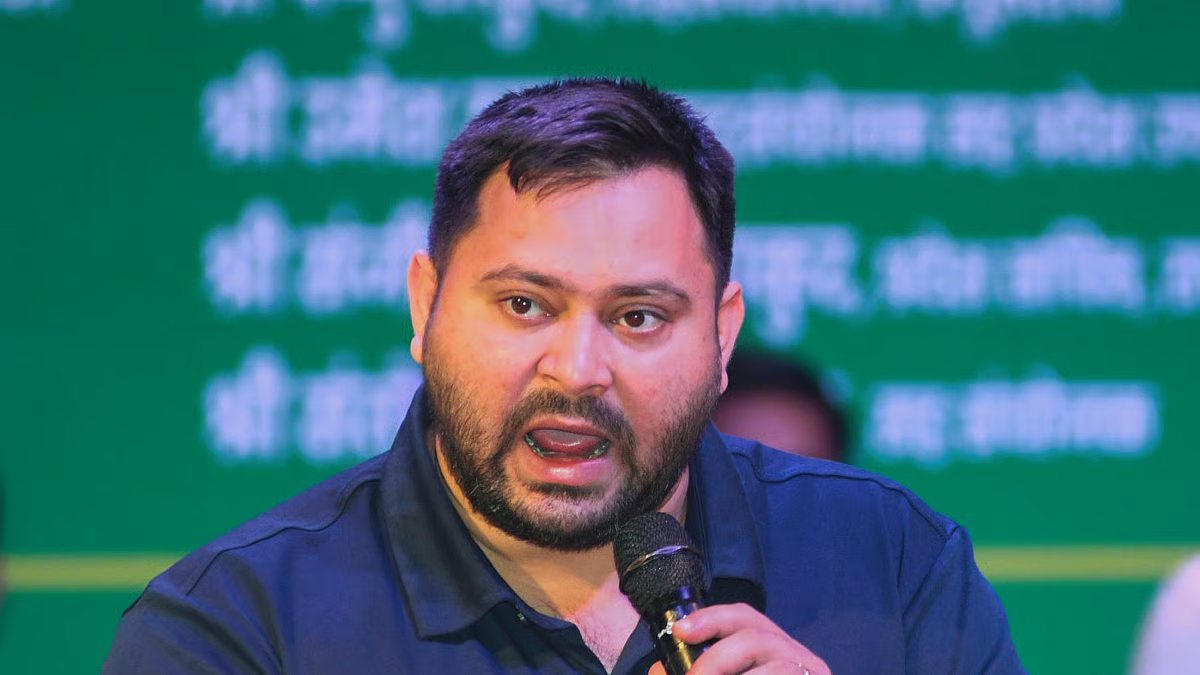
Amid growing political tensions in Bihar over voter lists and the Special Intensive Revision (SIR) process, Rashtriya Janata Dal (RJD) leader Tejashwi Yadav has raised serious allegations concerning the issuance of multiple voter identification cards to key NDA leaders. Tejashwi Yadav claimed that certain prominent leaders, including a sitting Member of Parliament and her husband, a Member of the Legislative Council, are in possession of two separate Electors Photo Identity Cards (EPIC), potentially giving them the ability to cast multiple votes in different constituencies. This allegation has sparked a wave of political controversy, raising questions about the integrity of the electoral process and the functioning of the Election Commission in Bihar.
Allegations Against NDA Leaders and Questions on Electoral Process
Tejashwi Yadav, taking to social media platform X, highlighted the case of Veena Devi, the MP from Vaishali representing the Chirag Paswan-led Lok Janshakti Party (Ram Vilas), and her husband Dinesh Singh, a JDU member of Bihar’s Legislative Council. According to Tejashwi Yadav, Veena Devi holds two EPIC cards, UT01134543 and GSB1037894, allowing her to cast votes in two different Lok Sabha constituencies. He pointed out discrepancies in her age across the two voter IDs and questioned whether the forms filled during the SIR were signed legitimately by her or if there were administrative errors by the Election Commission. Tejashwi Yadav framed these issues as potential electoral fraud designed to favor the NDA, asking whether the Election Commission would verify these claims and issue notices against the alleged irregularities.
Extending his allegations, Tejashwi Yadav also drew attention to Dinesh Singh, Veena Devi’s husband, alleging that he too possesses two separate EPIC IDs allowing him to vote in distinct Lok Sabha constituencies.
Highlighting the proximity of Dinesh Singh to the Chief Minister, Tejashwi Yadav suggested that this may have facilitated the issuance of multiple voter IDs, presenting a direct challenge to the principles of fair and free elections. The RJD leader expressed concerns that such discrepancies could undermine the credibility of the electoral process and potentially sway election outcomes, calling on the Election Commission to acknowledge the errors and take corrective action. In addition to the couple, Tejashwi Yadav flagged another case involving Muzaffarpur Mayor and BJP leader Nirmala Devi, alleging that she too holds two separate EPIC IDs. The Election Commission, responding to these claims, reportedly issued notices to the leaders mentioned, including Nirmala Devi, seeking explanations regarding the multiple voter ID registrations.
According to electoral norms, every eligible voter in India is entitled to only one EPIC card and can vote from a single constituency. The issuance of multiple EPICs to a single individual, if proven, represents a direct violation of these rules and raises the specter of systemic lapses in voter list management.
Political Reactions and Controversy Surrounding the Allegations
The allegations have elicited sharp rebuttals from the NDA leadership. Mr. Sinha, one of the leaders named in the claims, stated that he has already requested the removal of his name from one of the constituencies, asserting that he has consistently voted from only one location. He accused Tejashwi Yadav of spreading misinformation to mislead the public, dismissing the claims as politically motivated. Sinha emphasised that the RJD leader was attempting to manipulate public perception by presenting incomplete or incorrect data regarding the voter lists.
The controversy has further intensified political rhetoric in Bihar, as parties and leaders prepare for upcoming elections. Opposition leaders, particularly from the RJD, have argued that the alleged multiple EPICs for NDA leaders indicate a deeper issue of systemic favoritism and potential manipulation of electoral rolls. Tejashwi Yadav’s campaign to highlight these discrepancies has involved public posts and media engagements, where he has consistently framed the issue as evidence of electoral mismanagement by the Election Commission, potentially benefiting the ruling coalition.
From a procedural standpoint, the Election Commission has responded to individual cases by issuing notices and seeking clarifications. However, Tejashwi Yadav and his party contend that isolated actions are insufficient and that a comprehensive investigation is needed to ensure the integrity of the entire electoral process in Bihar. The RJD leader’s concerns underscore the critical role of transparency in maintaining public trust in elections, particularly in states like Bihar, where political competition is intense and voter engagement is high.
The allegations of multiple EPIC IDs have also brought attention to the Special Intensive Revision (SIR) process, which aims to update voter lists and verify the eligibility of registered voters. According to Tejashwi Yadav, the discrepancies in EPIC issuance could reflect broader lapses within the SIR process, including insufficient verification measures, errors in data entry, or potential manipulation by political actors with influence over local administrative machinery. By highlighting such issues, Tejashwi Yadav has sought to generate public scrutiny of the electoral process and prompt accountability from the Election Commission.
Political analysts note that voter list discrepancies are a sensitive subject in Indian elections, with even minor errors potentially impacting close contests. Allegations such as those raised by Tejashwi Yadav can shape public discourse, influencing perceptions of fairness and impartiality in the electoral system. The broader political implication is that parties accused of benefiting from irregularities may face reputational risks, while opposition parties can leverage these issues to question the legitimacy of governing coalitions. In response to the ongoing controversy, the Election Commission has reiterated its commitment to maintaining accurate and transparent voter records. Notices issued to leaders with alleged multiple EPIC cards are intended to clarify individual cases and correct errors where necessary.
Nevertheless, the political debate continues, as RJD leaders argue that systemic issues require proactive reforms rather than reactive fixes. Public attention on the matter has intensified as media coverage and social media discussions amplify the claims, placing additional pressure on electoral authorities to act swiftly and transparently.