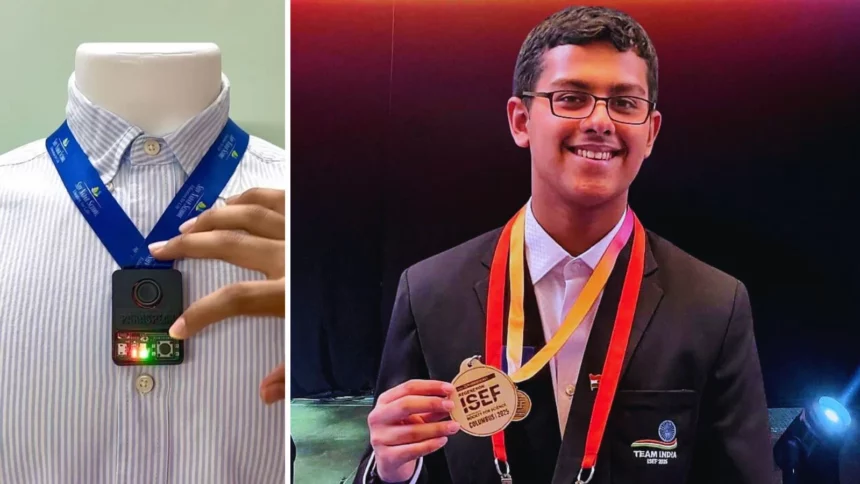
In a remarkable display of innovation and empathy, 16-year-old Pranet Khetan, a Class 11 student from Shiv Nadar School in Gurgaon, has developed Paraspeak, an affordable AI-powered device capable of converting slurred speech into fluent Hindi in real time. The invention addresses a critical communication gap faced by millions of patients suffering from conditions like stroke, cerebral palsy, and Parkinson’s disease in India. This breakthrough has not only earned him international recognition at the prestigious 75-year-old Regeneron International Science and Engineering Fair (ISEF 2025) in the United States but has also highlighted the transformative potential of low-cost, socially conscious AI technologies in healthcare. By combining advanced AI algorithms with practical accessibility, Pranet has shown how a teenager’s empathy-driven vision can create meaningful impact in real-world contexts.
The Spark Behind Paraspeak and Its Journey to Creation
The journey of Paraspeak began during a school field trip to a paralysis care center, where Pranet witnessed patients struggling to express themselves. Despite being fully aware of what they wanted to say, the patients’ words were tangled and incomprehensible due to slurred speech. Watching their frustration left a lasting impression on him. “I saw patients struggling to communicate with their caretakers despite knowing exactly what they wanted to say. Seeing this, I felt I could create an AI system that can give their voice back to them,” Pranet recalls.
Months of rigorous experimentation, coding, and testing ensued. Early prototypes failed to deliver the precision required for real-time speech conversion, and limited datasets of dysarthric speech in Hindi presented a formidable challenge. Dysarthric speech refers to impaired speech caused by conditions affecting muscle control, such as stroke, cerebral palsy, or Parkinson’s disease. Unlike English, Hindi lacked sufficient dysarthric speech data, which is critical for training AI models to accurately interpret slurred words. Undeterred, Pranet designed his own data collection toolkit, capturing a variety of Hindi speech patterns affected by slurring. This dataset became the foundation for the deep learning model powering Paraspeak, enabling it to process slurred speech in real time and reproduce clear, fluent Hindi outputs.
Paraspeak’s development demonstrates not only technical ingenuity but also social sensitivity. Pranet’s focus on affordability ensured that the device cost under Rs 2,000, making it accessible for small towns and villages, rather than just large hospitals. The design choices reflect a deliberate effort to democratize access to speech-assistive technologies in a country where millions of people face speech impairments. According to the Indian Stroke Association, nearly 1.8 million people in India experience strokes each year, many of whom suffer from slurred or impaired speech. Adding the millions living with cerebral palsy or Parkinson’s disease, the scale of the communication challenge becomes evident. Paraspeak emerges as a practical, culturally tailored solution in this context.
AI Innovation Meets Cultural Relevance: How Paraspeak Works
At the heart of Paraspeak is a deep learning AI model trained to recognize speech patterns characteristic of slurring. Unlike most commercial speech recognition systems, which require massive datasets to function accurately, Paraspeak’s AI was trained using limited yet carefully engineered datasets. Once the device captures audio input from the user, the model processes the slurred speech in real time, converting it into clear, intelligible Hindi and immediately playing it back for listeners. This capability allows patients to communicate seamlessly with caretakers, family members, and healthcare professionals, restoring their voice and dignity.
Pranet also prioritized linguistic accessibility. Most existing AI speech recognition systems are tailored for English, leaving a significant portion of India’s population underserved. By focusing on Hindi, he ensured that Paraspeak addresses a critical gap in assistive technology. Moreover, the device’s architecture allows scalability to other Indian languages, such as Bengali and Tamil, by extending the data collection methodology. Even with minimal initial datasets, the system can be trained to handle multiple regional languages, opening possibilities for wider national adoption.
The device is not only technologically innovative but also user-centric. It is portable, simple to operate, and cost-effective. The Rs 2,000 price point is less than the cost of a mid-range smartphone screen replacement, reflecting Pranet’s vision of creating solutions accessible to everyday families. He emphasizes that technology should not be a privilege confined to elite hospitals or urban centers. With Paraspeak, he has effectively bridged the gap between cutting-edge AI and practical social need.
Paraspeak’s recognition on the global stage underscores its significance. At ISEF 2025, the device earned the Fourth Grand Award in Biomedical Engineering, placing Pranet among a global cohort of young innovators. The award recognized both the technical ingenuity and the social impact of his work. “It was surreal,” he recalls. “I met young innovators from across the globe and realized that ideas don’t need to be perfect to create impact. What matters is taking the first step.” The accolade highlights how empathetic, human-centered innovation can resonate internationally, inspiring young scientists to tackle real-world problems with AI.
Pranet’s journey also illustrates the importance of persistence and experimentation in scientific innovation. For most high school students, academic life revolves around grades and exams, yet Pranet chose to pursue an ambitious project addressing a pressing societal issue. Months of trial and error, iterative design, and coding challenges exemplify the type of persistence required to turn a concept into a functional device. He emphasizes that large laboratories or massive funding are not prerequisites for meaningful innovation; curiosity, empathy, and consistent effort are often more important.
Pranet envisions expanding Paraspeak beyond Hindi. His goal is to create a multilingual platform capable of serving diverse linguistic communities across India. Plans include deployment on low-cost, portable hardware, potentially transforming it into a pocket-sized translator that patients can carry anywhere. The scalability and adaptability of the system ensure that it can address a broad spectrum of communication challenges in diverse environments, including rural areas with limited access to healthcare facilities.
Paraspeak’s success also raises important questions about the integration of AI into healthcare and social technology. It demonstrates that AI solutions do not need to be expensive or complex to be impactful. By carefully understanding user needs, leveraging limited datasets, and designing context-specific solutions, young innovators like Pranet are redefining the possibilities for socially conscious AI. His approach underscores the importance of designing technology for inclusivity, affordability, and real-world applicability rather than for prestige or profit alone.
Moreover, Paraspeak’s development reflects a broader trend in AI innovation that emphasizes empathetic design. As technology becomes increasingly pervasive, the human-centered approach taken by innovators like Pranet ensures that AI serves as a tool for empowerment rather than exclusion. By restoring communication to patients, Paraspeak transforms the lives of individuals, enabling them to interact confidently, access education, and participate more fully in social and professional contexts.
The long-term implications of Paraspeak are profound. Beyond improving day-to-day communication, the device could contribute to better healthcare outcomes. By allowing patients to communicate symptoms more clearly, healthcare providers can deliver more accurate diagnoses and targeted treatments. Families and caregivers, too, benefit from reduced frustration and improved interaction with patients. In essence, Paraspeak strengthens the connection between patients, caregivers, and medical professionals, creating a more inclusive and supportive healthcare environment.
Paraspeak’s story also highlights the potential of young innovators to address India’s unique challenges through technology. With a focus on culturally and linguistically relevant solutions, Pranet demonstrates that innovation is most powerful when it responds to real human needs. His journey exemplifies how students can leverage AI not only to experiment academically but also to make a tangible difference in society.
Pranet’s experience at ISEF 2025 provided valuable lessons for his future endeavors. Interacting with innovators from around the world reinforced his belief that collaboration, empathy, and the willingness to take risks are as important as technical skill. By embracing experimentation and learning from failure, he has shown that young minds can create technology that is both advanced and socially transformative.
Paraspeak is more than a device; it is a model for how AI can be deployed thoughtfully, ethically, and inclusively. It merges deep learning, real-time processing, and user-centric design with a commitment to social good. Its affordability and linguistic accessibility make it a standout example of technology that bridges the gap between innovation and real-world application.
Pranet’s story offers inspiration for educators, policymakers, and students alike. It emphasizes the importance of nurturing curiosity, supporting experimentation, and fostering a culture where empathy-driven technological solutions are encouraged. By demonstrating that age is no barrier to impactful innovation, Pranet challenges conventional perceptions about who can create meaningful technological solutions.
Paraspeak is a testament to the power of merging technical expertise with human empathy. It shows that even teenagers can tackle complex societal issues through creativity, AI, and persistence. As Pranet continues to expand Paraspeak’s capabilities and reach, his work promises to influence the future of speech-assistive technologies, setting new standards for inclusivity, affordability, and practical impact.