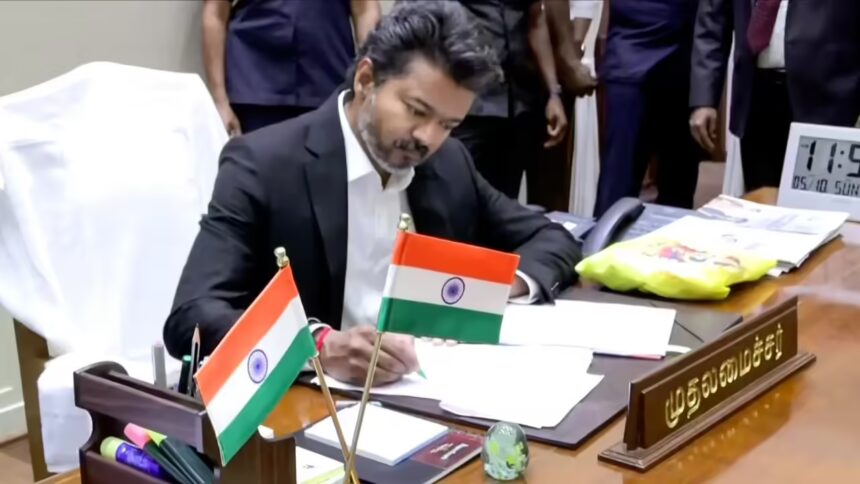
Tamil Nadu has entered a new political chapter as the first session of the 17th Tamil Nadu Legislative Assembly is set to begin on May 11 following the swearing in of the newly elected government led by Tamilaga Vettri Kazhagam chief C Joseph Vijay. The opening of the Assembly session marks the formal beginning of legislative proceedings under the new administration and signals the transition from election politics to governance in one of India’s most politically influential states.
According to the official notification issued by the Tamil Nadu Legislative Assembly Secretariat, the first sitting of the newly constituted Assembly will commence at 9.30 AM on Monday at the Secretariat complex in Chennai. All newly elected Members of the Legislative Assembly will take oath during the opening proceedings, completing a crucial constitutional process after the recently concluded Assembly elections.
The Secretariat also announced that elections for the Speaker and Deputy Speaker positions will take place on May 12 at 9.30 AM inside the Legislative Assembly Chamber at Fort St George. The election of these constitutional posts will be closely watched because the Speaker plays a critical role in maintaining discipline, regulating debates and ensuring smooth functioning of the House.
The Assembly session comes immediately after the dramatic political developments that followed the election results, where Tamilaga Vettri Kazhagam emerged as the single largest political force in Tamil Nadu, paving the way for actor turned politician Vijay to become Chief Minister.
The rise of Vijay from cinema superstar to state leadership has become one of the most discussed political developments in India. His political success has drawn national and international attention, with observers closely monitoring how his government plans to translate electoral popularity into administrative governance.
Earlier on Sunday, newly elected TVK leader MV Karuppaiah MV took oath as the Pro Tem Speaker of the Tamil Nadu Legislative Assembly. Governor Rajendra Vishwanath Arlekar administered the oath at Lok Bhavan in Chennai in the presence of Chief Minister Vijay and other senior leaders.
The appointment of the Pro Tem Speaker represents an important constitutional procedure because the official temporarily presides over the Assembly until a permanent Speaker is elected. The Pro Tem Speaker also administers oath to all newly elected legislators during the first session of the House.
The swearing in ceremony at Lok Bhavan witnessed strong political symbolism as Chief Minister Vijay felicitated Governor Arlekar upon his arrival. Visuals from the event quickly spread across television channels and social media platforms, attracting enormous public interest across Tamil Nadu.
Supporters of the ruling party celebrated the beginning of the Assembly session as the start of a new political era in the state. Celebrations were reported from multiple districts after the government formation process concluded successfully.
The first Assembly session is expected to carry major political significance because it will establish the tone and direction of the new administration’s governance priorities and legislative strategy.
Political analysts believe the opening proceedings will offer the first major indication regarding how the Vijay government plans to function administratively while balancing massive public expectations created during the election campaign.
The new government is expected to focus strongly on employment generation, youth oriented welfare schemes, industrial growth, infrastructure expansion, digital governance and investment promotion in the coming months.
The Assembly session also marks the first opportunity for opposition parties to formally challenge the ruling government inside the House. Debates during the initial proceedings are expected to shape the political atmosphere for the remainder of the year.
Sources within political circles suggest that the ruling alliance intends to project administrative stability and efficient legislative functioning during the opening phase of the Assembly.
Meanwhile, opposition parties are preparing strategies to raise questions regarding governance priorities, coalition management, economic planning and administrative appointments made by the new government.
Security arrangements around Fort St George and the Secretariat complex have been strengthened ahead of the Assembly proceedings because several newly elected legislators, senior political leaders and government officials are expected to participate in the opening session.
The new Tamil Nadu Assembly will consist of first time legislators, experienced political veterans and representatives from multiple regional and national parties. Political observers believe this combination could produce highly dynamic legislative debates during the coming term.
Tamil Nadu’s Legislative Assembly has historically remained one of the most influential state legislatures in India. Several major welfare reforms, social justice measures and governance policies associated with Tamil Nadu’s development model have emerged through Assembly discussions over decades.
Under the new political leadership, public attention now remains fixed on whether the Assembly will continue that tradition while adapting to new governance expectations and changing political realities.
For supporters of the ruling party, the opening session represents the fulfilment of a major political transition after years of campaigning and organisational expansion by TVK.
For opposition parties, however, the Assembly session marks the beginning of a new phase of political resistance, legislative scrutiny and ideological competition against the Vijay government.
Political experts believe the election of the Speaker and Deputy Speaker will also provide important insights into alliance stability and internal political coordination within the ruling formation.
The smooth conduct of oath taking procedures and Assembly operations is being viewed as an important demonstration of democratic continuity and constitutional stability in Tamil Nadu.
Across the state, citizens are now waiting to see how quickly the new administration shifts focus from political symbolism toward practical governance and policy implementation.
The coming days are expected to shape the administrative identity of the Vijay government and determine how effectively the new leadership manages governance challenges while maintaining public confidence.
The Assembly proceedings beginning on May 11 may therefore become historically significant not only because they mark the first legislative session under Vijay’s leadership, but also because they could redefine the future political direction of Tamil Nadu for years to come.