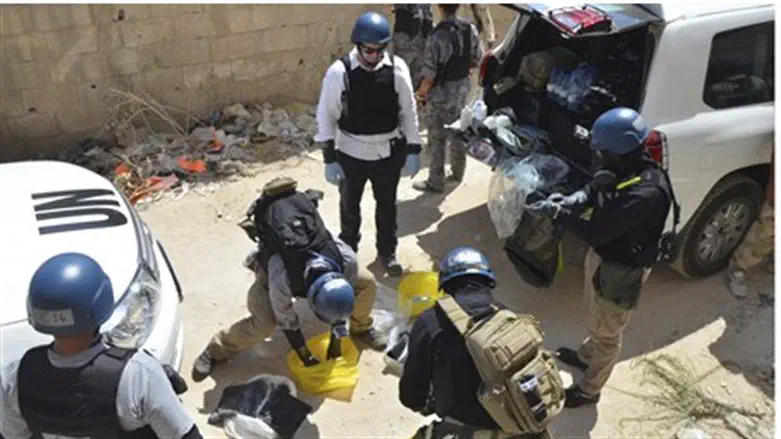
Syria has reaffirmed its commitment to dismantling any remaining chemical weapons left from the era of ousted President Bashar al-Assad. The country’s foreign minister, Asaad al-Shibani, addressed a meeting of the Organisation for the Prohibition of Chemical Weapons (OPCW) in The Hague, pledging to end this chapter of Syria’s history and ensure compliance with international law.
Shibani emphasized Syria’s dedication to justice for victims of chemical attacks while acknowledging that international cooperation would be essential in achieving this goal. “We need the support of the global community to complete this process and move forward,” he stated.
The Assad regime has long denied using chemical weapons during Syria’s 14-year civil war. However, reports from activists and independent investigations have accused the government of carrying out multiple chemical attacks. One of the most notorious incidents occurred in 2013 when rockets loaded with sarin nerve agent struck several rebel-held areas in Eastern and Western Ghouta, killing hundreds of civilians. A United Nations investigation confirmed the use of sarin but was not mandated to assign responsibility.
Following international pressure, Assad agreed to sign the Chemical Weapons Convention (CWC) and allowed a joint OPCW-UN mission to oversee the destruction of Syria’s declared chemical stockpiles. Despite this, concerns remained about the accuracy of Syria’s declarations, with allegations that undisclosed stockpiles and production sites might still exist.
The OPCW’s Investigation and Identification Team has since confirmed multiple instances of chemical weapons use by Syrian forces. The team linked the Syrian military to five documented chemical attacks in 2017 and 2018, including the infamous 2018 Douma attack. In that incident, a Syrian Air Force helicopter allegedly dropped chlorine-filled cylinders on two residential buildings, resulting in at least 43 deaths.
An earlier OPCW fact-finding mission also found evidence of chemical weapons use in at least 20 other cases.
Last month, OPCW Director General Fernando Arias visited Damascus, where he met Shibani and interim President Ahmed al-Sharaa, the opposition leader who led the uprising that removed Assad from power. Arias described the shifting political landscape in Syria as a “historic opportunity” to ensure the full dismantling of the country’s chemical weapons program.
As part of this initiative, a team of OPCW technical experts is set to travel to Damascus in the coming days to assess suspected chemical weapon sites. Additionally, Shibani met with International Criminal Court (ICC) Chief Prosecutor Karim Khan in The Hague to discuss accountability for past war crimes.
Syria is not a member of the ICC, but Karim Khan suggested that the new government could take steps to recognize the court’s jurisdiction, as Ukraine did in response to its conflict with Russia.
The unfolding developments mark a significant shift in Syria’s stance on chemical weapons, but the success of these efforts will largely depend on continued international cooperation and oversight.