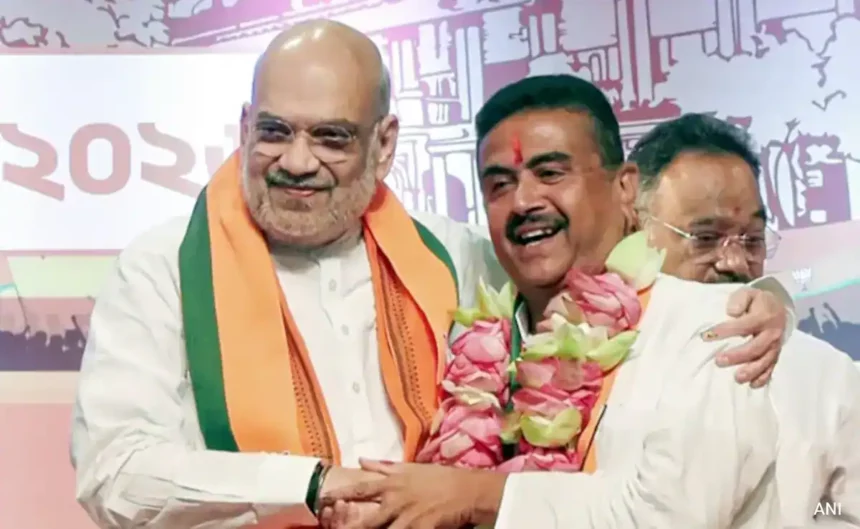
West Bengal is poised for a dramatic political shift today as Suvendu Adhikari prepares to take oath as the state’s first Bharatiya Janata Party chief minister following the party’s sweeping victory in the 2026 Assembly elections. The oath-taking ceremony, scheduled for May 9 at Brigade Parade Ground in Kolkata, marks the formal beginning of a new political chapter in Bengal after years of Trinamool Congress dominance. With Narendra Modi and Amit Shah expected to attend, the event is being watched not only as a government formation exercise but as a symbol of one of the BJP’s biggest electoral breakthroughs in eastern India.
The BJP’s rise in West Bengal has been built over years of aggressive organisation, repeated electoral battles and a steady expansion of its political base in a state long considered one of the party’s most difficult frontiers. The 2026 mandate, in which the BJP won 207 out of 294 seats, has decisively altered the political balance in the state and ended the long reign of the All India Trinamool Congress. The result has not only elevated Suvendu Adhikari to the highest office in Bengal politics but has also brought the BJP to the centre of governance in a state it had never ruled before. The transition is being viewed by party leaders as both a political vindication and a signal to the rest of eastern India that the BJP is now capable of converting organisational strength into direct state power.
Historic Shift in Bengal Politics
The road to today’s ceremony began with the BJP legislature party meeting in Kolkata on Friday, where Suvendu Adhikari was formally elected as the party’s leader. The meeting was chaired by Amit Shah, whose presence underlined the importance that the BJP central leadership has attached to the Bengal victory. Shah congratulated the newly elected legislators and praised the people of Bengal for voting for the BJP despite what he described as a climate of violence and intimidation during the campaign. His remarks reflected the party’s effort to frame the result not merely as an election win, but as a mandate against fear-driven politics and a sign of voter trust in Prime Minister Narendra Modi’s leadership.
For Adhikari, the moment marks a remarkable political transformation. Once one of Mamata Banerjee’s most trusted colleagues within the TMC, he has over the past few years emerged as the BJP’s most prominent face in Bengal. His switch to the BJP in 2020 dramatically changed the state’s political calculus, and his high-profile defeat of Mamata Banerjee in Nandigram during the 2021 Assembly elections made him one of the most recognisable opposition leaders in the country. The 2026 election further strengthened his stature when he defeated Banerjee again in Bhabanipur, a seat long regarded as one of the TMC’s most secure bastions. That victory, seen as both symbolic and strategic, helped establish Adhikari as the unquestioned leader of the BJP’s Bengal campaign.
Political observers say the BJP’s success in Bengal has been driven by a combination of Adhikari’s organisational discipline, ground-level mobilisation and the central leadership’s sustained investment in the state. The party’s victory is particularly significant because Bengal had long resisted the BJP’s rise even as the party expanded in other parts of the country. For the BJP, this election has now validated its long-term strategy in a state that was once considered nearly unreachable. Today’s oath ceremony therefore represents more than the appointment of a chief minister. It marks the culmination of a decade-long effort to break through in a politically complex, ideologically charged and intensely competitive state.
The scale of the result also adds weight to the moment. Winning 207 seats gives the BJP a comfortable majority and leaves little ambiguity about the public mandate. The Trinamool Congress, which had dominated Bengal politics under Mamata Banerjee, suffered one of its most severe setbacks in recent memory. Banerjee’s post-result refusal to immediately accept defeat, her allegations of irregularities and her challenge to the electoral process all fed into an atmosphere of political confrontation. The BJP, meanwhile, has used the results to claim that Bengal has embraced change and that voters have chosen stability, development and a different political direction.
Swearing-In Preparations And National Attention
The oath-taking ceremony will be held at Brigade Parade Ground in Kolkata at 11 am, with Governor RN Ravi administering the oath of office and secrecy to Suvendu Adhikari. The venue, historically associated with major political rallies and large-scale public events, is expected to draw a substantial gathering of party workers, supporters and invited guests. Security arrangements across Kolkata have been intensified in anticipation of the presence of the Prime Minister, the Union Home Minister, chief ministers from NDA-ruled states and senior BJP leaders from across the country.
The BJP is treating the ceremony as a major political showcase. Party strategists believe the event should project not only a new government but also a visible transfer of political power in a state that has for decades been one of the most closely contested arenas in Indian politics. By bringing together national leaders, NDA chief ministers and Bengal’s new legislators at one venue, the BJP aims to send a message of unity, momentum and historic change. The party also wants to present the event as a public affirmation of its growing footprint in eastern India, especially at a time when it is positioning itself as a national force with deep regional roots.
The timing and symbolism of the event have been amplified further by the political drama surrounding Bengal in recent days. The murder of Chandranath Rath, a close aide to Suvendu Adhikari, added a darker note to the atmosphere just before the oath ceremony. The incident triggered sharp political reactions and heightened security concerns, with BJP leaders alleging that it reflected the same pattern of political violence that they say had characterised Bengal’s recent past. Rath’s killing became another flashpoint in the already charged environment surrounding the transfer of power. While police continue their investigation, the BJP has used the episode to argue that the state needs a change in political culture as much as a change in government.
Nationally, the Bengal transition is being watched closely because it could reshape the political narrative for the BJP in the east. A successful swearing-in ceremony followed by stable governance would strengthen the party’s claim that it can not only win elections in difficult terrain but also govern effectively in states with complex political traditions. For opposition parties, on the other hand, the result represents a warning that the BJP’s organisational model, when combined with a strong state-level leader, can overcome entrenched local dominance. Bengal therefore becomes a test case for the party’s future expansion strategy in other politically resistant regions.
Mamata’s Fall, BJP’s Rise And What Comes Next
The fall of the Trinamool Congress government has been one of the defining stories of the 2026 election cycle. Mamata Banerjee’s defeat in Bhabanipur, combined with the TMC’s overall setback, marked a dramatic reversal for a leader who had long been seen as almost inseparable from Bengal’s political identity. Her allegations after the results, along with the INDIA bloc’s support for concerns around the conduct of the elections, did little to alter the final outcome. The dissolution of the Assembly by the Governor on Thursday formally ended the Trinamool era and created the constitutional space for the BJP’s new administration to take charge.
For the TMC, the result has forced a period of introspection. The party had entered the election with the advantage of incumbency, organisational familiarity and deep social roots, yet it could not withstand the BJP’s broader campaign and Adhikari’s growing personal appeal. The BJP’s success suggests that the political map of Bengal has shifted in a way that may have long-term consequences for both state and national politics. With Bengal now under BJP rule, the party gains not only access to one of India’s largest and most politically important states but also a powerful new platform in eastern India.
For Suvendu Adhikari, the next challenge begins after the oath ceremony. Winning an election and forming a government are only the first steps. The real test will come in converting this sweeping mandate into effective administration, managing expectations, balancing party interests and demonstrating that the BJP can govern Bengal with stability and confidence. His rise from TMC insider to BJP chief minister is one of the most striking political journeys in recent years, and his success or failure in office will likely shape his legacy far beyond this ceremonial moment.
Today’s swearing-in is therefore both an end and a beginning. It closes the chapter on the TMC’s long dominance and opens a new one for the BJP in West Bengal. The atmosphere in Kolkata is charged with history, symbolism and political anticipation. As the crowd gathers at Brigade Parade Ground and national leaders take their places, Bengal prepares to witness a transfer of power that may define the state’s political future for years to come.