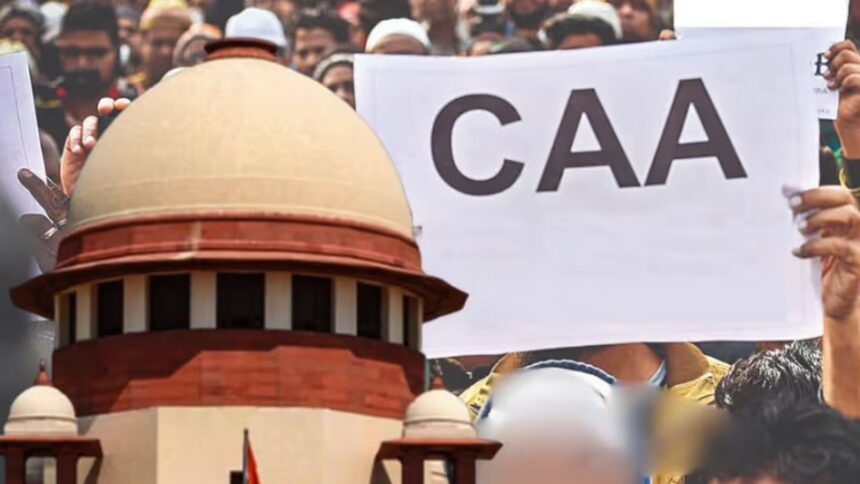
The Supreme Court of India is set to begin final hearings from May 5 in the long-pending legal challenge against the controversial Citizenship (Amendment) Act, 2019 (CAA), marking a significant development in one of the country’s most closely watched constitutional cases. More than 250 petitions challenging both the CAA and its associated Rules will be taken up by the apex court during an intensive multi-day hearing schedule.
A three-judge Bench headed by Chief Justice of India Surya Kant announced on Thursday that the matter would be heard continuously from May 5 to May 7, with additional hearings scheduled for May 12 to consider rejoinder submissions before the court reserves its judgment.
The hearing is expected to have major constitutional, political and social implications because the Citizenship (Amendment) Act has remained one of the most debated legislations enacted in recent Indian history. Since its passage in Parliament in December 2019, the law has generated widespread legal scrutiny, political protests and public debate across the country.
The Citizenship (Amendment) Act provides an accelerated pathway to Indian citizenship for non-Muslim migrants belonging to Hindu, Sikh, Buddhist, Jain, Parsi and Christian communities who migrated to India from Afghanistan, Bangladesh and Pakistan before December 31, 2014. The legislation excludes Muslims from its scope, a provision that became the central basis for constitutional challenges filed before the Supreme Court.
Petitioners opposing the law have argued that the religion-based classification violates the principles of equality, secularism and non-discrimination guaranteed under the Indian Constitution. They contend that the Act discriminates on religious grounds and undermines the secular framework of citizenship embedded in the Constitution.
The Union government, however, has consistently defended the law, stating that the legislation is a narrowly tailored humanitarian measure intended to provide relief to persecuted minority communities from neighbouring Islamic countries. The Centre has argued that the law does not take away citizenship from any Indian citizen and instead seeks to address the plight of refugees facing religious persecution.
The final hearing scheduled for May is expected to witness detailed constitutional arguments from senior advocates representing petitioners, civil society organisations, state governments and the Union government. Legal experts anticipate extensive debate over constitutional principles including equality before law under Article 14, secularism as part of the basic structure doctrine and Parliament’s legislative competence in citizenship matters.
The CAA case has remained pending before the Supreme Court for several years despite repeated mentions and interim proceedings. The matter gained renewed urgency after the Union government notified the Citizenship (Amendment) Rules in 2024, paving the way for implementation of the law.
The Rules laid down the procedural framework through which eligible migrants could apply for Indian citizenship under the amended provisions. Following the notification of the Rules, several petitioners sought urgent intervention from the Supreme Court, arguing that implementation of the law before adjudication on constitutional validity could create irreversible consequences.
However, the apex court declined to stay the implementation of the Rules at the interim stage and instead prioritised final hearing of the constitutional challenge. The upcoming hearings are therefore expected to determine the legal future of the CAA and its implementation framework.
Constitutional Questions Likely to Dominate Supreme Court Proceedings
The final hearing in the CAA matter is expected to focus heavily on constitutional interpretation and the scope of Parliament’s powers under citizenship law. Petitioners challenging the legislation are likely to argue that citizenship policy cannot be framed on religious criteria because such classification violates the constitutional guarantee of equal treatment.
One of the principal arguments raised against the law concerns Article 14 of the Constitution, which guarantees equality before law and equal protection of laws to all persons. Petitioners argue that the exclusion of Muslims from the citizenship relaxation framework lacks a rational constitutional basis and therefore fails the test of reasonable classification established under Indian constitutional jurisprudence.
The issue of secularism is also expected to occupy central importance during the hearings. Several petitions have argued that the Constitution’s secular character forms part of its basic structure and cannot be diluted through legislation that explicitly distinguishes between religious communities.
Senior advocates opposing the law are likely to cite earlier Supreme Court judgments that described secularism as an essential constitutional principle guiding state action. The petitioners may also argue that citizenship cannot be linked to religious identity in a secular republic.
The Union government, on the other hand, is expected to defend the legislation by asserting Parliament’s broad powers to frame citizenship laws under the Constitution. The Centre is likely to argue that the CAA is based on intelligible differentia because it specifically addresses persecuted minorities from neighbouring Islamic states where those communities allegedly face systemic discrimination.
The government may also contend that Muslims from those countries cannot be treated similarly because the law was designed specifically for religious minorities vulnerable to persecution in officially Islamic nations. According to the Centre’s earlier submissions before the court, the classification introduced by the Act is therefore reasonable and constitutionally permissible.
Another important aspect likely to arise during the hearing concerns the relationship between the CAA and the proposed National Register of Citizens (NRC). During nationwide protests against the law in 2019 and 2020, several critics argued that the combined effect of the CAA and NRC could disproportionately impact Muslim communities.
The Union government repeatedly denied those allegations and maintained that the CAA and NRC were separate issues. Nevertheless, the broader political and constitutional concerns arising from that debate may continue to influence arguments presented before the court.
Background of Nationwide Protests and Political Controversy
The Citizenship (Amendment) Act became the centre of massive nationwide protests shortly after its passage by Parliament in December 2019. Demonstrations erupted across multiple states, universities and urban centres, with protesters alleging that the law violated constitutional principles and discriminated against Muslims.
Several university campuses witnessed prolonged protests, while large public demonstrations took place in cities including Delhi, Kolkata, Mumbai, Bengaluru and Lucknow. The anti-CAA movement also drew significant participation from students, civil society organisations, activists and opposition political parties.
One of the most prominent protests emerged at Shaheen Bagh in Delhi, where women-led sit-ins became symbolic of the nationwide movement against the law. Similar protest sites later emerged in several parts of the country.
The protests occasionally led to clashes between demonstrators and police forces in certain regions, resulting in detentions, violence and political tensions. Opposition parties accused the central government of undermining constitutional values, while the BJP defended the legislation as a humanitarian initiative aimed at protecting persecuted minorities.
The political debate surrounding the law remained intense even after the COVID-19 pandemic interrupted several protest movements. The issue continued to feature prominently in election campaigns and parliamentary debates over subsequent years.
Several state governments also approached the Supreme Court challenging the legislation, arguing that the law affected the federal structure and social harmony within their states. Petitions were filed by political parties, student organisations, advocacy groups and private individuals from different parts of the country.
The Supreme Court initially issued notices to the Union government after the petitions were filed but refrained from staying the operation of the Act. Over time, the number of petitions increased significantly, making the CAA challenge one of the largest batches of constitutional cases pending before the apex court.
The notification of the Citizenship Amendment Rules in 2024 revived legal and political attention around the issue. The Rules operationalised the process through which eligible applicants could seek Indian citizenship under the amended provisions.
The Centre argued that implementation of the law fulfilled a long-standing humanitarian commitment to minority communities facing persecution in neighbouring countries. Critics, however, maintained that the constitutional objections to the law remained unresolved and required urgent judicial scrutiny.
Supreme Court Verdict Expected to Have Far-Reaching Impact
The final verdict in the CAA case is expected to have far-reaching constitutional and political implications for India’s citizenship framework and secular constitutional structure. Legal experts believe the judgment could emerge as one of the most significant constitutional rulings in recent years because it directly concerns questions of equality, citizenship and state policy.
If the Supreme Court upholds the law, it would strengthen Parliament’s authority to frame citizenship legislation based on targeted classifications linked to geopolitical and humanitarian considerations. Such a ruling could also reinforce the government’s broader argument that the law addresses historical persecution faced by minority communities in neighbouring countries.
On the other hand, if the court strikes down the legislation or parts of it, the verdict could establish important constitutional limitations on the use of religion-based criteria in citizenship policy. The judgment may also shape future constitutional interpretation regarding equality and secularism.
Political observers note that the Supreme Court’s decision is likely to influence public discourse and electoral narratives across several states. The CAA issue continues to remain politically sensitive, particularly in regions that witnessed strong protest movements after the law’s enactment.
The upcoming hearings are therefore expected to attract significant national attention from legal scholars, political parties, civil society groups and international observers. Security and administrative arrangements around the Supreme Court are also likely to be strengthened during the hearing period because of the case’s sensitivity.
For now, all eyes remain on the Supreme Court as the country prepares for a landmark constitutional hearing that could redefine the legal and political trajectory of India’s citizenship framework. The hearings beginning May 5 will mark the culmination of years of legal challenges and public debate surrounding one of the most contentious laws enacted in independent India.