
• English
  • Hindi
  • Punjabi
  • Marathi
  • German
  • Gujarati
  • Urdu
  • Telugu
  • Bengali
  • Kannada
  • Odia
  • Assamese
  • Nepali
  • Spanish
  • French
  • Japanese
  • Arabic
  • Home
  • Noida
  • National
    • BulletsIn
    • cliQ Explainer
    • Government Policy
    • New India
  • International
    • Middle East
    • Foreign
  • Entertainment
  • Business
    • Tender News
  • Sports
    • IPL2025
  • Services
    • Lifestyle
    • How To
    • Spiritual
      • Festival and Culture
    • Tech
Notification
  • Home
  • Noida
  • National
    • BulletsIn
    • cliQ Explainer
    • Government Policy
    • New India
  • International
    • Middle East
    • Foreign
  • Entertainment
  • Business
    • Tender News
  • Sports
    • IPL2025
  • Services
    • Lifestyle
    • How To
    • Spiritual
      • Festival and Culture
    • Tech
  • Home
  • Noida
  • National
    • BulletsIn
    • cliQ Explainer
    • Government Policy
    • New India
  • International
    • Middle East
    • Foreign
  • Entertainment
  • Business
    • Tender News
  • Sports
    • IPL2025
  • Services
    • Lifestyle
    • How To
    • Spiritual
      • Festival and Culture
    • Tech
  • Noida
  • National
  • International
  • Entertainment
  • Business
  • Sports
CliQ INDIA > National > Supreme Court Stays UGC 2026 Equity Regulations, Sparks Major Debate on Equality and Education Policy | Cliq latest
National

Supreme Court Stays UGC 2026 Equity Regulations, Sparks Major Debate on Equality and Education Policy | Cliq latest

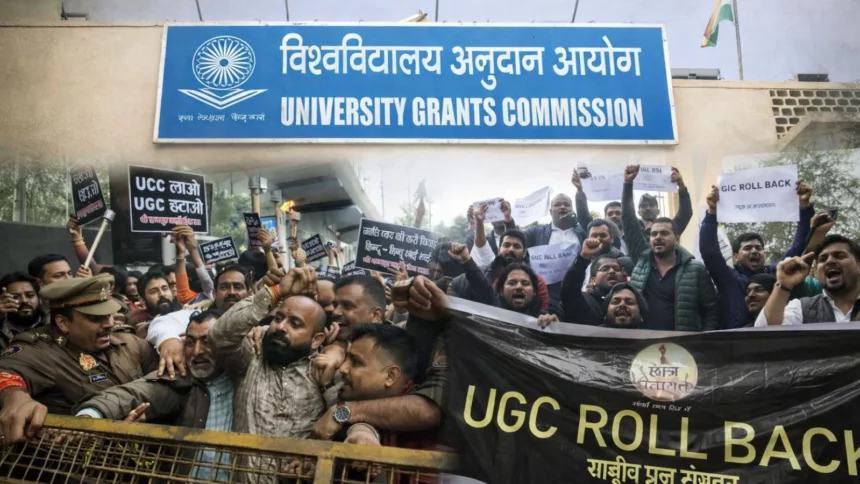
 The Supreme Court has stayed UGC 2026 equity regulations citing vagueness and misuse concerns, triggering a nationwide debate on equality, fairness and higher education policy.

cliQ India
cliQ India
Share
5 Min Read
SHARE
Highlights
  • 2012 rules to remain in force till final decision
  • Supreme Court stays UGC 2026 equity regulations over vagueness concerns

The Supreme Court of India’s decision to stay the University Grants Commission Promotion of Equity in Higher Education Institutions Regulations 2026 has emerged as a landmark moment in the ongoing discourse on equality and institutional governance in the country. This development is not merely a procedural intervention but a significant constitutional checkpoint that raises fundamental questions about how fairness and inclusivity should be balanced in a diverse society like India.
The regulations were notified on January 13 2026 with the stated objective of addressing caste based discrimination and preventing student harassment in higher educational institutions. However within days of their release they became the subject of intense legal scrutiny and public debate. On January 29 2026 a bench led by Chief Justice Surya Kant and Justice Joymalya Bagchi stayed the regulations observing that they appeared prima facie vague and capable of misuse.

Contents
Core controversy: Definition and exclusion concernsJudicial observations and legal implicationsImpact on education policy and future direction

Core controversy: Definition and exclusion concerns

At the center of the dispute lies Clause 3(c) which defines caste based discrimination only in relation to Scheduled Castes Scheduled Tribes and Other Backward Classes. Petitioners argued that this definition is exclusionary and ignores the possibility that discrimination can occur against individuals belonging to the general category as well. They contended that such a limited definition violates Article 14 of the Constitution which guarantees equality before law.
Advocate Vishnu Shankar Jain representing the petitioners argued that the provision lacks “intelligible differentia” and does not have a rational nexus with the objective it seeks to achieve. He warned that such a framework could lead to misuse and create further divisions within society. Another major concern raised was the absence of safeguards against false complaints which could potentially harm innocent students.

Judicial observations and legal implications

During the hearings the Supreme Court raised several critical questions regarding the scope and implementation of the regulations. The bench examined the relationship between Clause 3(c) and Clause 3(e) which provides a broader definition of discrimination including religion race gender place of birth and disability. The Court noted that having two overlapping definitions could create confusion and complicate enforcement.
The issue of ragging also emerged as a key concern. Petitioners pointed out that ragging remains one of the most common forms of discrimination in educational institutions yet it was not explicitly addressed in the 2026 regulations. The Court acknowledged that ignoring such a prevalent issue weakens the overall framework.
Chief Justice Surya Kant also expressed concern about the possibility of segregation within institutions. He cautioned against any interpretation of the regulations that could lead to separation of students based on identity in hostels classrooms or academic groups. Such practices he noted would contradict the constitutional vision of equality and inclusivity.

Impact on education policy and future direction

The stay on the 2026 regulations has far reaching implications for higher education policy in India. It highlights the challenges of designing policies that address historical injustices while ensuring fairness for all sections of society. The Court has directed that the 2012 UGC regulations will continue to operate under Article 142 ensuring that there is no regulatory vacuum.
This case also underscores the evolving nature of equality jurisprudence in India. It reflects the judiciary’s role in scrutinizing policy frameworks to ensure that they align with constitutional principles. The final verdict is expected to provide clarity on how discrimination should be defined and addressed within educational institutions.
In the coming months the Supreme Court’s decision will likely shape the future of higher education governance and set a precedent for similar regulations. It will determine whether the balance between social justice and universal equality can be achieved in a manner that is both fair and effective.

You Might Also Like

NCERT revises Class 8 book to highlight Delhi Sultanate, Mughal intolerance with historical disclaimer | cliQ Latest
Donald Trump’s tariff spree may push iPhone prices up by 43%, analysts warn | CliqExplainer
Sharad Pawar’s Faction Renamed ‘Nationalist Congress Party — Sharadchandra Pawar’
Assam Cabinet to probe MP's alleged ties to national security threats on Feb 16
Two Kolkata police officers arrested for extortion and threatening cab driver | CliqExplainer
TAGGED:EducationPolicySupremeCourtUGC

Sign Up For Daily Newsletter

Be keep up! Get the latest breaking news delivered straight to your inbox.
By signing up, you agree to our Terms of Use and acknowledge the data practices in our Privacy Policy. You may unsubscribe at any time.
Share This Article
Facebook Whatsapp Whatsapp Telegram Copy Link Print
Share
What do you think?
Love0
Sad0
Happy0
Angry0
Wink0
Previous Article 69,000 UP Teacher Recruitment Case: Supreme Court Reserves Verdict, Big Decision Ahead for Shiksha Mitras | Cliq latest
Next Article Trump–Takaichi Tokyo Summit Signals New Era in Trade Security Cooperation | Cliq Latest

Stay Connected

FacebookLike
XFollow
InstagramFollow
YoutubeSubscribe
TelegramFollow
- Advertisement -
Ad imageAd image

Latest News

Bengal Falta Repoll 2026: Massive Security Deployment After Election Controversy | Cliq Latest
National
May 21, 2026
Peddi Promotion Event In Bhopal: Ram Charan And AR Rahman Ready For Mega Show | Cliq Latest
Entertainment
May 21, 2026
Junior NTR Dragon Teaser Out: NTR Stuns Fans With Intense Assassin Avatar | Cliq Latest
Entertainment
May 21, 2026
KKR Vs MI IPL 2026: Manish Pandey And Bowlers Revive Kolkata Playoff Dream | Cliq Latest
Sports
May 21, 2026

//

We are rapidly growing digital news startup that is dedicated to providing reliable, unbiased, and real-time news to our audience.

We are rapidly growing digital news startup that is dedicated to providing reliable, unbiased, and real-time news to our audience.

Sign Up for Our Newsletter

Sign Up for Our Newsletter

Subscribe to our newsletter to get our newest articles instantly!

Follow US

Follow US

© 2026 cliQ India. All Rights Reserved.

CliQ INDIA
  • English – अंग्रेज़ी
  • Hindi – हिंदी
  • Punjabi – ਪੰਜਾਬੀ
  • Marathi – मराठी
  • German – Deutsch
  • Gujarati – ગુજરાતી
  • Urdu – اردو
  • Telugu – తెలుగు
  • Bengali – বাংলা
  • Kannada – ಕನ್ನಡ
  • Odia – ଓଡିଆ
  • Assamese – অসমীয়া
  • Nepali – नेपाली
  • Spanish – Española
  • French – Français
  • Japanese – フランス語
  • Arabic – فرنسي
Welcome Back!

Sign in to your account

Username or Email Address
Password

Lost your password?



