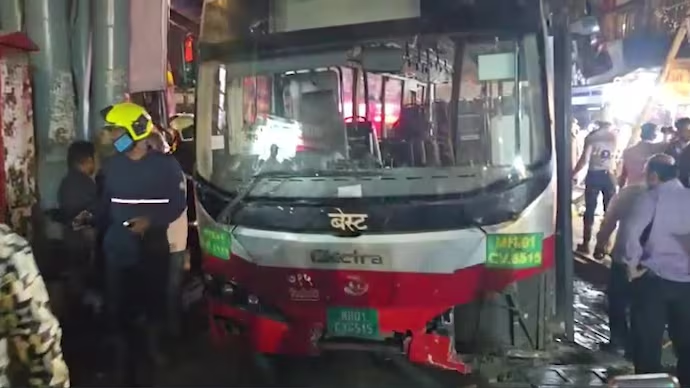
At least four people, including three women, were killed and nine others seriously injured late Monday night after a city bus rammed into pedestrians near a railway station in Mumbai’s Bhandup area. The tragic accident occurred when a Brihanmumbai Electric Supply and Transport bus reportedly lost control while reversing, triggering scenes of chaos, panic and grief in one of the city’s crowded suburban neighbourhoods.
The incident took place around 9:35 pm on Station Road near Bhandup railway station, an area that witnesses heavy pedestrian and vehicular movement throughout the day and late into the night. According to police officials, the bus ran over at least 13 people who were walking along the roadside, leaving multiple victims crushed beneath the vehicle and others flung onto the road. Emergency services rushed to the scene within minutes, but by the time the injured were taken to hospitals, four had succumbed to their injuries.
Accident details, eyewitness accounts and rescue efforts
Mumbai Police confirmed that the vehicle involved belonged to the Brihanmumbai Electric Supply and Transport, commonly known as BEST. Preliminary information suggests that the bus was reversing near the station when the driver allegedly lost control, causing the vehicle to mount the footpath and strike pedestrians who had little space to escape. The impact was severe enough for the bus to hit an electric pole, which collapsed, adding to the confusion and fear at the scene.
Eyewitnesses described harrowing moments as the bus ran into the crowd. Pharmacist Saimini Mudaliar, who was waiting at a nearby bus stop, said she heard a loud sound similar to an explosion before witnessing people being struck by the bus. She recounted seeing some victims thrown into the air before falling on the road, while others were trapped beneath the vehicle. According to her, blood was scattered around the bus, and several people lay injured and motionless.
Local residents and passersby were among the first responders, rushing to lift and push the bus in an attempt to rescue those trapped underneath. Ambulances, personnel from the Mumbai Fire Brigade and BEST officials soon arrived, working alongside locals to pull victims out and transport them to nearby hospitals. The injured were taken to Rajawadi Hospital and MT Agrawal Hospital, where doctors confirmed four deaths and stated that several injured remained in critical condition, raising concerns that the toll could rise.
Disturbing scenes were reported from the accident site, with bodies seen lying on the road, partially covered by fallen poles and banners. Visuals from the area suggested that the bus had climbed onto the footpath while reversing, an inference that has intensified questions about driver judgment, vehicle handling and safety measures in congested urban zones.
An eyewitness blamed encroachment by hawkers on the footpath for worsening the situation. She said pedestrians were forced to walk on the road due to lack of space, increasing the risk of accidents. The area, she added, remains crowded throughout the day as vendors sell vegetables at cheaper rates, drawing large numbers of people. According to locals, buses often struggle to take turns or reverse in the narrow, congested stretch near the station.
Police action, compensation announcement and concerns over bus operations
Following the incident, the bus driver was taken into custody for questioning. Mumbai Police officials said preparations were underway to register a first information report against the driver. Deputy Commissioner of Police Hemraj Singh Rajput stated that a detailed investigation would be conducted, including mechanical and technical inspections of the bus, to determine whether the accident was caused by human error, mechanical failure or other contributing factors.
Preliminary information revealed that the medium-sized bus involved in the crash had been taken on a wet lease from Olectra Greentech and was being operated by a BEST driver at the time of the accident. Notably, no official response was issued by BEST for nearly an hour after the mishap, drawing criticism and raising questions about emergency communication and accountability.
Maharashtra Chief Minister Devendra Fadnavis expressed deep grief over the tragedy and announced an ex gratia assistance of ₹5 lakh for the families of those who lost their lives. In a social media post, he described the incident as extremely tragic, paid tribute to the deceased and wished a speedy recovery to the injured.
The accident has also renewed focus on BEST’s operational challenges and fleet management. BEST is Mumbai’s primary public bus transport service, operating under the Brihanmumbai Municipal Corporation and serving millions of commuters daily. Its fleet consists of approximately 2,700 to 3,200 buses, including ordinary, limited, air-conditioned and electric buses. In recent years, the service has faced issues related to staff shortages, ageing vehicles and route constraints.
According to a senior civic official, mini-buses were earlier withdrawn from routes passing through densely populated areas between Bhandup station and Sanjay Gandhi National Park due to safety concerns. However, a shortage of buses reportedly led to the introduction of Olectra’s midi-buses on routes originating from Bhandup station, despite challenges such as limited turning radius and manoeuvrability in crowded streets. The use of such buses in high-density areas has now come under scrutiny in the wake of the fatal accident.
As investigations continue, the tragedy has sparked wider discussions on pedestrian safety, enforcement against encroachments, route planning and the suitability of certain bus models for congested urban environments. For residents of Bhandup and daily commuters, the incident stands as a grim reminder of the vulnerabilities faced by pedestrians in one of India’s busiest cities.