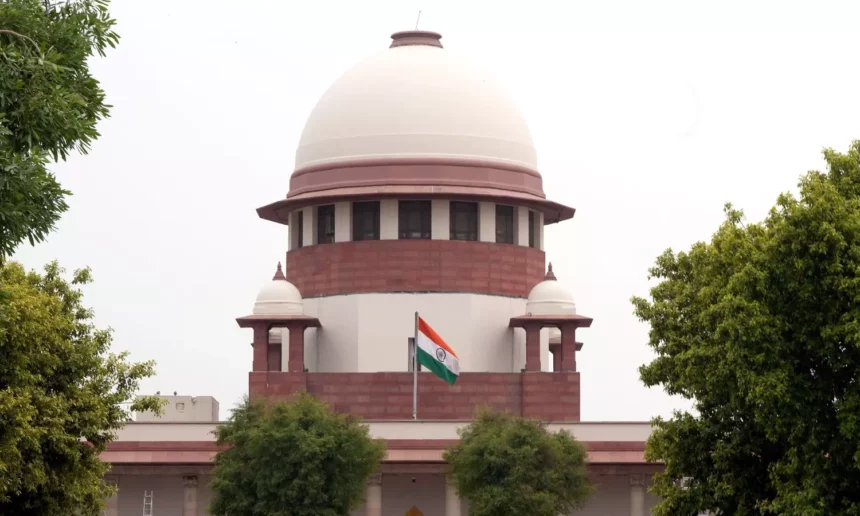
The Supreme Court of India has declined to intervene in the ongoing dispute over the Bhojshala Temple-Kamal Maula Mosque complex, directing that all objections related to videography and survey records be examined by the Madhya Pradesh High Court. The decision comes amid continued legal contestation over the archaeological survey conducted at the disputed site in Dhar district.
A bench led by Chief Justice Surya Kant observed that the High Court is the appropriate forum to consider concerns raised by the Muslim side, including demands for access to videography and colour photographs of the Archaeological Survey of India (ASI) survey.
The apex court made it clear that it was not expressing any opinion on the merits of the dispute and that all issues remain open for adjudication at the High Court level.
Supreme Court refuses to interfere, asks High Court to examine videography objections
The case reached the Supreme Court after the mosque management sought access to video recordings and photographs of the ASI survey, arguing that their objections during the process were not adequately reflected. The Madhya Pradesh High Court had earlier stated that such requests would be considered at the time of final hearing rather than immediately.
Dissatisfied with this approach, the petitioners moved the Supreme Court. However, the apex court upheld the High Court’s procedure, noting that the request had not been rejected but merely deferred.
The bench emphasized that the High Court would review the videography and take into account all objections raised during the survey. It also underlined that principles of natural justice must be followed, ensuring that both sides are given a fair opportunity to present their case.
Legal representatives for the petitioners argued that certain activities during the survey, including alleged excavation, went beyond the scope permitted earlier by the Supreme Court. They insisted that access to complete video evidence was necessary to substantiate their claims.
Long-standing dispute over religious identity and ASI survey findings
The Bhojshala-Kamal Maula site has been at the center of a long-standing dispute between Hindu and Muslim communities. Hindus consider it a temple dedicated to Goddess Saraswati, while Muslims regard it as a mosque. The site is currently managed under a regulated arrangement that allows Hindu पूजा on Tuesdays and Muslim नमाज on Fridays.
The controversy intensified after the ASI conducted a detailed scientific survey of the site, which included videography, photography, and archaeological analysis. The findings of the survey have been contested, with different parties interpreting the evidence in support of their respective claims.
According to reports, objections raised during the survey process were recorded on video, making the issue of access to videography crucial for legal proceedings. The Supreme Court noted that these objections would be properly examined by the High Court during the final hearing.
The Madhya Pradesh High Court is now set to begin regular hearings in the matter, where it will consider all objections, including those related to the ASI survey and its documentation.
The outcome of these proceedings is expected to play a significant role in determining the future course of the dispute, which has both legal and socio-religious implications.