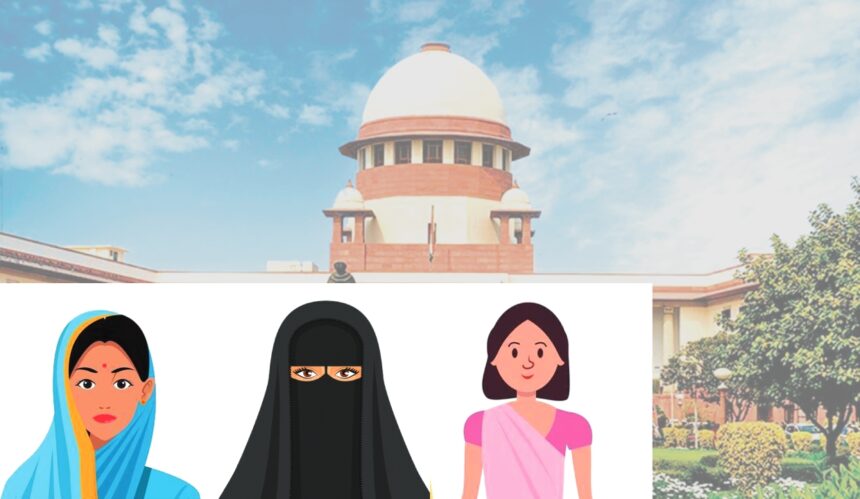
The All India Muslim Personal Law Board (AIMPLB) on Thursday told the Supreme Court of India that there is no restriction on women entering mosques to offer namaz, while also challenging how courts have historically interpreted Islamic practices under the Essential Religious Practice (ERP) doctrine.
The submissions were made before a nine-judge Constitution bench headed by Chief Justice Surya Kant, which is currently hearing the larger constitutional questions arising from the Sabarimala case and related petitions concerning religious freedoms under Articles 25 and 26 of the Constitution.
Women’s Entry Into Mosques: AIMPLB Clarifies Position
Senior Advocate MR Shamshad, appearing for AIMPLB, stated unequivocally that Islamic traditions do not prohibit women from entering mosques. He clarified that there is broad consensus across Islamic denominations on this issue.
According to the counsel, while it is not mandatory for women to attend congregational prayers, they are fully permitted to do so if they choose. He emphasized that the absence of obligation should not be misinterpreted as a restriction.
“There is clarity from the earliest Islamic teachings that women should not be prevented from entering mosques,” he argued, referring to narrations attributed to Prophet Muhammad that support women’s access to places of worship.
The bench sought factual clarity during the hearing. Chief Justice Surya Kant directly asked whether women are allowed to enter mosques, to which the counsel responded affirmatively, reiterating that there is no doctrinal bar.
Congregational Prayer and Religious Preference
The counsel explained that Islamic jurisprudence distinguishes between obligation and preference. For men, attending congregational prayers in a mosque is considered obligatory. For women, however, offering prayers at home is considered equally valid and, in some interpretations, preferable.
However, he clarified that this does not exclude women from participating in congregational prayers at mosques. If women choose to attend, they are allowed to be part of the congregation.
The discussion also touched upon practical and social considerations historically associated with these practices, though the court focused primarily on the constitutional and doctrinal aspects.
No Concept of Sanctum Sanctorum in Mosques
A key argument presented by AIMPLB was that mosques differ structurally and theologically from certain other places of worship. The counsel pointed out that there is no concept of a “sanctum sanctorum” within a mosque, unlike in some temples or dargahs.
This distinction, he argued, is crucial in evaluating claims related to access and equality. Without a designated sacred inner space, the question of restricting entry to specific areas does not arise in the same way.
He cautioned against importing concepts from other religions into Islamic practices, stating that such comparisons can lead to misunderstandings and flawed legal interpretations.
Objections to Certain Petitions
While AIMPLB did not oppose the general proposition that women can enter mosques, it raised concerns about specific demands made in petitions before the court.
These include requests for unrestricted access through main entrances, equal positioning within prayer spaces, and removal of any physical separation between men and women during prayers.
The counsel argued that such demands interfere with the internal discipline and established practices of mosques. He maintained that while entry is permitted, the manner of participation must align with religious norms.
Challenge to Essential Religious Practice Doctrine
A significant portion of AIMPLB’s argument focused on the Essential Religious Practice (ERP) test, a judicial doctrine used to determine whether a particular practice is protected under the Constitution.
The counsel contended that courts have applied this doctrine incorrectly in the context of Islam. He argued that Islamic practices are often misinterpreted because they are assessed using parameters that do not align with the religion’s textual and doctrinal framework.
Islam, he noted, is a deeply codified religion with detailed classifications of actions—ranging from mandatory to recommended to permissible. However, courts have often dismissed practices as non-essential simply because they are not strictly mandatory.
Past Judgments and Controversies
The counsel referred to several past judgments to illustrate his point. One such case is the Ismail Farooqui case, where the court held that a mosque is not essential to Islam because prayers can be offered anywhere.
He argued that such interpretations undermine the central role of mosques in Islamic life. “If a mosque is not considered essential, it raises serious questions about the protection of religious freedom under Article 25,” he said.
Another example cited was a case involving a Muslim man dismissed from the army for maintaining a beard, which the court ruled was not an essential religious practice.
These examples, according to AIMPLB, demonstrate a pattern of judicial reasoning that fails to adequately account for the nuances of Islamic teachings.
Concerns Over Interpretation of Religious Texts
The counsel also raised concerns about the reliance on translations of Arabic texts, including the Quran and Hadith, in judicial proceedings. He argued that inaccuracies in translation can lead to incorrect conclusions about religious practices.
Such issues, he said, contribute to the misapplication of the ERP test and highlight the need for a more informed and sensitive approach when dealing with religious matters.
Broader Constitutional Questions
The case is part of a larger constitutional debate on the balance between religious freedom and equality. The Sabarimala reference has brought together multiple petitions involving different religions, all raising similar questions about access, discrimination, and the role of courts in interpreting faith.
The bench, which includes several senior judges, is tasked with examining the scope of Articles 25 and 26, which guarantee freedom of religion while allowing the state to regulate secular aspects of religious practice.
Implications for Religious Freedom in India
The outcome of this case could have far-reaching implications for how religious practices are understood and protected in India. It may redefine the boundaries of judicial intervention in matters of faith and clarify the application of the ERP doctrine.
For the Muslim community, the case addresses both internal practices and broader concerns about how Islamic traditions are interpreted within the legal system.
Ongoing Proceedings
The hearing marked the eighth day of arguments in the Sabarimala reference matter. The bench continues to hear submissions from various parties, each presenting perspectives on religious freedom, gender equality, and constitutional rights.
As the proceedings continue, the court is expected to examine complex questions that go beyond individual cases, potentially setting important precedents for the future.
The AIMPLB’s submissions before the Supreme Court highlight a critical intersection of law, religion, and constitutional principles. By asserting that women are allowed to enter mosques while challenging the application of the ERP doctrine, the board has brought attention to deeper issues surrounding judicial interpretation of faith.
The case underscores the need for a balanced approach that respects religious diversity while upholding constitutional values. As the Supreme Court deliberates, its eventual ruling is likely to shape the discourse on religious rights and gender equality in India for years to come.