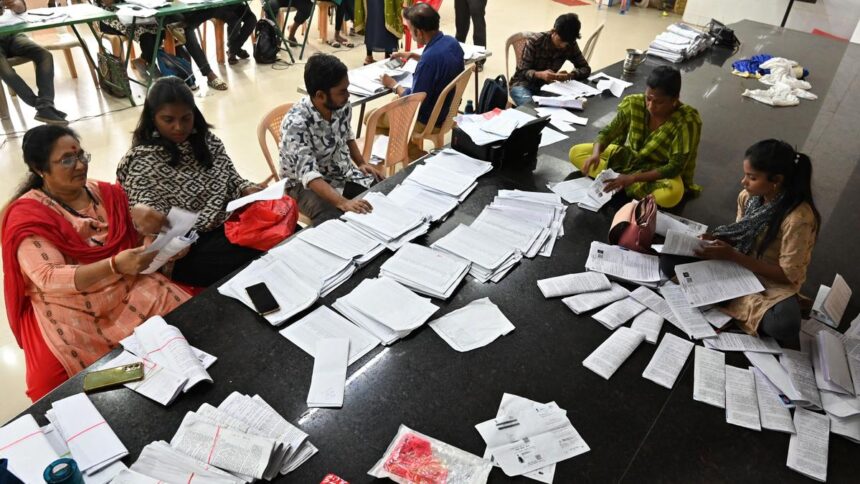
The Supreme Court’s ongoing hearings on the challenges to the Election Commission of India’s Special Intensive Revision of electoral rolls have triggered an intense national debate over the limits of the Commission’s authority, the rights of existing voters, and the implications of citizenship verification on a massive scale. The proceedings reflect deep apprehensions among petitioners that the SIR process could impose unprecedented scrutiny on India’s electorate and potentially reshape electoral administration across the country.
Petitioners Question the Legality and Purpose of the Special Intensive Revision Process
The Supreme Court Bench continued hearing multiple petitions contesting the Election Commission’s decision to conduct a Special Intensive Revision of electoral rolls, raising probing questions about the constitutional and statutory foundations of the exercise. During the hearing, the Bench examined whether the Commission has the authority to go beyond verifying age and residence and adopt what petitioners described as an “inquisitorial approach” to determine the citizenship status of existing voters.
Senior advocates representing the petitioners argued that the decision to introduce an extensive verification exercise through SIR effectively shifts the burden of proof onto Indian citizens. According to them, this runs contrary to established legal principles, particularly the Supreme Court’s ruling in the Lal Babu Hussein case, which held that only new voters are required to provide a declaration of citizenship, while existing voters enjoy the presumption that they are citizens until proven otherwise.
Advocate Shadan Farasat emphasised that existing voters cannot be removed from electoral rolls unless authorities conduct a full-fledged inquiry under legally sanctioned procedures. He submitted that the Election Commission does not possess the power—either explicit or implied—to verify citizenship. That authority, he argued, lies solely with the Foreigners Tribunals and the Union government under the Citizenship Act. In his assessment, the Commission’s decision to issue a wide-ranging notification effectively blurs the constitutional boundary between administrative supervision and judicial inquiry.
Other senior advocates, including Prashanto Sen, elaborated on the Commission’s alleged overreach by asserting that the SIR notification cannot be equated with a legal or rule-making exercise. He pointed to Section 21(3) of the Representation of the People Act, 1950, which he described as a complete code governing the revision of electoral rolls. Sen argued that once the Commission invokes Section 21(3), it cannot rely on Article 324 of the Constitution to expand its authority. According to him, there is no rational link between the stated objectives of the SIR and the methods being deployed. He urged the Court to scrutinise the disconnect between intent and execution, especially when the outcome could affect millions of voters.
Meanwhile, advocate Nizam Pasha raised critical concerns about what he described as the Commission’s assumption of a “parallel” power to inquire into citizenship—a function that traditionally belongs to the central government. He noted that the Commission’s affidavit suggested that the Centre’s authority to inquire into citizenship was limited to cases where Indian citizens voluntarily acquire foreign citizenship. Pasha argued that through the SIR notification, the Election Commission had claimed investigative powers beyond its remit, compelling ordinary voters to produce citizenship documents in a manner that could jeopardise their voting rights.
He further observed that the SIR is being conducted as a blanket exercise requiring all voters across the country to effectively prove their citizenship. This, he argued, imposes a massive burden on nearly 140 crore people, regardless of whether they have ever faced questions about their citizenship status. Such an approach, he contended, contradicts established legal protections and risks creating conditions under which voters may be rendered stateless due to administrative errors or documentation gaps.
Another advocate, Shahrukh Alam, questioned the Election Commission’s locus standi to inquire into citizenship matters, stating that determining whether someone is an “illegal immigrant” is not a matter of personal identity or administrative assessment but a judicial determination requiring due process. He asserted that the Commission’s notification does not expressly mention citizenship verification as its purpose and therefore cannot be interpreted as granting the Commission authority to conduct such inquiries.
Petitioners also highlighted the historical practice of introducing significant electoral changes through legislation rather than executive notifications. Advocate Neha Rathi noted that major transitions—such as the shift from paper ballots to electronic voting machines—were implemented only after legislative approval. She argued that the SIR departs from this democratic precedent, especially when it carries the potential to disenfranchise large populations.
The Bench, after hearing extended arguments, adjourned the matter for further discussion, signalling the complexity and gravity of the issues raised.
Regional Concerns and Administrative Challenges Add Complexity to the National Debate
While the constitutional and legal debates formed the core of the petitioners’ arguments, regional and administrative concerns further complicated the discourse. The case of Assam, which has a long and sensitive history regarding citizenship verification and illegal migration, came into focus during the hearings.
A separate petition alleged that the Election Commission had discriminated against Assam by not conducting a Special Intensive Revision there despite longstanding concerns about alleged illegal immigration. The Supreme Court highlighted the special protective laws applicable to the state, which were enacted to address its unique historical and demographic circumstances. The Court sought a response from the Election Commission on why only a special revision—not an SIR—had been carried out in Assam, given the allegations of substantial undocumented immigration.
The position of Tamil Nadu also entered the discussion during the proceedings. The state requested an extension for the enumeration phase as many residents had travelled to Sabarimala for annual religious pilgrimages and would return only around Pongal. Tamil Nadu argued that conducting the enumeration during this period could lead to inaccuracies in the voter lists and inadvertently exclude individuals who were temporarily away.
These developments underscore the uneven impact that the SIR exercise could have across different regions. States differ widely in demographics, migration patterns, literacy levels, and documentation access. Critics argue that applying a uniform verification model across such diverse contexts risks disproportionately affecting vulnerable populations. Petitioners warned that without safeguards, the SIR may create bureaucratic hurdles that could disempower citizens instead of strengthening the electoral system.
The Election Commission’s perspective, while not yet fully outlined in the hearing, is expected to emphasise the need to maintain electoral integrity and eliminate inaccuracies or fraudulent entries from voter rolls. However, petitioners counter that the existing framework already contains detailed provisions for correcting voter lists without resorting to nationwide reassessment of citizenship.
Underlying the debate is the central issue of whether the Election Commission’s pursuit of “purity of electoral rolls” justifies the procedural burdens imposed on citizens. In previous hearings, petitioners expressed concern that the Commission’s approach rests on a presumption of suspicion, effectively treating every voter as a potential non-citizen until they can prove otherwise. They described the SIR as an unprecedented countrywide survey that risks disenfranchising those who are unable to obtain or produce the required documents.
Questions have also arisen about administrative capacity. Conducting a nationwide verification exercise involving millions of households, collecting documentation, and processing forms would strain existing infrastructure and create scope for error. Petitioners argue that such an exercise, if undertaken without clear legislative backing, may violate the principles of proportionality and fairness.
In the context of India’s vast and diverse population, the consequences of an expansive verification drive could be far-reaching. Rural residents, migrant labourers, senior citizens, the economically disadvantaged, and individuals lacking robust documentation could face the greatest challenges. Petitioners warn that inadvertent exclusion from electoral rolls could lead not only to disenfranchisement but also to broader social ramifications, given the symbolic and legal importance of citizenship status.
As arguments continue, the Court’s examination of the boundaries of the Election Commission’s authority and the safeguards required to protect voting rights will play a critical role in shaping India’s democratic processes. The next phase of the hearing is scheduled for December 10, when the Bench will resume its scrutiny of the SIR framework and the legal arguments surrounding it.