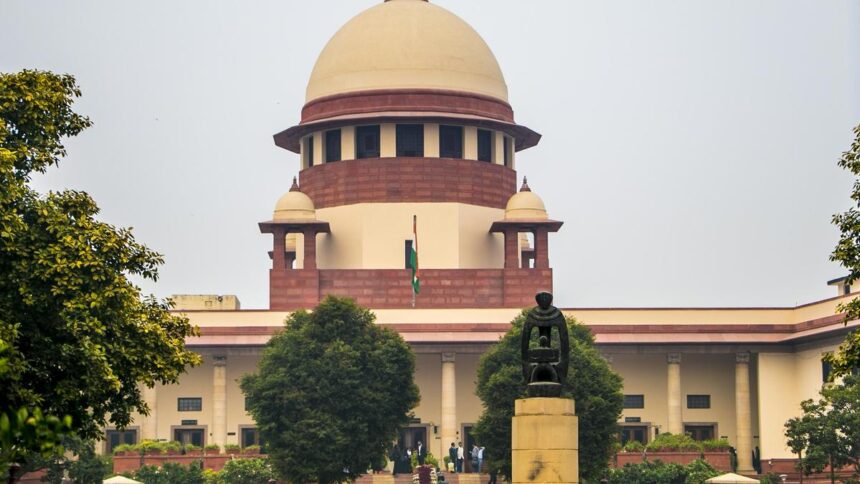
The Supreme Court has sought a formal response from the Election Commission of India on a petition questioning why Assam is undergoing a limited electoral roll revision instead of a more rigorous verification exercise ahead of the 2026 assembly elections, a move that has reopened long-standing debates over migration, citizenship, and electoral integrity in the state. A bench comprising Chief Justice of India Surya Kant and Justice Joymalya Bagchi took up the matter after hearing submissions from senior advocate Vijay Hansaria, appearing for the petitioner, and agreed to list the case for further hearing on December 16. The court, however, declined to issue any interim directions, stating that it would be inappropriate to interfere with an ongoing electoral process without first hearing the election commission’s position in detail. The petition has been filed by Mrinal Kumar Choudhury, former president of the Gauhati High Court Bar Association, through advocate Anasuya Choudhary. It challenges the election commission’s decision to conduct only a special revision of the electoral roll in Assam, arguing that the state’s unique demographic and historical circumstances warrant a stricter special intensive revision similar to that being carried out in several other states and union territories.
Challenge to limited revision in a migration-sensitive state.
At the heart of the petition lies the argument that Assam has been treated differently from other states without any transparent or legally justified reasoning. Senior advocate Vijay Hansaria submitted before the court that while states such as Bihar, Gujarat, Rajasthan, Uttar Pradesh, West Bengal, Kerala, Tamil Nadu, Madhya Pradesh, Chhattisgarh and several union territories are undergoing special intensive revision, Assam has been confined to a comparatively less stringent process.
Hansaria emphasized that under the current special revision exercise in Assam, electors are not required to submit documentary proof of citizenship, age, or residence while filling enumeration forms. In contrast, special intensive revision mandates the submission and verification of supporting documents before a voter’s name is included in the electoral roll.
He argued that this distinction is critical, particularly for a state like Assam, where concerns over illegal migration have been acknowledged for decades by constitutional authorities, governments, and the judiciary. During the hearing, Hansaria questioned the rationale behind the Election Commission’s approach, stating that he could not understand why Assam had been “singled out” for a relaxed procedure despite its well-documented history of cross-border migration. He referred to multiple Supreme Court judgments, including the court’s recent ruling on the Citizenship Amendment Act, where the issue of infiltration and demographic change in Assam had been discussed at length. According to the petitioner, these judicial observations underscore the need for heightened scrutiny rather than procedural leniency.
The petition also points out that in earlier proceedings before the Supreme Court, the election commission had indicated that a pan-India special intensive revision of electoral rolls would be undertaken. The petitioner contends that the current approach in Assam is inconsistent with that stated position, raising questions about arbitrariness and unequal treatment under the law.
Responding to these submissions, Chief Justice Surya Kant observed that the election commission might have adopted a different approach in Assam due to the presence of “special laws” and institutional mechanisms, such as foreigners’ tribunals, that are unique to the state. However, Hansaria countered this observation by stating that no such justification had been formally placed on record by the commission. He urged the court to stay the ongoing special revision process until the matter was fully examined, but the bench declined to do so without hearing the election commission’s response.
The plea draws attention to official assessments and public statements over the years that have highlighted the scale of illegal migration in Assam. It cites a 1997 report by then Assam governor Lt Gen S K Sinha, which warned of large-scale demographic changes due to unchecked migration, as well as remarks by former union home minister Indrajit Gupta suggesting the presence of 40 to 50 lakh illegal migrants in the state. The petitioner argues that these assessments, along with repeated judicial observations, establish that Assam’s ground realities are not fundamentally different from, and in some respects more complex than, those of states currently undergoing special intensive revision.
According to the petition, there is no rational basis to conclude that Assam requires a lower standard of verification when compared to other states. On the contrary, it asserts that the state’s history and socio-political context demand a more robust and document-driven exercise to ensure the purity of electoral rolls and public confidence in the democratic process.
Election commission’s rationale and broader implications
While the election commission has yet to file its formal response in the present case, its publicly stated position provides insight into the reasoning behind its decision. The commission has clarified that the choice to conduct a special revision, rather than special intensive revision or special summary revision, was made after multiple consultations and a careful consideration of Assam’s unique administrative framework.
One of the key factors cited by the commission is the existence of the national register of citizens and the category of “d-voters”, or doubtful voters, whose citizenship status is currently under adjudication. According to the commission, these mechanisms already provide a structured process for determining citizenship disputes, reducing the need for a fresh, document-heavy verification exercise during electoral roll revision.
The commission has stated that d-voters will continue to remain in the draft electoral roll without fresh verification, and their status will change only on the basis of orders passed by a foreigners’ tribunal or a competent court. This approach, it argues, avoids duplication of processes and ensures that individuals are not subjected to multiple, parallel verification exercises that could lead to confusion or inconsistency.
The Election Commission has also outlined the procedural differences between special revision, special intensive revision, and special summary revision. Under special intensive revision, electors are required to submit documentary proof through printed enumeration forms, which are then verified by election officials. In contrast, special revision and special summary revision rely on pre-filled electoral registers and standard forms such as forms 6, 7, and 8, without mandatory submission of supporting documents.
From the commission’s perspective, this distinction is significant in Assam, where large-scale verification has already taken place through the national register of citizens process. Requiring voters to once again submit documents, it argues, could place an undue burden on citizens and election machinery alike, particularly in a state with challenging geography and infrastructure constraints.
Assam chief minister Himanta Biswa Sarma has publicly welcomed the election commission’s decision to conduct a special revision with January 1, 2026, as the qualifying date. He described the exercise as a step toward ensuring clean, updated, and accurate electoral rolls, and assured full cooperation from the state government. His remarks indicate political acceptance of the commission’s approach, even as the legal challenge questions its adequacy.
The petition, however, maintains that reliance on existing mechanisms such as the national register of citizens does not justify a departure from uniform electoral standards across the country. It notes that the NRC process itself has been contentious and incomplete in terms of resolving citizenship questions for all residents. As such, the petitioner argues that electoral roll revision should independently ensure that only eligible citizens are included, especially in a border state with a long history of migration-related disputes.
The plea further refers to the Election Commission’s June 24 order initiating special intensive revision in Bihar and an affidavit filed in July in the Association for Democratic Reforms case, both of which, according to the petitioner, reflect an intent to carry out special intensive revision on a nationwide basis. The deviation in Assam, it contends, undermines the principle of equal treatment and raises concerns about the consistency of electoral administration.
As the Supreme Court prepares to hear the Election Commission’s response, the case is being closely watched for its broader implications. Beyond the immediate question of electoral roll revision in Assam, the matter touches upon fundamental issues of federalism, administrative discretion, and the balance between uniform national standards and state-specific considerations. It also highlights the continuing sensitivity surrounding questions of citizenship and voting rights in regions with complex demographic histories.
The court’s decision to seek a response without granting interim relief suggests a cautious approach, recognizing both the importance of timely electoral preparations and the need for transparency and accountability in decisions that affect the democratic process. When the matter comes up again on December 16, the election commission’s explanation is likely to play a decisive role in shaping the court’s view on whether Assam’s treatment stands on firm constitutional and administrative ground.