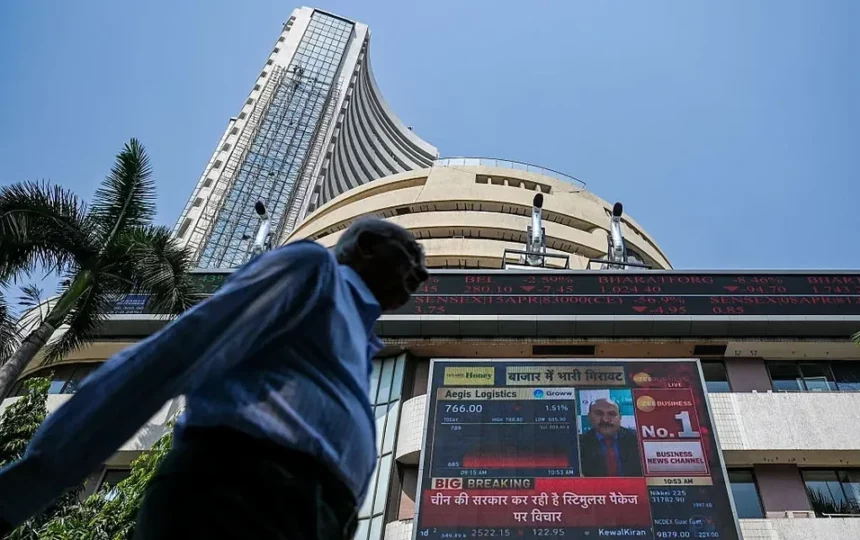
A sharp erosion in market capitalisation across six of India’s ten most valuable companies has highlighted the fragile intersection of global geopolitics and domestic market sentiment. The cumulative loss of ₹64,734.46 crore in just a week underscores how external shocks, particularly rising tensions in West Asia and the ongoing Israel-Iran conflict, continue to ripple through financial markets. Among the biggest casualties was Bharti Airtel, which alone accounted for nearly half the total decline, reflecting both sectoral vulnerabilities and investor caution in uncertain times.
The week’s trading sessions revealed a clear pattern of selective pressure, where financials and consumer-facing giants bore the brunt of the sell-off while technology and infrastructure stocks displayed relative resilience. Airtel’s steep decline of ₹29,993.07 crore brought its market capitalisation down to ₹10.20 lakh crore, making it the most significant loser in absolute terms. This was followed by ICICI Bank, which saw its valuation shrink by ₹12,845.81 crore to ₹8.70 lakh crore, indicating stress within the banking sector amid global uncertainty.
The pressure extended further to Bajaj Finance, which lost ₹11,169.36 crore in market value, settling at ₹5.14 lakh crore. Similarly, HDFC Bank witnessed a decline of ₹7,822.79 crore, bringing its valuation to ₹11.56 lakh crore. The broader trend also impacted consumer goods and public sector banking, with Hindustan Unilever and State Bank of India experiencing notable reductions in their market capitalisation.
Geopolitical Pressures and Sectoral Divergence Shape Market Trends
The primary driver behind this widespread erosion lies beyond domestic fundamentals. Escalating tensions in West Asia, particularly the geopolitical strain involving Israel and Iran, have injected a fresh wave of uncertainty into global markets. Such developments often trigger risk-averse behavior among investors, leading to capital outflows from equities and a shift toward safer assets. Indian markets, despite their relative resilience, are not immune to these global cues.
Telecommunications and financial stocks, which are closely tied to economic activity and investor confidence, tend to be more sensitive during such periods. Bharti Airtel’s sharp decline reflects not just company-specific factors but also broader concerns around capital-intensive sectors in volatile environments. Similarly, banking and financial services companies like ICICI Bank, HDFC Bank, and Bajaj Finance often face heightened scrutiny during uncertain times, as their performance is closely linked to credit growth, liquidity conditions, and macroeconomic stability.
In contrast, certain sectors demonstrated resilience, offering a counterbalance to the overall decline. Technology giants such as Tata Consultancy Services and Infosys managed to register gains in market value, benefiting from their global exposure and relatively stable revenue streams. Infrastructure major Larsen & Toubro also saw an uptick, reflecting continued investor confidence in India’s long-term growth story. Meanwhile, Reliance Industries added to its valuation, underscoring its diversified business model and strong market positioning.
This divergence highlights a critical aspect of modern markets: not all sectors react uniformly to global shocks. While some industries face immediate pressure, others may emerge as relative safe havens, attracting investor interest during turbulent periods.
Understanding Market Capitalisation and Its Impact on Investors and Companies
Market capitalisation, often referred to as market cap, represents the total value of a company’s outstanding shares. It is calculated by multiplying the total number of issued shares by the current share price. This metric serves as a key indicator of a company’s size, market position, and investor perception.
Fluctuations in market cap are primarily driven by changes in share prices, which in turn are influenced by a range of factors including financial performance, news events, market sentiment, and broader economic conditions. A rise in share price typically reflects strong performance, positive developments, or optimistic investor sentiment. Conversely, a decline may signal concerns about the company’s outlook, negative news, or broader market weakness.
For companies, market cap plays a crucial role in shaping their strategic options. A higher valuation enhances their ability to raise capital, secure loans, and pursue expansion through acquisitions. It also strengthens their credibility in the eyes of investors and stakeholders. On the other hand, a decline in market cap can limit financial flexibility, making it more challenging to execute growth plans or attract investment.
For investors, changes in market cap have direct financial implications. An increase in valuation boosts the value of their holdings, often encouraging further investment. In contrast, a decline can lead to losses, prompting some investors to reassess their positions or exit the market altogether. This dynamic creates a feedback loop where investor behavior further influences market movements.
The recent decline across six major companies serves as a reminder of the interconnected nature of global and domestic markets. While India’s economic fundamentals remain strong, external factors continue to play a significant role in shaping short-term market trends. Investors, therefore, must navigate this landscape with a balanced perspective, recognizing both the risks and opportunities that arise from such fluctuations.