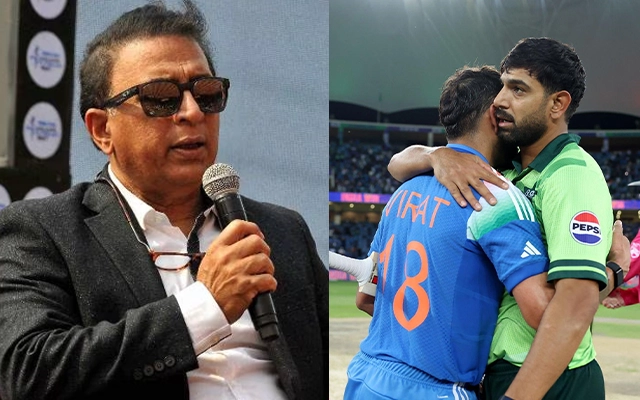
Indian cricket legend Sunil Gavaskar has made his stance clear on the long-standing debate regarding the resumption of bilateral cricket ties between India and Pakistan. The two cricketing giants have not faced each other in a bilateral series since 2012-13, when Pakistan toured India for a white-ball series. Political tensions between the two nations have restricted their encounters to global tournaments like the World Cup and continental events such as the Asia Cup. Amid ongoing speculation about a possible revival of bilateral cricket, Sunil Gavaskar has stated that such a move can only materialize if peace prevails at the borders, as this remains the fundamental prerequisite for any dialogue between the two countries.
Speaking on Ten Sports’ show ‘Dressing Room,’ Sunil Gavaskar emphasized that peace along the border is the foremost requirement for cricket to act as a bridge between the two nations. He noted that if both governments observe a period without any incidents or hostilities, they may eventually consider discussions about resuming bilateral cricket. His comments come at a time when diplomatic relations between India and Pakistan remain strained, with cross-border tensions often overshadowing sporting ties. While there have been occasional reports of back-channel talks and internal discussions to explore possibilities, Sunil Gavaskar pointed out that the ground reality of frequent border incursions and geopolitical unrest remains a major hurdle. The Indian government, according to him, is justified in maintaining its current stance of not engaging in cricketing ties with Pakistan until stability is ensured.
Sunil Gavaskar’s remarks follow India’s commanding six-wicket victory over Pakistan in the ongoing Champions Trophy 2025. The high-voltage clash was a one-sided affair, with Rohit Sharma’s men dominating their arch-rivals in all aspects of the game. The win secured India’s spot in the semi-finals, reaffirming their dominance in ICC tournaments against Pakistan in recent years. However, despite the lopsided nature of recent India-Pakistan encounters, the possibility of more face-offs between the two teams later this year has kept cricket fans intrigued. Reports suggest that the upcoming Asia Cup 2025, which is set to be played in the T20 format, could feature up to three India-Pakistan matches, depending on the tournament’s progression.
The Asia Cup 2025, initially allotted to India, has been shifted to a neutral venue due to the complex political and cricketing dynamics between the two nations. The Asian Cricket Council (ACC) has reportedly decided to stage the tournament outside India, with Sri Lanka and the UAE emerging as the most likely hosts. Despite this relocation, the Board of Control for Cricket in India (BCCI) will retain hosting rights for the competition. The tournament, featuring 19 matches, is expected to be played between the second and fourth week of September, making it a significant event in the lead-up to the T20 World Cup.
The ongoing Champions Trophy 2025 has already witnessed significant controversy regarding its venue allocation. Pakistan, as the designated host, was initially set to hold all matches on home soil. However, the BCCI’s refusal to send the Indian team to Pakistan led to a major standoff between the two cricket boards. As a compromise, India’s matches were relocated to Dubai, allowing the tournament to proceed without direct participation in Pakistan. This decision has once again highlighted the complexities of India-Pakistan cricketing relations, where political considerations continue to dictate scheduling and participation.
While cricket enthusiasts across both nations yearn for the revival of bilateral series, the practicalities remain far from simple. Sunil Gavaskar’s remarks have further reinforced the view that until broader diplomatic issues, particularly border tensions, are resolved, cricket will remain a secondary priority. His stance aligns with the Indian government’s official position, which has consistently maintained that sporting engagements with Pakistan cannot be viewed in isolation from larger national security concerns.
The anticipation surrounding future India-Pakistan clashes, particularly in multi-nation tournaments, remains high, with the Asia Cup expected to be another high-profile event featuring the two teams. However, a full-fledged bilateral series, involving home-and-away fixtures, appears unlikely in the near future. As cricket continues to be a reflection of political realities, Sunil Gavaskar’s straightforward response serves as a reminder that in the India-Pakistan equation, sport and diplomacy are inseparably linked.