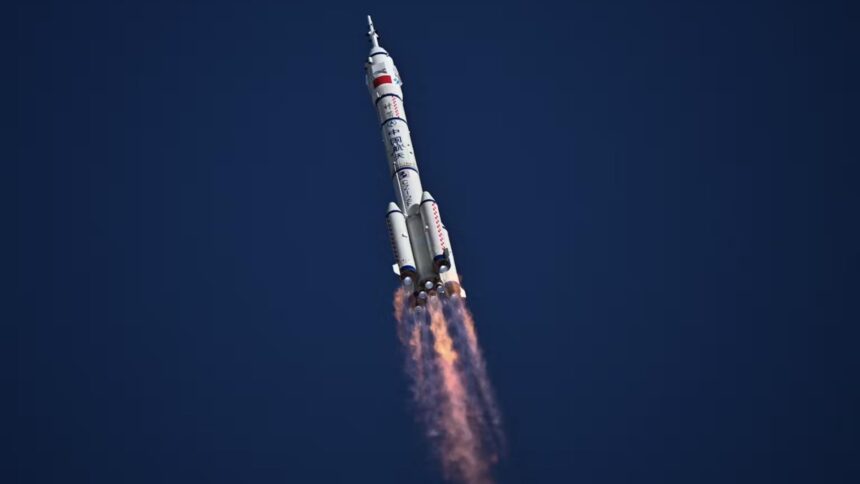
Newswise — China’s Shenzhou-20 spacecraft took a hit from a piece of space debris floating through orbit, causing Chinese officials to delay the spacecraft’s return from its Tiangong space station in early November 2025.
In addition to stranding the three Chinese astronauts – called taikonauts – who were set to return to Earth, this incident highlights the increasing risks posed to China and the broader international community by the growing amount of space debris.
I study China’s space program. My research suggests that national pride plays an important role in China’s growing space ambitions. As China continues to invest in expensive space capabilities, it will also likely become increasingly sensitive to losing them. The rise in space debris may create incentives for Chinese officials to cooperate with the United States on measures that reduce the risk of collisions.
Space Debris – a Growing Issue
Space debris is creating growing problems for space operations. It includes any artificial objects in orbit not operating as satellites or spacecraft. It ranges in size from a fleck of paint to large rocket bodies roughly the size of a school bus.
In the most commonly used orbit – low Earth orbit – this debris can move at speeds of roughly 18,000 mph, almost seven times the speed of a bullet. At such high speeds, even tiny pieces of space debris can be highly destructive, to the point that this debris might continue to multiply until one day it makes certain critical orbits unusable. When space debris collides with other objects and fragments, they can break into smaller pieces, generating even more debris.
It’s somewhat ironic that China’s spacecraft took a hit from space junk. The country is responsible for creating the majority of space debris. In 2007, China blew up a defunct Fengyun-1c weather satellite to test an anti-satellite weapon. It generated the most space debris in history – over 3,000 pieces are still orbiting today.
On several occasions, the International Space Station has had to maneuver to narrowly avoid being struck by debris from this test, including as recently as 2021.
Anti-Satellite Weapons
Why would China, or any other country, want to develop an anti-satellite weapon? Satellites provide significant benefits to militaries. They help with reconnaissance and intelligence, allow for the precise targeting and guidance of long-range munitions, support communication over large distances and supply weather data, to name just a few uses.
These advantages were showcased during the first Gulf War, often called the “first space war.” The United States used space technologies to quickly and decisively defeat the Iraqi military within weeks, and with far fewer casualties than expected. The Gulf War had a profound impact on Chinese military thinking, with analysts in the People’s Liberation Army recognizing the importance of space technologies in modern warfare.
Whereas the United States has been and remains highly dependent on space capabilities, China has historically been less dependent on them. This means that China has traditionally had far less to lose from striking satellites in orbit and comparatively more to gain from disabling an adversary’s satellites.
Since the 1990s, China has invested in technologies that can jam, disable or outright destroy another country’s satellites. This effort has been driven by a desire to counter what it sees as a key vulnerability of the U.S. military – its heavy reliance on space capabilities.
Yet much has changed since China’s first anti-satellite test in 2007.
China has gradually narrowed the gap with the United States in space capabilities and is now one of the most powerful spacefaring nations on Earth. As a result, China now has more at stake if it were to lose access to space.
Space debris is becoming a serious threat to Chinese interests in space. In 2022, for example, reports emerged that debris from Russia’s 2021 ASAT test came dangerously close to a Chinese satellite. Similarly, in 2021 China filed a claim at the United Nations that China’s Tiangong space station had to perform avoidance maneuvers due to “close encounters” with Starlink satellites. And now, in November 2025, China’s Shenzhou-20 spacecraft has actually been struck by space debris.
Recognizing the Problem
It is too early to gauge how seriously Chinese officials view the threat of space debris. However, the high-profile nature of this recent incident may alert China’s public and officials to the risks posed by space debris.
China’s space station, its astronauts and its satellites are important to the Chinese Communist Party. If space debris permanently destroyed parts or all of China’s space station, or even killed a Chinese astronaut, it would likely lead to significant public outcry.
China’s space station is a project over three decades in the making and is the crown jewel of its space program. The Tiangong is set to become the only space station in orbit if the United States proceeds with its plans to deorbit the ISS in 2030.
Just as an owner of an expensive Lamborghini may become increasingly worried about dangerous road conditions that may damage their prized possession, Chinese officials may become anxious about China’s ability to operate its space station should space junk continue to clutter low Earth orbit.
Even if space debris does not damage China’s space station, it still poses a risk to Chinese satellites. And low Earth orbit is likely to become only more crowded, as SpaceX has announced plans to add up to 40,000 Starlink satellites in orbit, and China plans to add tens of thousands more satellites in low Earth orbit through its Guowang and Qianfan satellite megaconstellations.
China’s growing vulnerability to space debris creates an area of mutual concern where the United States and China may be able to work together to avoid future accidents.
Risk-reduction measures could include the two countries notifying each other about potential collisions. China and the United States could also open discussions around how to safely operate satellites or remove them from orbit when they’re no longer useful.
It remains to be seen what lessons Chinese decision-makers draw from this recent episode. But the problem of space debris is not going away.
This article is republished from The Conversation under a Creative Commons license. Read the original article.
https%3A%2F%2Fwww.newswise.com%2Farticles%2Fspace-debris-struck-a-chinese-spacecraft-how-the-incident-could-be-a-wake-up-call-for-international-collaboration%2F%3Fsc%3Drsla