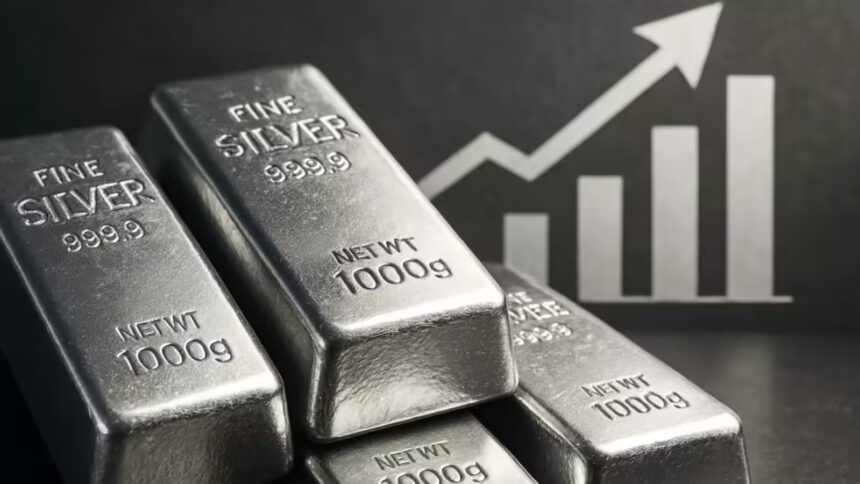
Silver, one of India’s most traded precious metals, witnessed a notable correction in prices after an unprecedented rally that saw its value soar to record highs earlier this month, as the white metal became approximately fifteen thousand rupees cheaper per kilogram from its recent peak when market forces adjusted following intense volatility and investor repositioning.
After months of sharp upward movement that took silver well above three lakh rupees per kilogram, trading data from markets indicates that prices have begun to temper, offering a rare respite for buyers and traders who faced steep cost pressures in recent weeks. The correction came amid broader adjustments in commodity markets, where initial exuberance about silver’s safe-haven appeal and industrial demand gave way to profit-taking and recalibration of expectations. In recent sessions, silver prices on domestic exchanges touched around ₹3.03 lakh per kilogram, reflecting a roughly five percent decline from record highs amid shifting sentiments among traders and investors alike. This moderation represents the first meaningful reversal in what had been a nearly uninterrupted ascent in the value of the white metal.
The recent price behaviour underscores the dynamic nature of commodity markets, where fundamentals, investor psychology, and global cues interact to shape short-term movements alongside long-term trends. For months, silver prices had been underpinned by strong global demand, tightening supplies, and heightened interest from investors seeking diversification and protection against financial uncertainty, driving the metal to previously unseen levels in domestic trading. However, as markets absorbed these gains and participants evaluated risk-reward profiles, a natural correction emerged, smoothing out some of the earlier exuberance and realigning prices to more sustainable levels in light of transactional realities in both futures and physical markets.
Broad market dynamics and the forces behind silver’s recent correction
The recent correction in silver prices can be traced to several interacting factors that influenced both the supply and demand sides of the market. For most of the current year, silver experienced a rally propelled by a combination of robust industrial demand and a growing perception of the metal as a hedge against economic uncertainty. Investors poured capital into silver as global economic challenges and geopolitical risks encouraged the search for safe-haven assets. This demand surge was mirrored in elevated futures contracts and hefty trading volumes across commodity exchanges, heightening the metal’s price trajectory and confidence in continued upward movement.
Industrial use has long been a foundational pillar of silver demand. The metal is integral to sectors ranging from electronics and solar panels to advanced medical technologies, with its unique physical properties making it indispensable in many modern manufacturing processes. As global economies focused on expanding renewable energy infrastructure and technological production, silver found increased consumption pathways that lent additional support to bullish outlooks. These fundamental drivers stood alongside broader investor enthusiasm, creating a pricing environment that favoured rapid appreciation.
Nevertheless, commodity markets are inherently cyclical, and sentiment can shift quickly when prices reach elevated levels. After several weeks of uninterrupted rallies that pushed silver above ₹3 lakh per kilogram, market participants began to reassess valuations and risk exposures. Traders, recognising substantial gains over a relatively short period, initiated profit-taking strategies that gradually exerted downward pressure on prices. This dynamic was especially evident in the physical market, where some dealers and buyers opted to secure profits or adjust holdings, leading to a widening gap between futures contract prices and spot rates in certain centres.
The divergence between futures market optimism and physical market pricing became a notable feature of recent trading sessions, reflecting nuanced sentiment across investor types. Futures prices often encapsulate forward-looking expectations and are influenced by speculative positioning, while spot market rates respond more directly to immediate transactional demand and supply conditions. As these two facets of the market exhibited differing rhythms, silver’s price adjustment unfolded in ways that highlighted the complexity of price formation in commodity markets.
Another factor contributing to the recent price shift was the behaviour of currency markets, particularly the relative strength of the Indian rupee against the dollar. Silver prices in India are closely linked to international valuations and currency movements. When the rupee strengthens against the dollar, the cost of importing silver tends to decrease, alleviating some price pressure in domestic markets. Conversely, a weakening rupee typically heightens the local currency cost of internationally priced commodities. In the recent period, fluctuations in the rupee’s value helped temper the pace of silver’s ascent and supported conditions conducive to a slower upward trend.
The correction also reflects a maturing of market expectations as participants calibrate their strategies in response to both macroeconomic signals and technical indicators. Commodity markets often exhibit phases of rapid expansion followed by stabilization, as traders weigh valuation extremes against historic norms and potential catalysts. In the case of silver, the initial record-breaking advances created a backdrop where caution began to surface once key psychological price levels were surpassed, prompting adjustments that manifested in the recent downshift in pricing.
Implications for investors, consumers, and domestic market trends
The recent moderation in silver prices has several implications for various stakeholders, including investors, retail buyers, industrial consumers, and broader market observers. For individual investors who entered the market during or after the peak of the rally, the correction presents a more favourable entry point compared with the higher price levels seen just weeks earlier. The pullback could attract new buyers who were previously hesitant due to the metal’s lofty valuations, offering them an opportunity to accumulate physical holdings or invest through financial instruments linked to commodity performance at comparatively lower rates.
At the same time, the correction has eased some of the cost burdens faced by consumers of silver, particularly jewellers and manufacturers who incorporate the metal into products. These sectors had grappled with elevated input costs as silver approached record pricing, putting pressure on profit margins and pricing strategies. As prices recalibrate, industrial buyers can plan procurement with greater confidence, potentially smoothing supply chain disruptions that had been amplified by unpredictable price movements.
For seasoned investors and traders, the recent price action reinforces the importance of risk management in volatile markets. The swift ascent followed by a corrective phase highlights how quickly sentiment can shift in response to evolving economic conditions, speculative flows, and technical triggers. Portfolio strategies that factor in market corrections alongside bullish positioning tend to be more resilient, enabling participants to navigate both upswings and downshifts with strategic agility.
The broader domestic market also reflects the interplay between local demand dynamics and global commodity trends. While international factors such as geopolitical uncertainty and industrial demand exert significant influence, domestic market behaviour is shaped by immediate buying and selling patterns, regulatory considerations, and seasonal variations in consumer interest. These influences collectively determine how silver’s price evolves over time, creating a landscape where adaptability and market awareness are essential for informed decision-making.
The correction in silver pricing serves as a timely reminder that commodity markets are not linear. While optimism and strong demand can propel prices to new heights, equilibrium is often restored through natural market mechanisms such as profit realisation, supply alignment, and currency movements. In this case, the white metal’s journey from record peaks to a notable correction illustrates how markets balance enthusiasm with caution, enabling participants across the economic spectrum to adjust their strategies and expectations.