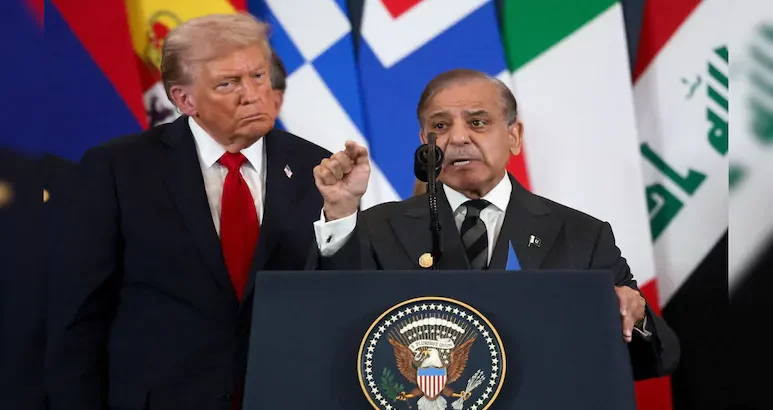
Pakistan Prime Minister Shehbaz Sharif has once again drawn criticism both at home and abroad after lavishing praise on U.S. President Donald Trump for his alleged role in promoting global peace. His remarks, made on social media and previously at the Gaza Summit in Egypt, have sparked a wave of ridicule and political commentary, with Pakistan’s former ambassador to the United States, Husain Haqqani, taking a sharp dig at the Prime Minister, and Indian politician Shashi Tharoor amplifying the jibe on X. The episode has reignited debates about Pakistan’s diplomatic credibility, the use of international flattery for political image-building, and the fragile nature of Islamabad’s foreign policy narrative.
Shehbaz Sharif’s Controversial Praise and Nobel Nomination for Donald Trump
In a recent post on X, Prime Minister Shehbaz Sharif expressed deep admiration for U.S. President Donald Trump, crediting him for what he called “instrumental efforts” in advancing peace across various conflict zones. Shehbaz Sharif specifically mentioned Donald Trump’s supposed contributions to the Kuala Lumpur Accord, the Gaza Peace Plan, and the mediation between Cambodia and Thailand. His statement read: “My deep appreciation to President Donald Trump for his instrumental role in advancing peace through the Kuala Lumpur Accord, the Gaza Peace Plan, and his resolute efforts for peace and stability in the Middle East and South Asia—saving millions of lives across the globe.”
Shehbaz Sharif went on to remind his audience that he had nominated Donald Trump for the Nobel Peace Prize earlier this year, citing the former President’s “extraordinary contributions” toward peace in multiple regions. His remarks, however, were met with widespread scepticism and mockery, given that Donald Trump’s actual diplomatic record remains controversial and divisive.
The Prime Minister’s statement triggered a strong response from Husain Haqqani, Pakistan’s former ambassador to the United States and an outspoken critic of Pakistan’s leadership. Haqqani wrote on X that Shehbaz Sharif remained “in the lead for the gold medal in the Olympic sport of flattering Donald Trump.” The sarcastic tone of Haqqani’s comment quickly went viral, with thousands of users engaging with the post. Indian Congress MP Shashi Tharoor later reshared Haqqani’s post on his own X account, further amplifying the conversation across South Asian political circles.
This is not the first time Shehbaz Sharif’s remarks about Donald Trump have stirred controversy. Earlier this month, during the Gaza Summit in Egypt, Shehbaz Sharif publicly credited Donald Trump’s “untiring and relentless efforts” for achieving peace in the Middle East. Standing among a gathering of global leaders, Shehbaz Sharif proclaimed that Pakistan had nominated Donald Trump for the Nobel Peace Prize for his “outstanding and extraordinary contributions” in mediating regional conflicts, including between India and Pakistan. The Prime Minister added that he wished to nominate Donald Trump again for his continued efforts in “saving millions of lives in South Asia and the Middle East.”
Such overt displays of admiration, especially in international forums, have drawn backlash from both Pakistani citizens and global observers, who view Shehbaz Sharif’s comments as diplomatically misplaced and politically tone-deaf.
Domestic Criticism and Public Reaction in Pakistan
Shehbaz Sharif’s remarks about Donald Trump have been met with sharp criticism from opposition figures, media commentators, and social media users in Pakistan. Many have accused the Prime Minister of undermining the dignity of his office by excessively flattering a foreign leader with whom Pakistan’s relations remain complex and often strained. The notion that Donald Trump played a role in “stopping a war” between India and Pakistan, as claimed by Shehbaz Sharif, has been widely dismissed by analysts as both factually incorrect and diplomatically embarrassing.
Critics argue that Shehbaz Sharif’s remarks reflect a larger pattern within Pakistan’s political leadership—of seeking international approval rather than asserting independent diplomatic positions. The recurring praise for Donald Trump, especially when many global leaders have distanced themselves from his legacy, has led to questions about Pakistan’s foreign policy direction under the current government.
Several Pakistani journalists and commentators expressed concern that Shehbaz Sharif’s statements could weaken Islamabad’s image on the international stage. They pointed out that the Gaza Summit was intended to address the ongoing humanitarian crisis in the region, yet the Prime Minister used the platform to heap praise on a leader whose policies were often criticized for exacerbating global divisions.
Public sentiment on social media was equally unforgiving. Pakistani users flooded X and other platforms with memes, sarcastic comments, and political cartoons mocking Shehbaz Sharif’s “obsession” with Donald Trump. Many described his remarks as an “insult to Pakistanis,” arguing that the Prime Minister should focus on addressing domestic challenges instead of engaging in symbolic gestures aimed at foreign approval.
Adding to the controversy, opposition parties accused Shehbaz Sharif of using such statements to distract from growing economic and governance challenges at home. Pakistan is currently grappling with inflation, debt crises, and political instability, which have led to widespread discontent. Critics claim that Shehbaz Sharif’s repeated praise for Donald Trump is part of a broader attempt to divert attention from internal issues and project an image of international relevance.
Husain Haqqani’s jibe, though humorous, resonated deeply within political and diplomatic circles. The former envoy’s sarcastic framing of Shehbaz Sharif’s actions as a “competitive sport of flattery” underscored the perception that Pakistan’s foreign policy often lacks seriousness and substance. Shashi Tharoor’s endorsement of Haqqani’s post added an Indian political dimension to the debate, reflecting how Shehbaz Sharif’s remarks have transcended Pakistan’s borders to become a topic of regional discourse.
Political analysts have also noted that Shehbaz Sharif’s apparent admiration for Donald Trump is not entirely new. During his previous tenures and political campaigns, Shehbaz Sharif has often sought to associate himself with powerful international figures, projecting these connections as symbols of diplomatic success. However, his recent comments appear to have backfired, inviting ridicule rather than respect.
Diplomatic observers in Islamabad caution that such incidents could erode Pakistan’s credibility at a time when the country is seeking to rebuild its relationships with key global powers. The attempt to link Donald Trump to peace achievements in Cambodia, Thailand, and Gaza—regions where his administration’s actual influence was limited—has particularly puzzled foreign policy experts. Many have interpreted Shehbaz Sharif’s remarks as a poorly calculated move aimed at gaining personal visibility rather than promoting Pakistan’s national interests.
Beyond the mockery, some within Pakistan’s political establishment have quietly expressed concern that Shehbaz Sharif’s statements could strain future diplomatic interactions with the Biden administration. With Donald Trump no longer in power, overt displays of allegiance to his leadership might be viewed unfavorably in Washington, potentially complicating Pakistan’s ongoing negotiations related to trade, security cooperation, and aid programs.
Meanwhile, Shehbaz Sharif’s party spokespersons have attempted to downplay the controversy, describing the Prime Minister’s remarks as part of his “vision for global peace and diplomacy.” They argue that Shehbaz Sharif’s acknowledgment of Donald Trump’s efforts was symbolic, intended to promote dialogue and unity rather than political partisanship. Yet, such explanations have done little to quell the growing criticism within Pakistan’s media and public sphere.
As the debate continues, one thing is evident—the incident has reignited a larger discussion about Pakistan’s diplomatic priorities and the tendency of its leaders to seek validation through high-profile flattery rather than strategic engagement. Shehbaz Sharif’s repeated praise of Donald Trump, both at international forums and on social media, underscores the complexities and contradictions of Pakistan’s foreign policy image in an increasingly polarized global landscape.
While his defenders describe him as a statesman advocating peace, critics see him as a leader out of touch with geopolitical realities. The episode, amplified by voices like Haqqani and Tharoor, has become yet another reminder of how public perception, humor, and diplomacy intertwine in the digital age—often to the detriment of political leaders who underestimate the scrutiny of global audiences.