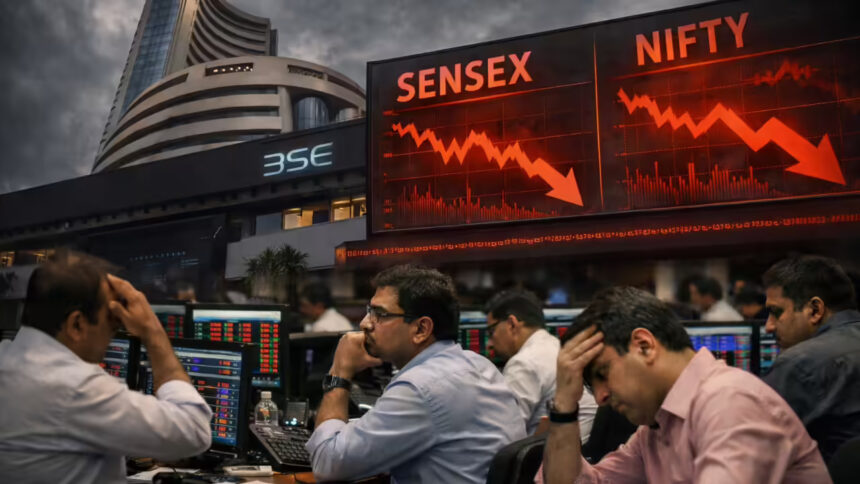
Indian stock markets managed to recover from sharp early losses on Wednesday and ended the trading session in positive territory despite continuing global uncertainty, foreign investor selling and persistent pressure on the Indian rupee. The recovery in equities offered temporary relief to investors, although concerns surrounding currency weakness and global economic volatility continued to dominate market sentiment.
After witnessing heavy fluctuations during the trading session, the benchmark Sensex closed 117 points higher at 75,318 while the Nifty ended marginally higher at 23,659. The rebound came after strong buying support emerged in select heavyweight stocks during the latter half of the session.
Market participants closely tracked crude oil prices, foreign institutional investor activity and global economic signals throughout the day. Analysts noted that despite negative global cues, domestic investors showed resilience and prevented deeper declines in Indian equities.
Among the biggest gainers during the session were companies linked to banking, infrastructure, industrial growth and energy demand. Shares of Reliance Industries, Bajaj Finserv, Axis Bank, IndiGo, Mahindra and Mahindra and NTPC attracted buying interest after early market weakness created fresh value opportunities for investors.
At the same time, sectors including media, real estate, chemicals and public sector banks remained under pressure as traders continued to exercise caution amid concerns regarding slowing global growth and rising geopolitical risks.
The pharmaceutical sector emerged as one of the strongest performers of the day. Analysts explained that defensive sectors such as healthcare and pharmaceuticals often attract investor interest during periods of economic uncertainty because they are viewed as relatively stable compared to cyclical industries.
Global energy markets also remained a major focus for traders. Crude oil prices cooled slightly during the day and slipped below the 110 dollar per barrel mark, providing some relief to import dependent economies such as India. However, analysts warned that ongoing tensions in West Asia continue to create uncertainty regarding future energy supply stability.
India remains one of the world’s largest importers of crude oil, making fluctuations in global energy prices extremely important for inflation, transportation costs and overall economic stability. Even temporary spikes in crude prices can significantly affect household expenses, industrial production and government fiscal planning.
Despite softer crude prices, the Indian rupee continued to weaken sharply against the United States dollar. The domestic currency declined by another 20 paise and touched a historic low of 96.90 against the dollar, intensifying concerns among investors and policymakers.
Currency market experts attributed the rupee weakness to a combination of foreign investor outflows, strong global demand for the dollar and rising import related pressures. The appreciation of the dollar globally has created challenges for many emerging market currencies, including the Indian rupee.
A weaker rupee increases the cost of imports and raises pressure on inflation. It also affects sectors dependent on imported raw materials, overseas travel, international education and cross border trade activities. Economists believe persistent currency weakness may eventually force policymakers to consider additional stabilisation measures if volatility continues.
Foreign institutional investors remained net sellers in Indian equities during the session. Market data showed that foreign investors sold shares worth thousands of crores, continuing the trend of cautious positioning amid global economic uncertainty.
However, domestic institutional investors once again played a stabilising role by absorbing selling pressure and maintaining confidence in the broader Indian market. Their continued participation has become one of the strongest support mechanisms for Indian equities during recent periods of foreign capital withdrawal.
Asian markets largely ended lower on Wednesday as investors across the region reacted to fears surrounding slowing global growth, elevated energy prices and geopolitical tensions. Major indices in Japan, South Korea and Hong Kong closed in negative territory, reflecting broader caution among international investors.
United States markets had also ended lower overnight, adding to weak sentiment in Asia. Selling pressure in technology and industrial stocks contributed to declines across major American indices including the Dow Jones, Nasdaq and S and P 500.
Another development that attracted attention in financial circles was the absence of Indian companies from the list of the world’s top 100 companies by market value. Earlier in the year, several major Indian corporations including Reliance Industries, HDFC Bank and Tata Consultancy Services were part of the global ranking.
According to financial reports, the prolonged weakness in Indian equity valuations contributed to the decline in market capitalisation of these companies, pushing them out of the top global rankings.
Market experts cautioned against interpreting this as a sign of structural weakness in the Indian economy. Instead, they argued that global capital flows, valuation adjustments and temporary market corrections have significantly influenced rankings across international markets.
Still, the development has renewed discussion regarding the need for Indian companies to strengthen global competitiveness through innovation, technological expansion and sustained long term investment strategies.
Investor sentiment within India currently reflects a combination of optimism regarding long term economic growth and caution regarding near term global risks. While India continues to maintain strong macroeconomic fundamentals compared to many large economies, external uncertainties continue to influence market direction.
Analysts believe upcoming movements in crude oil prices, global central bank decisions and geopolitical developments will remain critical for Indian markets in the coming weeks. Any escalation in global tensions could increase volatility across both currency and equity markets.
At the same time, stabilisation in oil prices and easing foreign investor concerns could support a recovery in Indian equities. Domestic consumption trends, infrastructure spending and corporate earnings will also remain key factors shaping investor confidence.
Wednesday’s recovery in Indian markets demonstrated that despite global challenges, domestic participation continues to provide strong support to equities. However, the historic weakness in the rupee serves as a reminder that external risks remain significant and require close monitoring.
As investors navigate an increasingly uncertain global environment, Indian markets are expected to remain highly sensitive to both domestic economic indicators and international geopolitical developments. The coming weeks may therefore prove crucial in determining whether current volatility stabilises or intensifies further.