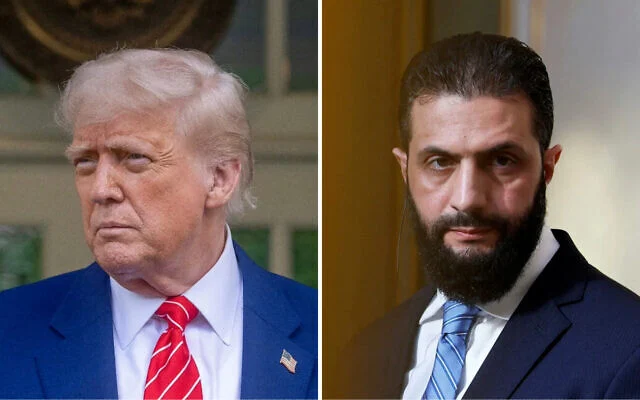
Donald Trump Sends Signature Cologne To Syrian President, Viral Note Grabs Global Attention
A surprising diplomatic gesture involving perfume bottles, handwritten humour and viral social media reactions has once again pushed United States President Donald Trump into the center of global attention. This time, the spotlight is on Trump’s decision to send additional bottles of his signature branded cologne to Syrian President Ahmed al Sharaa, a move that has triggered international discussion about modern diplomacy, political branding and the growing influence of personal symbolism in global politics.
The unusual exchange quickly became one of the most talked about international political moments online after Ahmed al Sharaa publicly shared photographs of the gift package on social media. The images included two bottles of Trump’s “Victory” fragrance line alongside a handwritten note from the American president.
In the message, Trump jokingly referred to the cologne gifted during their previous White House meeting and humorously suggested that the Syrian president may have already used it all. The informal tone of the note immediately captured public attention and transformed what could have been a routine diplomatic gesture into a viral international story.
Ahmed al Sharaa responded warmly to the gift and posted a carefully worded message online stating that some meetings leave not only memories but also a fragrance. His reaction further amplified the story across global media platforms and sparked widespread debate regarding the changing nature of diplomacy in the digital era.
Political analysts believe the exchange reflects the growing importance of personality driven diplomacy in international relations. Unlike traditional diplomatic communication dominated by formal statements and carefully scripted appearances, modern global politics increasingly revolves around personal chemistry, symbolic gestures and social media narratives.
The resurfacing of footage from Trump and Sharaa’s previous White House meeting added another layer to the viral moment. In the widely circulated video, Trump is seen playfully spraying the branded fragrance on the Syrian president before handing over the bottle as a gift. During the exchange, Trump described it as his “best fragrance” and joked about gifting another bottle to Sharaa’s wife.
The conversation then moved into a lighthearted exchange regarding marriage and cultural assumptions, producing a moment that many internet users described as both awkward and entertaining. The clip rapidly spread across multiple social media platforms, generating millions of views and reactions.
Beyond the humour and internet fascination, however, the episode carries broader diplomatic significance. The exchange occurred shortly after the United States extended the temporary suspension of certain sanctions on Syria for another 180 days, a decision viewed by observers as a potential sign of cautious engagement between Washington and Damascus.
Relations between the United States and Syria have remained deeply strained for years due to regional conflict, sanctions, security concerns and geopolitical rivalries across West Asia. Diplomatic communication between the two countries has often been limited and highly sensitive.
Against this backdrop, Trump’s unusually personal gesture has attracted attention not only because of its entertainment value but also because it may reflect attempts to soften diplomatic tensions through informal symbolism and public messaging.
Experts in international relations note that symbolic gestures between leaders have historically played important roles in diplomacy. Gifts, cultural references and personal interactions often serve as subtle signals capable of influencing political atmospheres even when official disagreements remain unresolved.
Donald Trump has consistently relied on unconventional communication methods throughout his political career. Coming from a business and branding background, Trump has frequently blurred the lines between political leadership, personal marketing and media spectacle.
His political identity has long been tied to strong personal branding, and the use of his own fragrance line in diplomatic interactions further reinforces that image. Analysts argue that Trump understands the power of viral moments and deliberately uses them to shape public perception.
Social media has dramatically transformed how international diplomacy is consumed by global audiences. Moments that once remained behind closed doors now instantly become viral content capable of influencing public narratives worldwide. In this environment, leaders increasingly perform not only for political elites but also for digital audiences.
The Trump Sharaa perfume exchange demonstrates how even minor personal gestures can dominate international conversation when amplified through internet culture. The story combined humour, political symbolism, celebrity style branding and geopolitical curiosity in a way that resonated strongly online.
Public reactions to the episode have varied significantly. Some observers praised the interaction as an example of relaxed diplomacy capable of reducing tensions through personal warmth. Others criticised the exchange as overly theatrical and reflective of politics becoming entertainment driven.
Still, most analysts agree that the incident highlights a larger transformation in global political communication. Traditional diplomacy based entirely on formal protocol is gradually being replaced by a hybrid model where social media visibility, personal charisma and viral storytelling play increasingly influential roles.
The story also reflects the broader evolution of political leadership in the digital age. Leaders are now expected not only to manage policy and governance but also to shape emotional narratives capable of attracting public attention in a highly competitive media environment.
For Syria, the public interaction with the American president also carries symbolic importance. After years of international isolation and conflict, even small signs of engagement with Washington attract significant global scrutiny.
Whether the perfume exchange ultimately carries any long term diplomatic implications remains uncertain. Personal rapport between leaders does not automatically resolve deeper geopolitical disagreements involving security, regional alliances and economic sanctions.
However, symbolic interactions can still influence the tone of diplomatic engagement. They often help create softer public atmospheres that make future negotiations politically easier for both sides.
Observers also point out that modern political audiences increasingly respond to authenticity, humour and unexpected human moments. The viral success of the Trump Sharaa interaction demonstrates how global audiences are often drawn more strongly to unscripted exchanges than to formal policy statements.
As discussions surrounding the incident continue across international media, the story has become a striking example of how diplomacy, internet culture and personal branding are becoming deeply interconnected in the twenty first century.
A simple perfume gift may appear trivial at first glance, but in today’s political environment, even the smallest symbolic gesture can shape global conversation, influence perception and redefine how world leaders communicate with one another in the public eye.