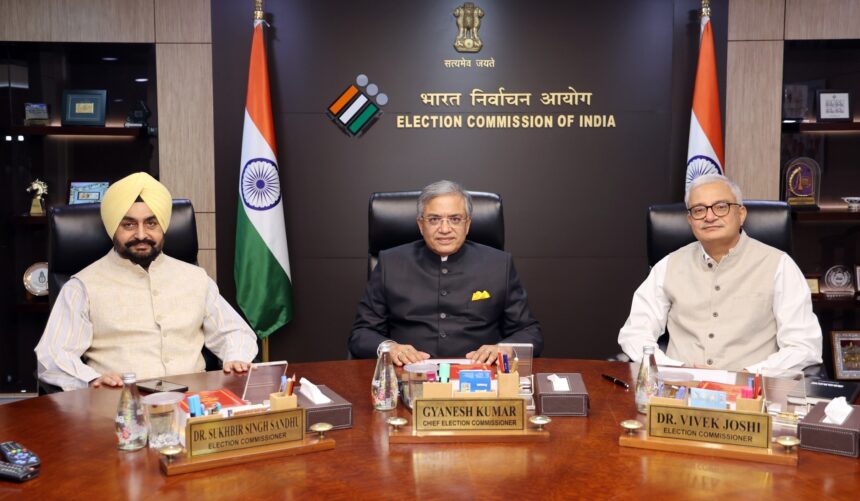
The Supreme Court of India has raised serious concerns over the process used for appointing the Chief Election Commissioner and Election Commissioners, questioning whether the current system genuinely ensures institutional independence or merely creates the appearance of it. The court’s observations have once again brought the debate over electoral neutrality and executive control into sharp focus.
A bench comprising Justices Dipankar Datta and Satish Chandra Sharma examined the structure of the selection committee and questioned the logic behind including the Leader of Opposition when the final decision is effectively determined by the government through majority voting. The court remarked that if the executive holds decisive power, the presence of the Opposition leader risks becoming symbolic rather than substantive.
The observations come amid ongoing petitions challenging the current law governing appointments to the Election Commission of India, a body widely regarded as central to safeguarding free and fair elections in the world’s largest democracy.
Judicial Concerns Over Institutional Independence
During the hearing, the bench compared the appointment process of the Election Commission with that of other constitutional posts, noting that the selection of the CBI Director includes the Chief Justice of India, which introduces a degree of institutional independence.
However, the court highlighted that the Election Commission’s selection panel consists of the Prime Minister, a Union Cabinet Minister, and the Leader of Opposition, with decisions taken by majority vote. The judges questioned whether such a structure truly protects autonomy or simply formalises executive dominance.
The bench also posed a direct query to the Attorney General, asking what would happen in case of disagreement between the Prime Minister and the Leader of Opposition on a candidate. The Attorney General reportedly acknowledged that in such a scenario, the outcome would likely still depend on the majority, reinforcing the court’s concern about executive control.
The remarks underscore a broader constitutional question about whether independent institutions can function effectively when their appointment mechanisms remain politically weighted.
Background of the Legal Challenge
The matter before the Supreme Court stems from petitions challenging the law governing the appointment of Election Commissioners, enacted after the court’s 2023 ruling in the Anoop Baranwal versus Union of India case.
In that judgment, the Supreme Court had directed that until Parliament framed a law, the selection committee should include the Prime Minister, the Leader of Opposition, and the Chief Justice of India. The intention was to create a balanced mechanism that ensured independence through judicial participation.
However, the new law removed the Chief Justice of India from the committee and replaced the judicial presence with a Union Cabinet Minister nominated by the Prime Minister. Petitioners argue that this change tilts the balance heavily in favour of the executive and weakens the autonomy of the Election Commission.
They contend that since the Election Commission oversees national and state elections, its independence is essential for maintaining public trust in democratic processes.
Political Reactions and Rahul Gandhi’s Stand
The issue has also gained political traction following recent comments by Leader of Opposition Rahul Gandhi, who expressed dissatisfaction with the appointment process during a meeting related to the selection of the CBI Director.
Rahul Gandhi alleged that the selection exercise had been reduced to a procedural formality, arguing that candidates’ details were not transparently shared and that the process lacked genuine consultation. He maintained that the Leader of Opposition should not be treated as a symbolic participant in such critical decisions.
His remarks came after a meeting held at the Prime Minister’s official residence, where senior officials, including members of the selection committee, discussed appointments. Following the meeting, Gandhi publicly recorded his dissent and reiterated concerns about institutional independence.
The opposition’s criticism aligns with broader concerns raised by several petitioners who argue that increasing executive influence over key appointments could undermine the credibility of democratic institutions.
Institutional Balance and Constitutional Debate
The Supreme Court’s observations have reopened a significant constitutional debate about how India’s democratic institutions maintain independence while functioning within a system dominated by elected executives.
Supporters of the current framework argue that elected governments must have a decisive role in appointments, as they are accountable to the public. However, critics warn that excessive executive control risks weakening institutional checks and balances, particularly in bodies responsible for overseeing elections.
The Election Commission of India plays a critical role in enforcing electoral law, regulating political parties, and ensuring fair conduct during elections. Any perception of bias or influence could have far-reaching implications for public confidence in democratic outcomes.
The court’s remarks suggest that the issue is not merely procedural but fundamental to the structure of India’s constitutional democracy.
As hearings continue, the focus will remain on whether the existing appointment mechanism adequately balances independence with accountability, or whether further reforms are necessary to strengthen institutional neutrality.