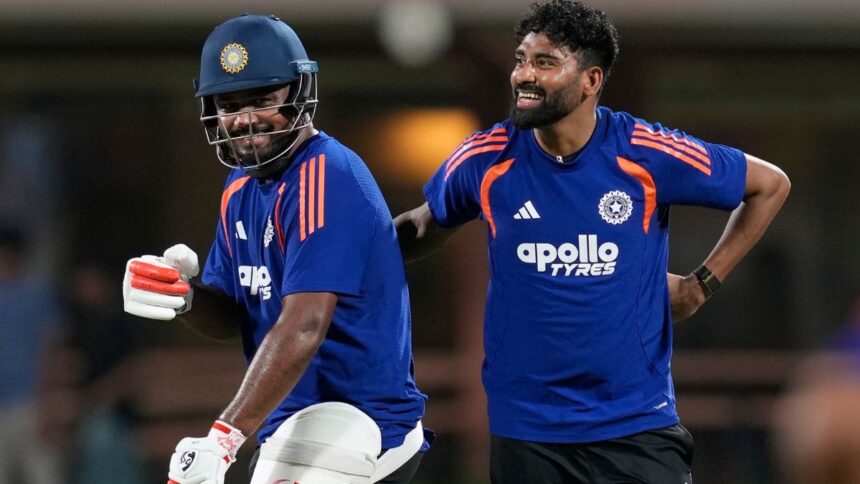
India’s Super 8 campaign in the ICC Men’s T20 World Cup 2026 has reached a decisive juncture, with batting coach Sitanshu Kotak hinting at possible changes to the playing XI, including the return of Sanju Samson, as the team prepares for a must-win encounter against Zimbabwe in Chennai.
After suffering a heavy 76-run defeat to South Africa in their Super 8 opener, India now find themselves under immense pressure. The loss not only cost them valuable points but also severely dented their net run rate, which has plunged to -3.800. With semifinal hopes hanging in the balance, the clash against Zimbabwe at the MA Chidambaram Stadium becomes more than just a group-stage fixture. It is a test of composure, tactical clarity and resilience.
Batting coach Sitanshu Kotak acknowledged during the pre-match press conference that changes to the playing XI remain a possibility. While he refrained from confirming specific alterations, his comments suggested that the team management is actively evaluating combinations, particularly at the top of the order. India’s current top three features multiple left-handers, and opponents have consistently exploited this by deploying off-spin early in the innings. The tactic has yielded early breakthroughs, disrupting India’s momentum in each of their five matches so far.
Kotak admitted that the pattern of early wickets has prompted internal discussions. Although he downplayed the issue as not being inherently problematic, he conceded that recurring early dismissals inevitably lead to tactical reassessment. The potential inclusion of Sanju Samson could provide a right-handed option to counter opposition spin strategies and stabilize the powerplay phase.
Batting concerns and tactical recalibration after South Africa setback
India’s batting collapse against South Africa exposed vulnerabilities that had not been apparent during the team’s dominant bilateral performances prior to the World Cup. Chasing 188, India were bundled out for 111 in 18.5 overs, with three wickets falling inside the powerplay. The highest partnership of the innings was a modest 35-run stand between Hardik Pandya and Shivam Dube, underscoring the absence of sustained partnerships.
Kotak, however, sought to temper concerns. He described the performance as an outlier rather than a systemic failure. According to him, the team’s batting unit has functioned effectively over the past two years, and one low-scoring outing should not trigger overreaction. He emphasized that the coaching staff is not focusing on individual failures but rather on collective improvement.
The opening partnership has been an area of particular scrutiny. Abhishek Sharma and Tilak Varma have struggled to provide explosive starts, and the lack of significant opening stands has placed additional pressure on the middle order. Kotak acknowledged that while openers have not clicked consistently, he is not inclined to stress excessively about short-term fluctuations in form.
Tilak Varma’s performance has drawn attention, with the left-hander scoring 107 runs in five matches at a strike rate of 118.88. Though below expectations for a number three batter in T20 cricket, Kotak defended Tilak’s approach, pointing out that a couple of additional boundaries could significantly alter perceptions of his strike rate. He reiterated that there are no technical issues in Tilak’s batting and cited his composed innings against Pakistan as evidence of his capability.
Abhishek Sharma, who managed only 15 runs against South Africa after breaking a streak of three ducks, also received backing from the coaching staff. Kotak dismissed speculation of deeper concerns, stating that the team’s structure, featuring two all-rounders and six batters, allows flexibility and resilience even when individual players endure lean patches.
The pitch conditions at the Narendra Modi Stadium during the South Africa match had also come under discussion, with some observers attributing India’s struggles to the black soil surface. Kotak rejected this narrative, explaining that slow pitches naturally make batting challenging in T20 cricket. He maintained that collapses cannot be blamed solely on the surface and emphasized that the team has performed reasonably well overall.
Rinku Singh’s return and team morale ahead of crucial clash
In a significant boost to team morale, Rinku Singh is set to rejoin the Indian camp ahead of the Zimbabwe match. The left-hander had briefly returned home after his father was hospitalized due to a serious illness. His absence had raised questions about squad depth and emotional stability within the camp, particularly given the high-pressure scenario India currently face.
Kotak confirmed that Rinku would be back with the squad in time for the must-win fixture. His return not only strengthens India’s batting resources but also restores a sense of normalcy within the dressing room. Rinku has been regarded as a dependable middle-order option capable of accelerating in the death overs, a quality that could prove decisive if India need to chase aggressively to improve their net run rate.
The strategic focus for India now extends beyond securing two points. Given the damaged net run rate, a convincing victory is essential. This may influence in-game tactics, including batting tempo, bowling changes and field placements. If batting first, India could aim for an imposing total to apply scoreboard pressure and enhance NRR. If chasing, they may target a swift finish within a specific over bracket.
Zimbabwe, meanwhile, cannot be underestimated. Despite entering the contest as underdogs, they possess the capability to capitalize on pressure situations. Their bowlers will likely persist with off-spin early on, seeking to exploit India’s left-handed top order. Discipline in line and length, combined with sharp fielding, could test India’s resolve once again.
The atmosphere at the MA Chidambaram Stadium is expected to be electric. Chennai’s crowd has a reputation for passionate yet knowledgeable support, and home conditions could offer India both familiarity and motivation. However, with expectations running high, composure becomes critical. The margin for error has shrunk considerably, and every run, wicket and over could shape India’s semifinal trajectory.
Kotak’s measured tone in the press conference reflected a desire to maintain calm within the camp. Rather than dwelling on the setback against South Africa, the focus remains on forward momentum. The coaching staff appear committed to reinforcing confidence while making necessary tactical tweaks.
As India prepare to face Zimbabwe under the Chennai lights, the narrative is one of recalibration rather than crisis. The possible return of Sanju Samson, the confirmed rejoining of Rinku Singh and the backing of underperforming batters indicate a management group seeking balance between change and continuity. The upcoming match offers an opportunity not only to secure a vital win but also to restore rhythm and belief at a pivotal stage of the tournament.