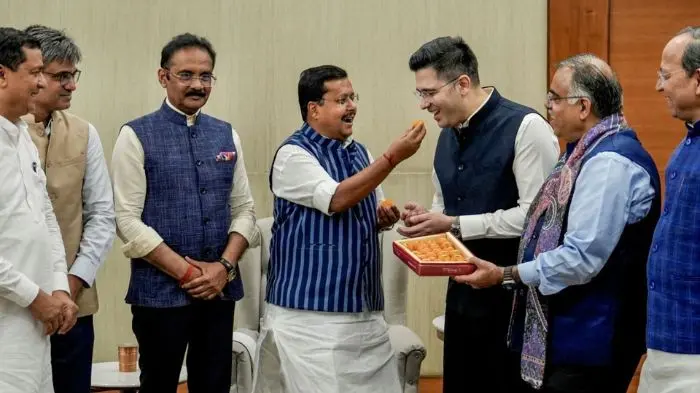
A major political controversy has erupted after Aam Aadmi Party (AAP) leader and Rajya Sabha MP Sanjay Singh formally submitted a petition to Vice President C. P. Radhakrishnan demanding the disqualification of seven Members of Parliament who recently switched allegiance to the Bharatiya Janata Party (BJP). The move has intensified the ongoing political confrontation between AAP and BJP, bringing the issue of party defection and constitutional provisions under sharp focus.
According to Sanjay Singh, the decision of these MPs to leave the Aam Aadmi Party and join the BJP constitutes a clear violation of the anti-defection law. The law, which aims to prevent political instability caused by elected representatives changing parties, provides grounds for disqualification if members voluntarily give up their party membership or defy party directives.
The seven MPs named in the petition include Raghav Chadha, Ashok Mittal, Sandeep Pathak, Harbhajan Singh, Vikramjit Singh Sahni, Swati Maliwal, and Rajendra Gupta. Their decision to join the BJP has not only triggered legal questions but also raised concerns about internal dynamics within the Aam Aadmi Party.
Sanjay Singh stated that the party has consulted several constitutional experts before filing the petition. Among those consulted were senior advocate Kapil Sibal and former Lok Sabha Secretary General P. D. T. Acharya. This consultation indicates that the party is preparing for a legal and constitutional battle over the issue, aiming to ensure that the provisions of the anti-defection law are strictly enforced.
The anti-defection law, introduced through the Tenth Schedule of the Indian Constitution, has been a critical tool in maintaining political discipline. It empowers the presiding officers of legislative bodies to decide on disqualification petitions. In the case of Rajya Sabha members, the Chairman—who is the Vice President of India—plays a crucial role in adjudicating such matters.
The controversy gained further traction with reports that Raghav Chadha experienced a significant drop in his social media following after switching parties. Within 48 hours, his Instagram followers reportedly declined by approximately 19 lakh, reflecting public reaction to the political shift. While social media trends do not determine legal outcomes, they often indicate public sentiment and political perception.
Adding another layer to the controversy, Swati Maliwal, one of the MPs who left AAP, made serious allegations against the party and its leadership, particularly targeting Arvind Kejriwal. She claimed that despite her long association with the party since 2006, she faced mistreatment and was denied opportunities to speak in Parliament. Maliwal also alleged that she was subjected to physical assault and pressure to withdraw a complaint, accusations that have further escalated tensions.
Maliwal described the party leadership as anti-women and accused it of corruption and authoritarian functioning. She also criticized the governance in Punjab, alleging issues such as illegal mining and drug trade. Her statements have added a personal and emotional dimension to the political dispute, making it more complex than a straightforward case of defection.
The reasons cited by the MPs for leaving AAP vary, but a common theme appears to be dissatisfaction with the party’s internal functioning and leadership decisions. For instance, Raghav Chadha reportedly faced criticism within the party for his absence during key political developments, including Arvind Kejriwal’s arrest. His extended stay abroad for medical treatment reportedly strained his relationship with the party leadership.
Sandeep Pathak, who played a significant role in expanding the party’s presence in states like Punjab, Goa, and Gujarat, is said to have been sidelined after electoral setbacks. His responsibilities were reassigned, and he was allegedly excluded from key decision-making processes, leading to discontent.
Ashok Mittal’s grievances reportedly stem from a lack of support during enforcement agency actions against him. Despite holding a significant position in the party, he felt abandoned during a critical period, which contributed to his decision to leave.
Harbhajan Singh, a former cricketer and Rajya Sabha MP, was reportedly not actively involved in party activities and felt disconnected from the organizational structure. Similarly, Vikramjit Singh Sahni and Rajendra Gupta, both prominent industrialists, were said to have felt neglected within the party framework.
These developments highlight internal challenges within AAP, including issues related to leadership, communication, and organizational cohesion. The departure of multiple MPs at once is a significant घटना, raising questions about the party’s stability and future strategy.
From a legal perspective, the outcome of the disqualification petition will depend on the interpretation of the anti-defection law and the evidence presented. The key question will be whether the MPs’ actions constitute voluntary resignation from the party or whether they fall under any exceptions provided by the law.
The Vice President, acting as the Chairman of the Rajya Sabha, will play a निर्णायक role in this process. The decision could set an important precedent for similar cases in the future, influencing how defection laws are applied in practice.
Politically, the issue is likely to have broader implications. It may impact public perception of both AAP and BJP, influence voter sentiment, and shape the narrative around party loyalty and governance. The controversy also comes at a time when political alignments and alliances are undergoing significant changes across the country.
The role of public opinion, as reflected in social media reactions and media coverage, cannot be ignored. While legal proceedings will follow constitutional processes, public perception often influences political outcomes and strategies.
The situation also underscores the importance of internal party democracy and transparent decision-making. Political parties must balance leadership authority with inclusive governance to maintain unity and trust among members.
As the case unfolds, it is expected to attract significant attention from legal experts, political analysts, and the general public. The proceedings will likely involve detailed examination of facts, legal arguments, and constitutional provisions.
In conclusion, the petition filed by Sanjay Singh marks a critical moment in the ongoing political developments involving AAP and BJP. The issue goes beyond individual defections, touching upon fundamental questions of law, governance, and political ethics. The decision taken by the Vice President will not only determine the fate of the seven MPs but also shape the future discourse on anti-defection laws in India.