Prime Minister Narendra Modi ramped up the Bharatiya Janata Party’s (BJP) campaign for the ongoing West Bengal Assembly elections with a high-energy roadshow in north Kolkata and a visit to the historic Thanthania Kalibari temple. The events took place ahead of the crucial second and final phase of polling, scheduled for April 29, and were marked by strong public participation and visible political enthusiasm.
The day began with the Prime Minister offering prayers at Thanthania Kalibari, a revered temple in north Kolkata with a history spanning over 300 years. The visit carried both spiritual and symbolic significance, as political leaders often seek blessings at religious sites during election campaigns. The temple, dedicated to Goddess Kali, is an important cultural and religious landmark in the city and attracts devotees throughout the year.
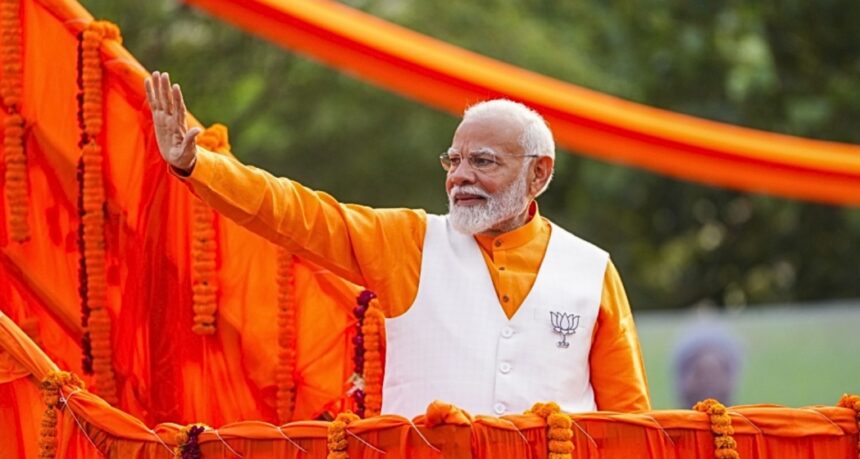
Following the temple visit, Prime Minister Modi took part in a grand roadshow that covered a distance of approximately two kilometers. The procession began at B K Pal Avenue and concluded at Khanna crossing, passing through the historic Sovabazar area. The route was lined with enthusiastic supporters, many of whom gathered hours in advance to catch a glimpse of the Prime Minister.
The atmosphere during the roadshow was charged with slogans and chants such as “Bharat Mata ki Jai,” “Jai Shri Ram,” and the BJP’s campaign slogan in West Bengal, “Paltano darkar, tai BJP sarkar,” which translates to a call for change through a BJP-led government. The slogans echoed across the streets, reflecting the intensity of the election campaign and the high stakes involved.
Prime Minister Modi stood atop a specially designed vehicle decorated with saffron colors, flowers, and symbols of the BJP, including the lotus emblem. Accompanied by West Bengal BJP president Samik Bhattacharya, he greeted the crowd by waving and acknowledging supporters on both sides of the road. The vehicle moved slowly through the packed streets, allowing people to interact and capture the moment on their mobile phones.
The turnout included a diverse cross-section of society, with people from different communities and age groups participating in the event. Many residents watched from balconies and windows, while others stood along the roadside holding banners and placards. The presence of a large number of women among the crowd was also notable, indicating broad-based engagement.
Security arrangements for the roadshow were extensive, involving personnel from the Special Protection Group (SPG), Kolkata Police, and central paramilitary forces. Managing the large crowd posed a significant challenge, as supporters surged forward to get closer to the Prime Minister. Despite the pressure, security personnel ensured that the event proceeded smoothly without any major incidents.
The roadshow is part of a broader campaign strategy by the BJP, which relies heavily on the popularity and outreach of Prime Minister Modi. His presence is often seen as a key factor in energizing party workers and attracting voters. The scale and organization of the event reflected the party’s efforts to make a strong impression ahead of the final phase of polling.
Earlier in the day, the Prime Minister also addressed public rallies in Bangaon and Arambagh. During these rallies, he criticized the ruling Trinamool Congress (TMC) government, alleging issues such as corruption, poor governance, and unfulfilled promises. He claimed that the large turnout at his rallies was an indication of growing support for the BJP and suggested that a political shift in the state was imminent.
The West Bengal Assembly elections are being conducted in two phases, with a total of 294 seats at stake. The first phase, held on April 23, recorded a voter turnout of 93.19 percent, the highest ever in the state’s history. This high participation reflects strong voter engagement and underscores the importance of the elections.
The second and final phase will cover 142 constituencies, making it a निर्णायक stage in determining the outcome. Political parties have intensified their campaigns, deploying top नेताओं and organizing large-scale events to reach voters. The results of the elections will be announced on May 4, drawing nationwide attention.
The significance of Kolkata, particularly north Kolkata, in the electoral landscape cannot be overlooked. The area has a rich political history and is home to several key constituencies. Campaign events in this region are seen as crucial for influencing voter sentiment and building momentum.
The roadshow also highlighted the evolving nature of election campaigns in India, where visual appeal, массов public participation, and direct engagement play a central role. Events like these are designed not only to mobilize supporters but also to create a strong media presence and narrative.
The inclusion of cultural elements, such as the Prime Minister holding a portrait of iconic Bengali actor Uttam Kumar during the roadshow, added a local touch to the campaign. Such gestures are often aimed at connecting with regional sentiments and cultural identity.
The BJP’s campaign in West Bengal has focused on themes of change, development, and governance. By organizing large rallies and roadshows, the party aims to convey its message directly to the जनता and build a strong electoral base.
At the same time, the elections have seen intense competition from other political parties, particularly the ruling TMC. The contest is being closely watched as it reflects broader political dynamics and voter preferences in one of India’s most politically active states.
The role of voters remains central to the democratic process. High turnout in the first phase indicates strong participation, and a similar response is expected in the second phase. The चुनाव results will ultimately determine the direction of governance in the state.
In conclusion, Prime Minister Narendra Modi’s roadshow in Kolkata and his visit to Thanthania Kalibari represent a significant push in the BJP’s election campaign. The events combined religious symbolism, массов outreach, and political messaging to create a strong impact ahead of the final phase of polling. As the state prepares for the decisive round of voting, such high-profile campaigns are likely to play a crucial role in shaping the electoral outcome.