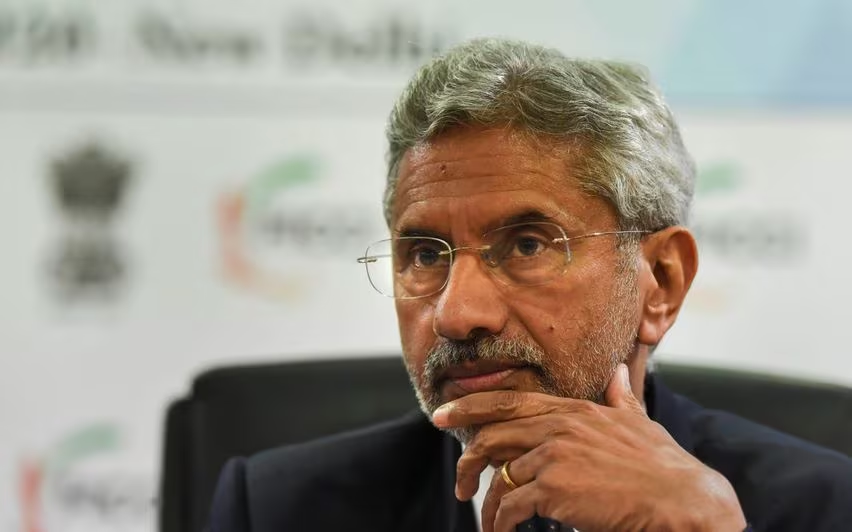
External Affairs Minister (EAM) S Jaishankar emphasized that the United States, under President Donald Trump, is moving towards a multipolar world order that aligns with India’s interests. Speaking at the Chatham House think tank in London, S Jaishankar discussed various aspects of India’s foreign policy, including US-India trade relations, the Quad alliance, and India’s stance on global conflicts.
Addressing a session titled ‘India’s Rise and Role in the World,’ S Jaishankar highlighted the evolving dynamics of the US administration and its impact on global geopolitics. He noted that Donald Trump’s approach to multipolarity resonates with India’s strategic vision and fosters a fair global order where nations contribute equally. According to S Jaishankar, one of the significant areas of convergence between India and the US under Donald Trump is the Quad alliance, which includes the US, India, Japan, and Australia. He described it as a model where all participating nations contribute their fair share without any “free riders,” reinforcing a cooperative global framework.
On trade relations, S Jaishankar acknowledged ongoing discussions regarding tariffs and a potential bilateral trade agreement between India and the US. He pointed out that Commerce and Industry Minister Piyush Goyal is currently in Washington to further negotiations, following a high-level meeting between Prime Minister Narendra Modi and President Donald Trump at the White House. According to S Jaishankar, both nations recognize the need for a comprehensive trade pact that benefits both economies.
The EAM also touched upon India’s negotiations with the UK on the Free Trade Agreement (FTA). He expressed cautious optimism regarding progress, citing recent discussions with British Prime Minister Keir Starmer, Foreign Secretary David Lammy, and Business Secretary Jonathan Reynolds. S Jaishankar acknowledged the complexity of the negotiations but stated that both sides are committed to advancing the talks.
India’s diplomatic role in the Russia-Ukraine conflict was another focal point of the discussion. S Jaishankar reiterated that India has consistently maintained open communication with both Moscow and Kyiv, advocating for direct negotiations as the only viable solution. He reaffirmed India’s willingness to contribute to peace efforts whenever possible.
Regarding China, S Jaishankar pointed out some positive developments since October 2024, including the reopening of the Mount Kailash pilgrimage route in Tibet. He underscored the unique nature of the India-China relationship, emphasizing the need for mutual respect and sensitivity to each other’s interests.
Responding to a question on Kashmir, S Jaishankar outlined India’s approach to restoring stability in the region. He described the revocation of Article 370 as the first step, followed by efforts to boost economic growth, social justice, and democratic participation through elections. He asserted that the final resolution of the Kashmir issue would come when the region under Pakistan’s illegal occupation is rightfully returned to India.
S Jaishankar is scheduled to meet his Irish counterpart, Simon Harris, for further diplomatic talks, continuing India’s active engagement in global affairs.