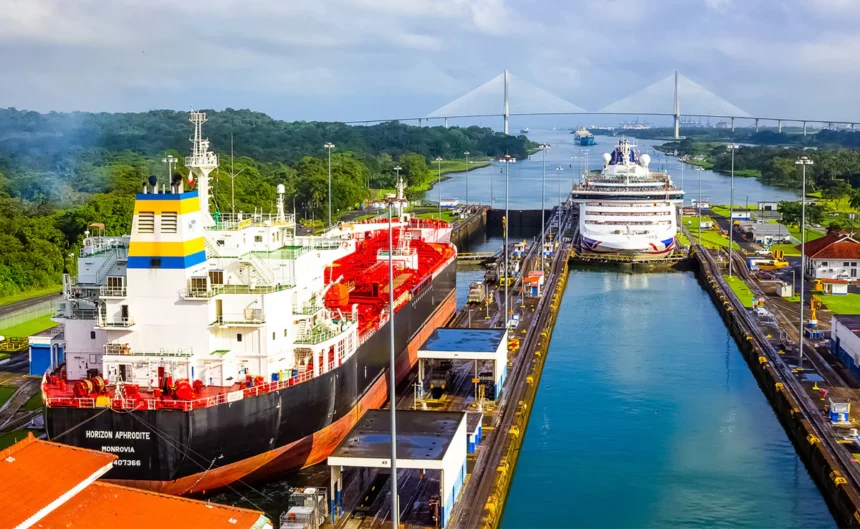
As tensions rise between the United States and Panama regarding the Panama Canal, Louis Sola, the newly appointed head of the Federal Maritime Commission (FMC) under President Donald Trump, has voiced concerns about Panama’s increasing closeness to China and the fairness of business practices surrounding the canal. Louis Sola’s comments come amid a broader dispute over the control of the crucial maritime passage, which has long been a strategic asset for global trade.
Louis Sola, in his first interview since assuming his role as FMC Chairman, highlighted the escalating concerns of American businesses regarding their ability to fairly compete for contracts related to the Panama Canal and its surrounding ports. He criticized Panama’s treatment of American companies, accusing the country of preventing U.S. businesses from bidding fairly. Louis Sola pointed to instances where Chinese companies have received reimbursements for their canal transits, a practice he found particularly troubling, especially since American companies are not afforded the same treatment. “I find the entire practice alarming, that canal tolls would be refunded for any reason whatsoever, especially when Panama has a neutrality contract or neutrality clause in their treaty,” said Louis Sola.
The rising influence of China in the region has been a focal point of U.S. concerns. Louis Sola expressed alarm over the growing ties between Panama and China, noting that the country has moved closer to Beijing in recent years, distancing itself from traditional U.S. alliances. This shift is not limited to diplomatic relations but extends to significant economic engagements, such as the no-bid contracts awarded to Chinese companies to operate ports on either side of the canal. Louis Sola raised concerns over the terms of these contracts, particularly the low payment rates Panama receives for the operation of two crucial ports — the Port of Cristobal and the Port of Balboa — both managed by Hutchison Ports PPC. Sola claimed that these ports, worth billions of dollars, are generating a mere $7 million annually, which he believes is inadequate compensation for such valuable assets.
In addition to the issue of port contracts, the United States has also expressed concerns over Panama’s tolling practices. Donald Trump has accused Panama of charging excessive rates for canal transits, and the U.S. government has warned that it may consider reasserting control over the canal to ensure fair pricing and access for American businesses. The rising tolls have been a point of contention, particularly as they increase the costs of shipping goods through the canal. According to Louis Sola, the U.S. government has been hindered in its ability to support American companies in Panama, as U.S. firms have been increasingly sidelined in favor of Chinese and Brazilian interests. Louis Sola’s comments reflect broader concerns about the United States losing its competitive edge in the region to other global powers.
Amid these concerns, Louis Sola stressed the need for a more transparent bidding process for infrastructure projects in Panama, including a proposed train line linking Panama with Costa Rica. While China and other countries have secured direct contracts for such projects, Louis Sola emphasized that the U.S. also has a vested interest in these developments and should have the opportunity to compete for them on a level playing field.
Louis Sola’s interview also touched upon the U.S. government’s potential responses to perceived unfair practices. He made it clear that the United States is prepared to take action if it deems that Panama is offering unfair advantages to Chinese companies. “If Panama is going to give subsidies to Chinese vessels or ports, we have to see what’s in the best interest of the U.S. shipper and to ship U.S. goods. If that becomes an issue, we do have all options on the table,” Louis Sola warned, referring to the FMC’s authority to impose significant fines on foreign governments and restrict access to U.S. ports for foreign-flagged vessels. The Panama flag, which is the second most commonly registered flag in the world, has been a key point of contention due to its favorable tax and labor policies, which allow companies to operate more cheaply.
While the situation remains tense, Louis Sola suggested that the United States is not entirely opposed to Panama’s sovereignty over the canal. However, he made it clear that the U.S. government wants to ensure that its businesses have a fair opportunity to compete for contracts and that Panama adheres to international standards. He pointed out that the U.S. cannot compete effectively when its companies are hindered by regulations such as the Foreign Corrupt Practices Act, which restricts U.S. firms’ ability to engage in certain business practices that might be considered acceptable in other countries.
Despite the ongoing tensions, Louis Sola expressed optimism about future cooperation between the U.S. and Panama, particularly in light of President José Raúl Mulino’s stance on the issue. Louis Sola noted that Mulino appeared to be a pro-U.S. leader, citing his actions during a recent meeting in Panama, where Mulino broke off relations with Venezuela in response to the political crisis there. “The President of Panama did impress me as we were waiting in his office to meet with him,” Sola said. However, he also pointed out that Panama must address its internal challenges, including rampant corruption, to maintain a stable and competitive relationship with the United States.
As the United States and Panama continue to navigate these complex issues, it remains to be seen how the situation will evolve. With the Panama Canal playing a central role in global shipping and trade, any disruption in its operations could have far-reaching consequences for international commerce. The U.S. is keenly aware of its strategic interests in the region and is prepared to take necessary steps to protect American businesses and ensure a fair playing field for all global competitors. While the tensions between the two countries are palpable, both sides will need to find common ground to avoid further escalation and maintain stability in this vital part of the global trade network.