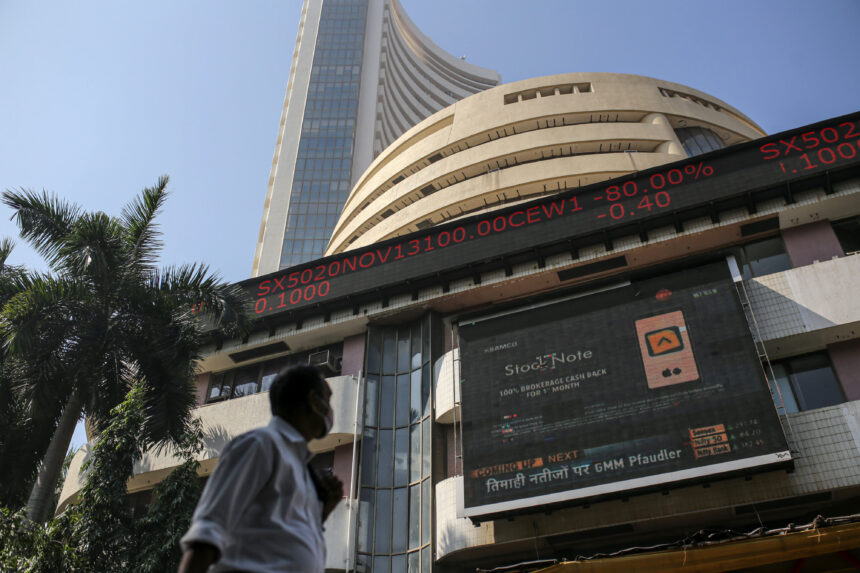
India’s stock market has witnessed a significant downturn since September, with foreign investors increasingly withdrawing from their holdings in response to a slowdown in the country’s economic growth. The withdrawal of foreign capital has been described by analysts as part of a “healthy correction,” following a period of strong market growth. India’s benchmark stock indexes, including the Nifty 50 and Sensex, have dropped to more than seven-month lows, signaling a firm entry into correction territory after a peak in September.
Key sectors such as real estate, energy, and automobiles have been the hardest hit, according to data from Goldman Sachs. This market reversal contrasts sharply with the performance of Indian equities in 2023, when the Nifty 50 frequently hit record highs and outperformed the S&P 500 for much of the year. Experts argue that the correction was inevitable after a period of rapid growth.
Venugopal Garre, the head of India research at AB Bernstein, explained that while the correction may seem sudden, it had been a long time in the making, with the bubble building up gradually over time. He attributed the current gloomy outlook to weak economic growth and sluggish earnings reports, particularly during India’s second fiscal quarter. India’s GDP growth slumped to 5.4% for the quarter ending in September, marking the slowest expansion in seven quarters. The government recently downgraded its full-year economic growth forecast to 6.4%, the lowest in four years.
As a result, analysts from Capital Economics believe that India’s economy has entered a softer phase, which is expected to continue for several more quarters. The firm predicts that this slowdown could lead to underperformance in Indian equities compared to other major global benchmarks. HSBC also downgraded its rating for Indian equities to “neutral” earlier this month and revised its earnings growth forecast for the Nifty 50 down to 5% for fiscal year 2025, a significant decrease from the previous projection of 15%.
Foreign investors have been net sellers of Indian equities over the past several months. According to data from the National Securities Depository, foreign portfolio investment (FPI) flows into Indian stocks have plunged by 99%, totaling just $124 million in 2024, compared to the previous year. The outflows have become more pronounced in recent weeks, with about $8.3 billion withdrawn from Indian equities by foreign investors as of January 28. Analysts suggest that foreign investors are rotating out of India and other emerging markets, opting instead to invest in US equities, which are perceived to offer safer returns.
The exodus of foreign funds comes at a time when US Treasury yields have been rising, leading to greater demand for bonds over stocks. This has compounded the situation for India’s equity market, as the rising yields have drawn investments away from the stock market. Profit booking by foreign institutional investors (FIIs) has also added to the pressure on the Indian stock market. Nilesh Shah, the managing director of Kotak Mahindra Asset Management, pointed out that long periods of strong market performance often lead to profit booking, which results in increased supply and lower stock prices, further contributing to the ongoing correction.
While foreign investors are pulling out, domestic investors have been pouring money into Indian equities. According to data from Manulife, domestic investors have invested around $27 billion into Indian equities since October. This influx of local capital has helped prevent a more severe decline in the stock market. However, Praveen Jagwani, CEO of UTI International, pointed out that the rapid increase in domestic investors, particularly retail investors, has led to inflated stock valuations. He believes that the market may be experiencing a “mini-bubble” and that a healthy pullback is necessary for sustainable long-term growth.
Despite the short-term challenges, some analysts are optimistic about the long-term potential of India’s equity markets. Pramod Gubbi, co-founder of Marcellus Investment Managers, believes that the ongoing market correction is a natural and healthy phase following a period of exceptional returns post-Covid. He suggests that the current sell-off could attract new investors, who had previously been hesitant due to high valuations. Similarly, Jagwani from UTI International stated that the correction is a “healthy mean reversion” after an unusually strong run in 2023 and 2024.
While foreign investors may remain cautious in the short term, there are opportunities in India for long-term investors. James Thom, senior investment director at Abrdn, emphasized that despite the recent market pullback, India presents “great opportunity” in the long run, particularly in sectors like domestic IT and private banking. Kotak Mahindra’s Shah also reassured investors, stating that the current correction is more likely to be a “speculator’s nightmare” than an investor’s concern, as long-term fundamentals remain strong.
Although India’s stock market is experiencing a temporary slowdown, driven by foreign capital outflows and weaker-than-expected economic performance, analysts remain bullish on the country’s long-term growth prospects. The ongoing correction may present an opportunity for new investors to enter the market, and as valuations become more reasonable, India’s equity markets could rebound, making the country an attractive destination for investment once again.