The Indian Air Force’s ‘Operation Safed Sagar’ marked a historic moment in India’s military history during the 1999 Kargil war. As the nation recalls the bravery and strategic importance of this operation, it’s important to recognize how the IAF, in coordination with the Indian Army, executed high-altitude air strikes against entrenched enemy forces along the Line of Control (LoC). This operation not only helped turn the tide of the conflict in India’s favor but also showcased the IAF’s ability to conduct precision strikes in challenging mountainous terrain, setting new benchmarks for military aviation in India.
A Bold Military Strategy in High-Altitude Warfare
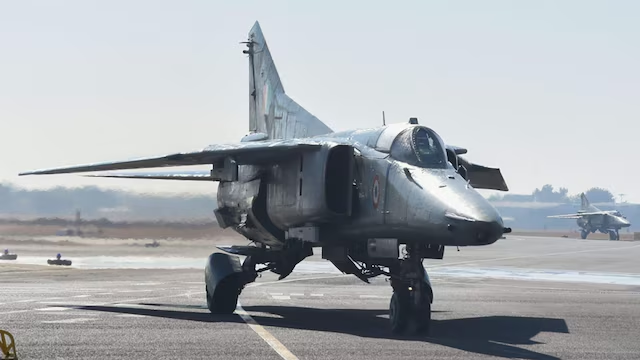
Operation Safed Sagar was launched as a direct response to Pakistani intrusions into Indian territory in the Kargil sector. Approved by the Cabinet Committee on Security on May 25, 1999, the mission authorized the Indian Air Force to strike infiltrators without crossing the LoC. This was the first significant use of air power in Jammu and Kashmir since the 1971 war. The operation involved a variety of aircraft, including MiG-21, MiG-27ML, MiG-23BN fighter jets, Mirage 2000s, Jaguars, and Mi-17 helicopters. These aircraft were deployed to attack enemy positions and supply routes with precision. Despite facing setbacks such as the loss of two aircraft early in the campaign and the capture of a MiG-27 pilot, the IAF adapted its strategies to continue its vital support for ground forces.
Trailblazing Impact and Tactical Innovation
Operation Safed Sagar proved to be a trailblazer in many aspects. It was one of the earliest examples of air power being used effectively in a localized, low-intensity conflict without escalating into a full-scale war. The operation demonstrated how air strikes could be calibrated to deliver maximum impact while maintaining strategic restraint. Modified and armed Mi-17 helicopters played a critical role in neutralizing enemy posts, working closely with the Indian Army to regain control over the rugged terrain. The operation’s success underscored the value of joint forces coordination and showcased the IAF’s versatility and resolve in hostile conditions. These lessons would prove crucial in shaping future military operations, including recent missions like Operation Sindoor.
The 1999 Kargil war itself began when Pakistani forces crossed the LoC under the cover of Operation Badr, aiming to seize strategic heights and cut off connectivity between Srinagar and Leh. India’s swift and coordinated response, including the launch of Operation Vijay, eventually reclaimed all occupied positions by late July 1999, concluding the conflict with Pakistan withdrawing its troops under international pressure. Operation Safed Sagar remains a defining chapter in India’s defense history, symbolizing courage, innovation, and strategic mastery.