A routine Monday evening in Delhi turned into a scene of devastation when a white Hyundai i20 exploded on Netaji Subhash Marg, near the historic Red Fort, claiming thirteen lives — including all three occupants of the car. The explosion, which took place near one of the Capital’s busiest areas, has now triggered a large-scale investigation involving multiple national security agencies. Preliminary findings suggest that the car, which bore a Haryana registration number, had been parked for nearly two hours in the Sunehri Masjid parking lot before the fatal blast occurred.
The incident, which occurred in the heart of Old Delhi, has raised significant questions about urban security, vehicle monitoring, and possible lapses in surveillance. Investigators are now piecing together the vehicle’s movements, ownership trail, and the potential motive behind the tragedy that shattered the evening calm near one of India’s most iconic monuments.
The Car’s Final Route: Two Hours Before Tragedy Struck
Investigators, relying heavily on CCTV footage from multiple locations around Daryaganj, Red Fort, and Old Delhi Railway Station, have reconstructed the Hyundai i20’s movements on the day of the blast. According to sources familiar with the probe, the footage reveals that the car entered Daryaganj Market at around 4 p.m. before making its way towards the Sunehri Masjid parking lot, situated a short distance from the Red Fort’s main gate.
The three occupants inside the vehicle appeared to be calm, and nothing about the car’s movements initially aroused suspicion. Witnesses later told police that the white i20 remained parked at the lot for nearly two hours. Around 5:50 p.m., CCTV footage captured the car exiting the parking area, driving slowly through the narrow lanes before taking a U-turn near Old Delhi Railway Station. Moments later, it headed towards Lower Subhash Marg, one of the arterial roads connecting Red Fort with the rest of the city.
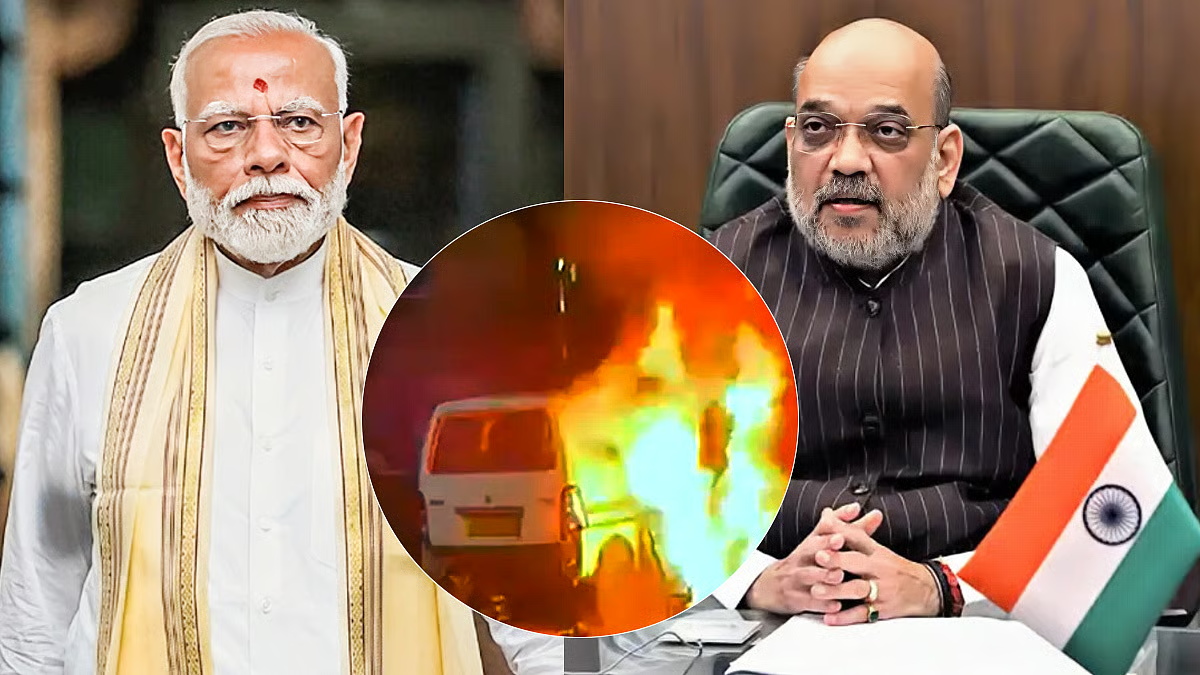
At approximately 6:05 p.m., the car approached a red traffic light on Chhata Rail Chowk stretch. The footage reviewed by investigators shows the car halting momentarily at the signal. Seconds later, a powerful explosion ripped through the vehicle, engulfing it in flames. The blast’s shockwave shattered nearby shop windows and caused chaos among motorists and pedestrians. Several vehicles in the vicinity were damaged, while passersby were thrown off balance due to the force of the explosion.
Eyewitnesses recall hearing a loud explosion followed by cries for help. Within minutes, the area was blanketed in thick smoke. Police, fire, and ambulance units rushed to the scene as terrified bystanders tried to pull victims from the burning car. Unfortunately, all three occupants inside were found dead. Preliminary forensic examination revealed that the explosion originated within the vehicle, though the exact cause — whether mechanical, chemical, or deliberate — remains under investigation.
“The footage shows the car slowing down at a signal when the explosion occurred,” said an officer associated with the investigation. “The nature of the blast suggests that it was powerful enough to kill all occupants instantly.”
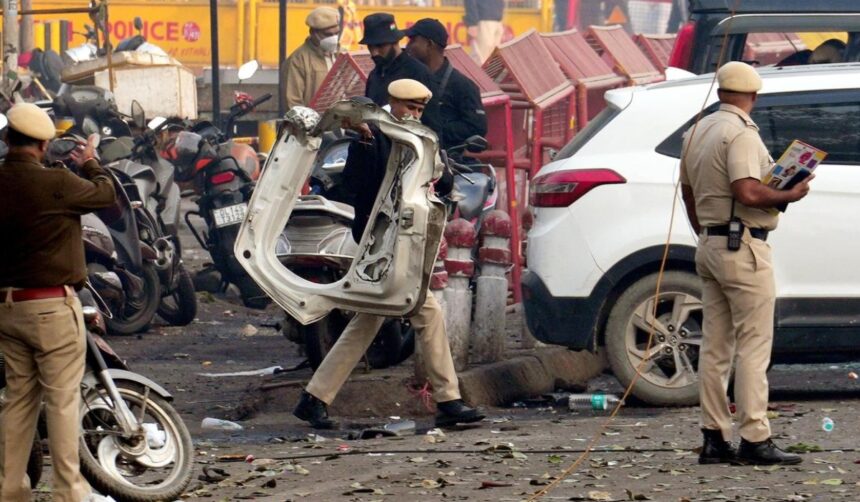
Investigators have since collected fragments from the car’s remains and are examining them for traces of explosives, accelerants, or mechanical defects. Sources said that while there is no immediate evidence of a terror link, the magnitude of the blast has led to the involvement of specialized agencies to ensure a comprehensive probe.
Complicated Ownership Trail: Car Changed Hands Several Times
The car’s registration details have presented yet another challenge for investigators. According to official records, the white Hyundai i20 carried a Haryana registration number — HR26CE7674 — and was first registered in 2014 to a Gurugram resident named Mohd Salman. Over the years, however, the car had changed hands multiple times, making it difficult to establish who the final owner was at the time of the explosion.
“Salman sold it to a man named Devender, who then sold it to someone in Ambala,” an investigator revealed. “The registered owner has been detained in Delhi, but the car appears to have been resold two to three times without proper transfer of ownership. We are still tracing the most recent buyer.”
A copy of the registration certificate (RC) accessed by investigators confirmed the initial ownership details. Following this discovery, Ambala Police have launched a parallel inquiry to identify the chain of transactions involving the car. Gurugram Police are also assisting Delhi Police and the NIA in gathering details from the Regional Transport Office (RTO) and cross-verifying the names of potential intermediaries involved in the sales.
Officials believe that the vehicle’s multiple resales may have provided an opportunity for someone to use it anonymously, complicating the investigation further. One senior Delhi Police officer noted that it is common for older vehicles to change hands informally in smaller towns, often without updating official registration records, making it easier for bad actors to exploit such loopholes.
Teams are now examining digital payment records, call data, and any communication between the former owners to determine how the car ended up in Delhi on the day of the blast. Investigators have also detained several individuals for questioning, including those who may have facilitated the car’s sale.
“The fact that the car changed ownership so many times has made this case particularly challenging,” another officer said. “We are exploring all possibilities — from a mechanical malfunction to a deliberate act — and nothing is being ruled out at this stage.”
Multi-Agency Probe and Heightened Security Across the Capital
Following the explosion, the Ministry of Home Affairs immediately ordered a multi-agency investigation. Union Home Minister Amit Shah addressed the media late Monday evening, assuring citizens that every possible angle was being examined. The probe now includes the National Investigation Agency (NIA), the Intelligence Bureau (IB), Delhi Police’s Special Cell, and the Anti-Terror Unit.
“A comprehensive probe is underway, taking all angles into account. The findings will be shared with the public as soon as possible,” Shah said. He added that the government was not treating the case as an isolated incident until all evidence was analyzed.
The involvement of multiple agencies indicates the seriousness with which the government views the incident. Teams from the NIA have already collected samples from the blast site and are working alongside Delhi Police’s forensic experts to determine whether any explosive substance was present in the car. Meanwhile, the Intelligence Bureau is analyzing inputs from its surveillance networks to identify any prior threats or suspicious activity in the area.
In the aftermath of the blast, security measures across the national capital were significantly strengthened. Additional personnel from the Central Industrial Security Force (CISF) and Delhi Police were deployed at high-security zones including metro stations, government buildings, and airports. Random vehicle checks were intensified, especially near the Red Fort, India Gate, and Connaught Place, to reassure the public and deter any further attempts at disruption.
Authorities also temporarily shut down Gates 1 and 4 of the Lal Qila Metro Station on the Violet Line, both located near the site of the explosion, to facilitate the investigation and prevent civilian movement through the area. Metro services on the line resumed only after forensic teams completed their on-site analysis.
A senior police official said that sniffer dogs, bomb disposal squads, and forensic experts combed through every inch of the site, recovering crucial fragments believed to belong to the vehicle’s undercarriage. “We are treating this with utmost seriousness. Nothing is being left to chance,” he added.
Sources have confirmed that police are also examining whether the car’s movements were tracked by any automatic number plate recognition (ANPR) systems in Delhi, which could provide further clarity about its route before the explosion. Additionally, investigators are scrutinizing CCTV footage from fuel stations and toll plazas to determine if the car had traveled from another state.
Meanwhile, eyewitnesses continue to be questioned. Some recalled seeing three men inside the car earlier in the day, but none could identify them clearly. Investigators are now attempting to match faces from CCTV footage with available records from local databases.
The magnitude of the blast has sparked concern among residents and commuters who frequent the area. The Red Fort, being one of Delhi’s most visited landmarks, attracts thousands of tourists daily, and the proximity of the explosion has underscored the urgent need for tighter surveillance and more robust parking regulations near heritage sites.
As investigators piece together the complex puzzle of ownership, movement, and motive, Delhi remains on high alert. Security personnel continue to monitor key zones, while forensic labs work around the clock to uncover what exactly triggered the blast that turned an ordinary evening into a national tragedy.