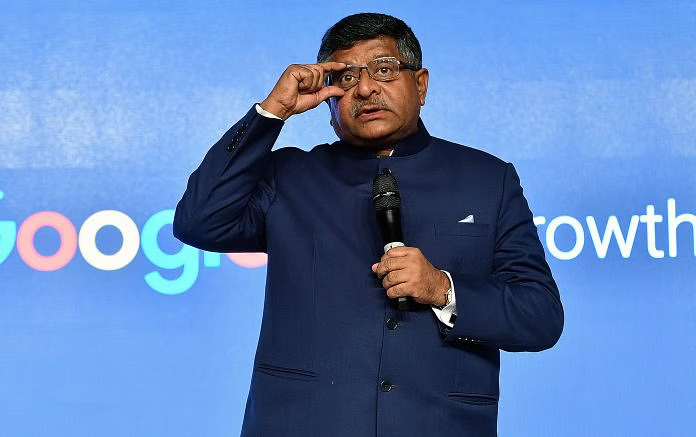
BJP leader and Member of Parliament Ravi Shankar Prasad, who is currently in the United Kingdom leading an all-party delegation, strongly criticized Pakistan’s governance, calling it a military-controlled state with no democratic accountability. Addressing the Indian community in London, he emphasized India’s firm stance against terrorism, detailed the success of Operation Sindoor, and drew attention to the role of Pakistan’s armed forces in fostering extremism. His speech painted a stark picture of Pakistan’s internal politics and military dominance, while underlining India’s evolving military posture and global messaging.
“Pakistan is Not a Democracy”
Speaking in London, Prasad said Pakistan is far from being a democracy and likened it to a military-run shop established by Muhammad Ali Jinnah. He highlighted how power in Pakistan has historically remained in the hands of unelected generals like Ayub Khan, Yahya Khan, Zia-ul-Haq, Musharraf, and now General Asim Munir—who, despite being “defeated in the field,” was promoted to Field Marshal. According to Prasad, Pakistan’s military has long overpowered civil leadership and functions without public accountability.
He also recounted India’s swift and targeted response to the April 22 terror attack in Pahalgam that killed 26 civilians. On May 7, under Operation Sindoor, the Indian Armed Forces launched precise strikes on terrorist camps in Bahawalpur, Muridke, Muzaffarabad, and other areas within Pakistan and Pakistan-occupied Kashmir. Prasad clarified that only terror infrastructure was targeted, and no civilian lives were lost.
Highlighting Global Terror Links
Ravi Shankar Prasad reminded the audience of Pakistan’s deep-rooted links with international terrorism. He pointed to Osama bin Laden being found in Pakistan and mentioned that Indian missiles had recently killed several terrorists involved in attacks on India, including the hijackers of IC-814 and relatives of Jaish-e-Mohammed chief Masood Azhar. He also spoke of the brutal killings in the Pahalgam attack, including that of a honeymooning couple, stressing the barbarity of the terrorists.
He emphasized that India has always responded, never initiated, conflict—be it in the wars of 1948, 1965, 1971, or Kargil. Despite multiple Indian leaders, including Prime Ministers from Nehru to Modi, trying to foster peaceful dialogue, Pakistan’s response has been consistent terrorism. Recalling PM Modi’s outreach to Nawaz Sharif in 2014, Prasad cited incidents like Uri and Pulwama as turning points that reshaped India’s security approach.