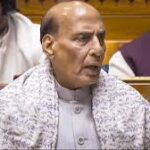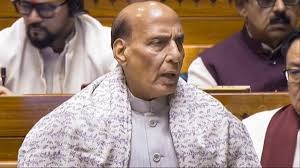
The heated exchange between Defence Minister Rajnath Singh and Opposition MPs during a special Lok Sabha discussion on the 150th anniversary of Vande Mataram has drawn widespread attention, reflecting heightened political friction inside Parliament. While addressing the House on the cultural and historical significance of the iconic national song, Singh faced repeated interruptions from Opposition members, prompting a visibly stern response that quickly went viral across social media platforms. The episode not only showcased the intensity of debates within the Lok Sabha but also underscored the sensitivity surrounding national symbols and the political interpretations attached to them.
A Charged Lok Sabha Moment as Rajnath Singh Responds Firmly to Opposition Interruptions
Defence Minister Rajnath Singh, known for his composed demeanour, momentarily lost his cool on Monday when Opposition MPs interrupted his speech during the commemorative discussion on Vande Mataram. The minister had only begun elaborating on the patriotic relevance of the song when several Opposition members reportedly urged him to “sit down,” objecting to the direction his remarks were taking. This unexpected interjection triggered a sharp response from Singh, whose firm voice echoed across the House.
A widely shared video of the incident captured the tense exchange as Singh, visibly frustrated by the interruptions, directly confronted the MPs. He repeatedly asked, “Kaun baithanewala hai? Kaun baithayega?”—translated as “Who is going to make me sit? Who will make me sit?” His tone reflected both defiance and indignation at what he perceived as an attempt to undermine his right to speak as a senior minister of the Union government.
The tension escalated as he added another pointed remark: “What are you even saying… sit down,” directing his words towards members who had challenged him. Several BJP MPs immediately stood in his support, raising their voices to question how Opposition lawmakers could ask a minister to halt his speech midway. Members of the treasury benches expressed strong disapproval of the interruptions, arguing that parliamentary norms required respectful attention when a minister was presenting remarks of national importance.
Singh eventually turned to the Speaker, Om Birla, for intervention. The Speaker signalled to Opposition MPs to maintain order in the House, urging them to allow the minister to continue. The moment highlighted the frequent disruptions that have characterised several recent Lok Sabha sessions, where ideological divides and political disagreements have often overshadowed the decorum expected during parliamentary proceedings.
Even as calm was gradually restored, the incident left a strong imprint on parliamentary watchers, marking yet another instance in which political tensions erupted over issues connected to national heritage, identity and historical memory.
The clip circulated online almost instantly, prompting contrasting reactions. Supporters of the Defence Minister praised his assertiveness and accused the Opposition of deliberately provoking disruption. Critics, meanwhile, argued that heated responses from ministers weaken parliamentary discipline and fuel unnecessary confrontation. The incident continued to dominate political discussions throughout the day, with commentators debating the broader implications of rising friction inside the Lok Sabha.
Vande Mataram Anniversary Reflection: Historical Context, Political Interpretations and Singh’s Strong Accusations
Before the confrontation erupted, Rajnath Singh had been delivering a detailed address on the 150-year legacy of Vande Mataram, the song that emerged during India’s early freedom movement as a rallying cry for unity, resistance and patriotism. Singh described it as “the immortal song of our nation,” emphasising that its influence has endured across generations and historical periods.
According to the minister, Vande Mataram was never merely a composition but a powerful emotional and cultural force that shaped collective consciousness during India’s struggle against colonial rule. He asserted that the song had inspired countless individuals and communities, lending courage and ideological strength to movements that later became foundational to India’s path toward independence.
Singh further referenced the first Indian flag designed in 1906, which carried the words Vande Mataram at its centre. He also mentioned a newspaper published under the same name in Bengal that served to spread nationalist thought and unite citizens during a time of pressing political transformation. These references underscored the enduring symbolic value of the song, which continues to hold deep significance within India’s cultural memory.
The minister argued, however, that political attempts had been made over time to dilute or undermine the spirit of the song. He accused the Congress party of practising a form of politics that, in his view, weakened the cultural and national unity associated with Vande Mataram. According to Singh, such political approaches contributed to divisions that ultimately shaped the trajectory leading to the Partition of India.
He spoke emphatically about the responsibility of younger generations to understand both the emotional resonance and historical context of Vande Mataram. According to Singh, any attempt to question or diminish the legacy of the song constitutes an injustice to India’s identity as a nation grounded in unity, sacrifice and shared cultural values.
Singh stressed that, under Prime Minister Narendra Modi’s leadership, the 150th anniversary of Vande Mataram would be honoured with the dignity, respect and historical recognition it deserved. He reiterated that the song represents a profound and unbreakable connection between the past and the present, one that continues to define India’s sense of collective belonging.
The Defence Minister’s speech, though interrupted, was intended to convey the message that Vande Mataram remains deeply embedded in India’s national fabric. He highlighted that the song’s legacy extends beyond geographical borders, inspiring individuals across diverse regions and communities, symbolic of India’s enduring resilience and unity. To Singh, anything that attempts to diminish its relevance contradicts the very essence of India’s cultural and historical strength.
As tensions from the earlier confrontation lingered, Singh’s concluding remarks on the symbolic weight of Vande Mataram continued to resonate through the House. Even as political disagreements intensified, the minister’s message reflected a broader narrative regarding patriotism, heritage and the responsibility to uphold historical truths in contemporary political discourse.