Congress leader Rahul Gandhi has reignited a political debate by comparing former prime minister Indira Gandhi’s leadership during the 1971 war with Prime Minister Narendra Modi’s handling of the United States, following recent remarks by former US president Donald Trump.
Rahul Gandhi’s remarks and the historical comparison with 1971
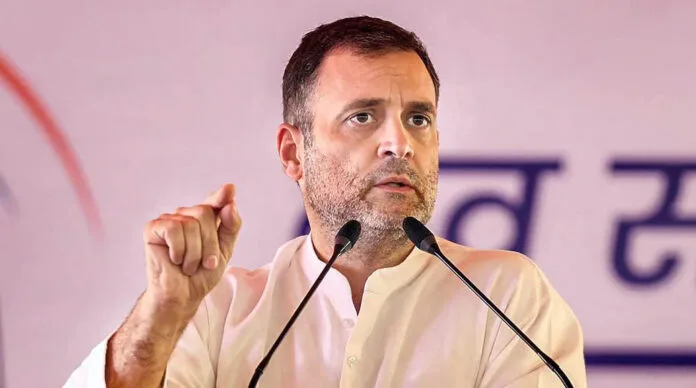
On Wednesday, Rahul Gandhi, the Leader of Opposition in the Lok Sabha, shared a video of his earlier statement delivered in Bhopal on June 3, posting it on X with the caption “Understand the difference, sir.” In the video, Rahul Gandhi draws a sharp contrast between the leadership style of Indira Gandhi and that of Narendra Modi, framing the comparison around India’s response to external pressure.
Referring to the events of the 1971 India–Pakistan war, Rahul recalled a period when India faced intense geopolitical pressure from the United States. He spoke about the arrival of the US Seventh Fleet in the Bay of Bengal, the movement of warships, and the broader atmosphere of coercion that surrounded India during the conflict that ultimately led to the creation of Bangladesh. According to Rahul, Indira Gandhi remained resolute despite these pressures, choosing to pursue what she believed was in India’s national interest rather than yielding to foreign influence.
In his remarks, Rahul stated that Indira Gandhi’s response was rooted in decisiveness and political courage. He quoted her as effectively saying that she would do what was necessary for the country, regardless of the external pressure being exerted. This, he argued, demonstrated a form of leadership that placed national sovereignty and strategic autonomy above diplomatic intimidation.
Rahul then shifted the focus to the present, alleging that Prime Minister Modi reacts very differently when confronted with pressure from Washington. He claimed that even limited pressure is enough to make Modi “surrender,” a charge aimed at portraying the current leadership as hesitant and overly accommodating in its dealings with powerful foreign governments. Rahul further extended his criticism to the ruling establishment, saying that figures associated with the BJP and the RSS retreat when challenged firmly, a remark intended to underline what he described as a lack of resolve.
The video and the accompanying remarks quickly gained traction on social media, adding fuel to an already heated political discourse. Supporters of the Congress party amplified Rahul’s comparison as an assertion of India’s past diplomatic strength, while critics dismissed it as selective interpretation of history designed to score political points. The reference to 1971, a defining moment in India’s modern history, ensured that the comments resonated beyond routine partisan debate.
Trump’s comments, Congress response, and the broader political context
Rahul Gandhi’s remarks came a day after comments by Donald Trump, in which Trump claimed that Prime Minister Modi had personally approached him requesting a meeting. Trump said Modi told him, “Sir, may I meet you?” and added that Modi was unhappy with Washington’s decision to impose a 50 percent tariff on India over its purchase of Russian oil. Trump, however, did not specify when or where this exchange allegedly took place, leaving the details vague and open to interpretation.
Trump’s comments immediately sparked reactions across India’s political spectrum. For the opposition, they provided an opening to question the government’s handling of foreign policy and its relationship with the United States. Rahul Gandhi seized on these remarks to argue that India’s stature on the global stage has diminished, contrasting what he described as Modi’s deference with Indira Gandhi’s defiance during a far more challenging international environment.
The Congress party moved swiftly to amplify this narrative. On Tuesday, it shared an AI-generated video on social media platforms showing an animated interaction between Trump and Modi. The video, which ran for 43 seconds, was accompanied by a caption suggesting that the country was paying the price for what the party described as Modi’s fear. The video was widely circulated, drawing both criticism and support, and adding a visual dimension to the opposition’s attack.
Trump’s remarks also included references to long-standing defence dealings between India and the United States. He spoke about India’s interest in Apache helicopters and claimed that Washington was “changing that,” even as India has already placed orders for 68 Apache helicopters. These statements further complicated the narrative, as they touched on defence cooperation that successive Indian governments have pursued as part of a broader strategic partnership with the US.
The political fallout has been most visible in New Delhi, where leaders from both the ruling and opposition camps have traded accusations over India’s global standing. The ruling party has dismissed Rahul Gandhi’s comments as misleading and argued that India’s foreign policy under Modi has been assertive, pragmatic, and focused on safeguarding national interests in a complex multipolar world. Government supporters have pointed to India’s expanding diplomatic footprint, strategic partnerships, and economic negotiations as evidence of strength rather than submission.
For the Congress, however, the comparison with Indira Gandhi serves a dual purpose. It invokes a legacy of strong leadership associated with the party while questioning the present government’s approach to diplomacy. By anchoring the argument in a historic moment like the 1971 war, Rahul Gandhi has sought to frame the debate in terms of courage, sovereignty, and national pride, themes that resonate deeply with the Indian electorate.
The exchange has once again highlighted how foreign policy statements by international leaders can quickly become domestic political flashpoints in India. Trump’s offhand remarks, combined with Rahul Gandhi’s pointed comparison, have turned questions of diplomacy, leadership style, and historical legacy into central issues of political debate. As reactions continue to unfold, the episode underscores the enduring power of history in shaping contemporary political narratives and the intense scrutiny faced by leaders when global and domestic politics intersect.