As Delhi continues to suffocate under a blanket of dense smog, the national capital’s pollution crisis has once again erupted into a fierce political confrontation. Congress leader Rahul Gandhi has launched a scathing attack on the Bharatiya Janata Party (BJP), accusing the ruling party of repeatedly shifting blame for the worsening air quality while offering no real solutions. The BJP swiftly retaliated, dismissing Gandhi’s remarks and turning the blame back on the Congress and the Aam Aadmi Party (AAP) for their decades-long governance failures in Delhi.
Political war of words over Delhi’s pollution crisis
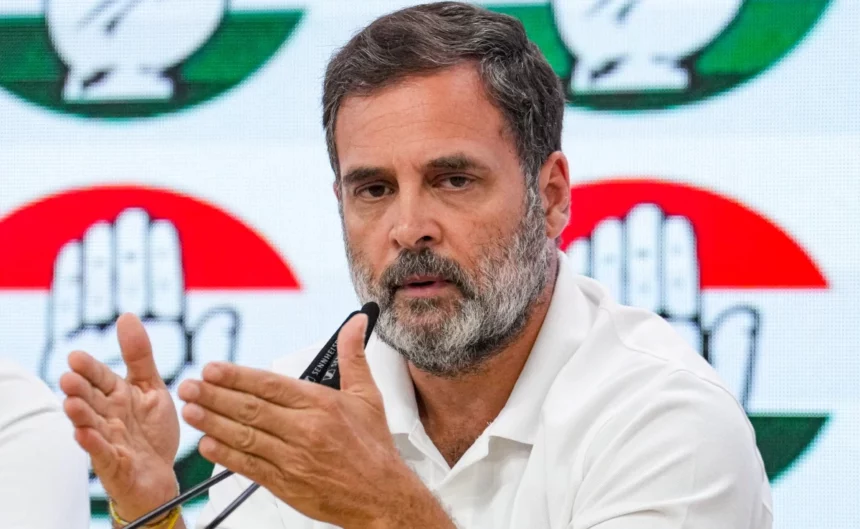
In a sharp post on social media, Rahul Gandhi criticised the BJP for what he described as its pattern of “changing excuses every year” as Delhi’s air quality continues to deteriorate. Gandhi wrote, “Year after year, Delhi’s air is turning more poisonous, yet BJP governments keep changing their excuses. Now that the BJP rules both at the Centre and in Delhi, there can be no more excuses. People want clean air, not just promises.”
The Congress leader’s statement came at a time when Delhi’s air quality has plunged into the “very poor” category, causing widespread health concerns. His comments not only targeted the BJP-led central government but also indirectly took aim at the party’s growing influence in Delhi after its recent electoral gains. Gandhi’s remarks sought to hold the BJP accountable for the worsening environmental conditions, demanding that the party move beyond rhetoric and deliver concrete action.
The response from the BJP was immediate and combative. Delhi Environment Minister Manjinder Singh Sirsa accused both the Congress and AAP of being the real culprits behind the city’s long-standing pollution problem. “Fifteen years of Congress government and ten years of AAP government are responsible for the pollution situation in Delhi. In the last ten years, the cleanest air quality has been recorded this year, under the BJP government,” Sirsa stated.
Sirsa’s counterattack was aimed at reframing the debate, highlighting that the BJP has only recently taken administrative control and that its policies are beginning to show results. He pointed out that pollution in Delhi has multiple causes, many of which, he argued, were neglected or worsened under previous administrations.
The war of words between the two parties underscores how Delhi’s pollution has become more than an environmental issue—it has evolved into a political flashpoint. Every year, as smog engulfs the city, political leaders trade accusations instead of collaborating on sustainable solutions. Gandhi’s statement, which touched a nerve in the BJP, reflects the Congress’s attempt to corner the ruling party on an issue that directly impacts millions of citizens. Meanwhile, the BJP’s sharp rebuttal highlights its strategy of deflecting blame and positioning itself as a corrective force to what it claims are years of environmental mismanagement by its predecessors.
Delhi’s worsening air quality and the recurring blame game
The exchange between Gandhi and Sirsa comes amid alarming data from the Central Pollution Control Board (CPCB). As of 7 a.m. Monday morning, Delhi’s overall Air Quality Index (AQI) was recorded at 309, placing it in the “very poor” category. Areas such as Alipur, Anand Vihar, Burari, and Wazirpur saw AQI levels soar beyond 400, pushing them into the “severe” category—where prolonged exposure can have serious health consequences.
According to CPCB standards, an AQI reading between 0 and 50 is considered “good,” 51–100 “satisfactory,” 101–200 “moderate,” 201–300 “poor,” 301–400 “very poor,” and 401–500 “severe.” The current figures reflect a consistent trend of worsening air during the winter months, when low temperatures and stagnant winds trap pollutants close to the ground.
Experts attribute Delhi’s air pollution to a mix of local and regional factors—vehicle emissions, construction dust, industrial activities, and stubble burning in neighbouring states such as Punjab and Haryana. Despite decades of public concern and court directives, the capital continues to struggle with smog each winter, leaving its residents exposed to hazardous air that causes respiratory illnesses, eye irritation, and cardiovascular problems.
Environmental scientists and policy experts have repeatedly stressed that Delhi’s pollution cannot be mitigated by political blame games or short-term measures such as odd-even road rationing schemes. They argue that the capital’s pollution crisis requires structural reforms, long-term coordination between central and state governments, and an integrated air quality management plan that addresses both urban emissions and regional agricultural practices.
However, as has often been the case, the public discourse surrounding air pollution tends to turn political rather than scientific. The ongoing spat between Gandhi and Sirsa mirrors a recurring pattern in which political leaders focus more on assigning blame than on implementing lasting solutions. Every winter, as the haze thickens, so do the political accusations, leaving citizens frustrated and health experts exasperated.
Despite the BJP’s claims that the air quality this year has shown some improvement, the data paints a more complex picture. Temporary dips in AQI readings are often attributed to weather fluctuations rather than policy effectiveness. Moreover, even a slight improvement from “severe” to “very poor” still leaves Delhi’s air far above permissible pollution limits.
Rahul Gandhi’s remarks resonate with many Delhi residents who have grown weary of the annual cycle of excuses. His assertion that “people want clean air, not just promises” captures the growing public disillusionment with all political parties that have governed Delhi in various capacities over the years. For citizens, the debate over who is to blame has become secondary to the urgent question of when they will be able to breathe clean air again.
For its part, the BJP maintains that it is actively addressing the pollution problem through stricter emissions standards, investments in cleaner technologies, and greater enforcement against industrial and vehicular polluters. Sirsa’s comments highlight the party’s attempt to position itself as a reform-oriented force committed to long-term environmental health, even as opposition voices accuse it of complacency.
The political tension surrounding Delhi’s air crisis also reflects broader national themes. Air pollution has emerged as one of India’s most pressing public health challenges, contributing to premature deaths and widespread illness. The World Health Organization consistently lists several Indian cities among the world’s most polluted, and Delhi frequently ranks near the top. Yet, despite the scientific consensus on the severity of the problem, policy implementation often falters due to bureaucratic hurdles, jurisdictional disputes, and political disagreements.
The current confrontation between Gandhi and Sirsa encapsulates this dynamic perfectly: while one side calls for accountability and urgency, the other deflects criticism by pointing to past failures. Lost in this tug-of-war are the citizens of Delhi, who continue to endure the suffocating effects of toxic air that affects every aspect of daily life—from schoolchildren forced indoors to workers commuting through thick haze.
In the absence of coordinated policy action, experts warn that Delhi’s pollution crisis could worsen in the coming years. The increasing number of vehicles, unchecked construction, and seasonal crop burning continue to feed the smog that envelops the city. Moreover, as urbanisation accelerates, energy consumption and industrial output are expected to rise, further straining the city’s air quality management systems.
The ongoing exchange between the Congress and BJP also reflects the changing political landscape in Delhi. As the BJP expands its footprint in the capital, it is now more directly accountable for issues that were previously attributed to state-level governance under AAP or historical governance under Congress. Gandhi’s comments seek to capitalise on this shift, positioning the BJP as the party that now “owns” Delhi’s air crisis and must therefore deliver solutions rather than excuses.
In contrast, the BJP’s counterargument aims to remind voters of the long history of neglect that preceded its current role, thereby diluting the perception of immediate culpability. This back-and-forth underscores how environmental issues—once seen as peripheral to political discourse—have now moved to the centre of electoral narratives, with parties recognising that pollution and climate change resonate deeply with urban voters.
While the political rhetoric intensifies, the grim reality remains unchanged. Millions of residents continue to breathe air laden with dangerous particulate matter, hospitals report rising cases of respiratory distress, and schools periodically shut down to protect children from the toxic smog. The stakes could not be higher, yet the conversation remains mired in political sparring rather than policy collaboration.
The clash between Rahul Gandhi and the BJP over Delhi’s pollution represents more than a political disagreement—it symbolises the widening gap between public health priorities and political accountability. As Delhi’s AQI continues to hover in the “very poor” and “severe” zones, citizens are left wondering whether this year’s promises will bring any real relief or if, as Gandhi claims, the cycle of excuses will continue to repeat itself under a different name.