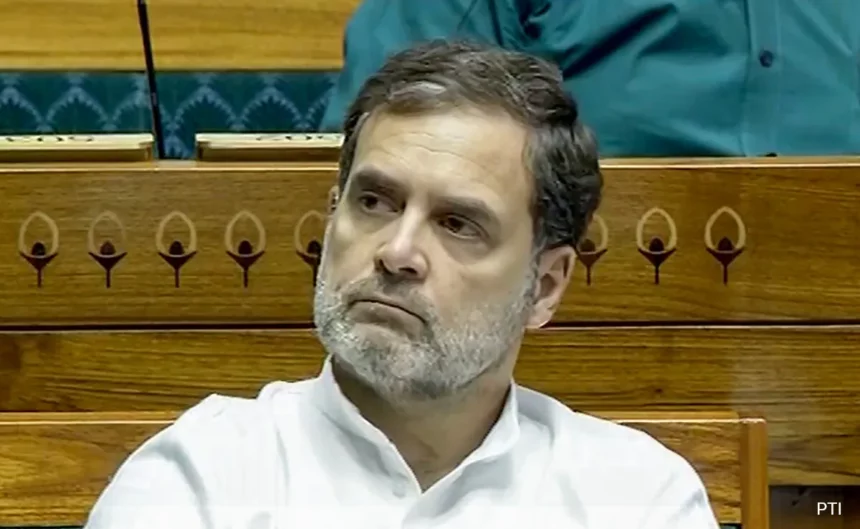
As Russian President Vladimir Putin arrived in India for a two-day visit for annual summit talks with Prime Minister Narendra Modi, a political storm broke out in New Delhi. Leader of the Opposition in the Lok Sabha, Rahul Gandhi, alleged that the Modi government was violating long-standing democratic traditions by preventing him and other Opposition leaders from meeting the visiting Russian leader. Gandhi’s remarks came on a day when diplomatic engagement between India and Russia took center stage, and they reflected deeper political tensions over foreign policy representation and the Opposition’s role in India’s global outreach. His statements highlighted what he described as a widening rift between established parliamentary practices and the current government’s approach.
Speaking to reporters on Thursday afternoon within the Parliament complex, Gandhi said the government was acting out of a sense of insecurity and was attempting to restrict the Opposition’s interaction with international dignitaries. According to him, the practice of including the Leader of the Opposition in meetings with foreign leaders has been a longstanding norm, deeply rooted in India’s political culture. The issue, he said, was not confined to the current visit by President Putin but represented part of a larger pattern where the government allegedly advises visiting dignitaries not to meet Opposition representatives. His comments brought renewed attention to India’s internal political dynamics at a time when external diplomatic engagement is prominently underway.
Rahul Gandhi Highlights Breach of Political Traditions as Government Faces Accusations of Insecurity
Rahul Gandhi emphasized that the tradition of Opposition leaders meeting foreign dignitaries has existed across administrations, including those led by former Prime Ministers Atal Bihari Vajpayee and Manmohan Singh. He argued that the current government’s reluctance to allow such meetings marks a departure from accepted democratic norms. According to Gandhi, these interactions hold importance because the Opposition presents a different perspective on India’s position in global affairs. In his view, India is represented not merely by the ruling government but by all its political voices, and restricting Opposition participation diminishes the depth and plurality of India’s engagement with the world.
Gandhi further stated that both during his foreign visits and during the visits of international leaders to India, he has been informed that the Indian government has conveyed instructions discouraging foreign dignitaries from meeting him. He described this as unprecedented and rooted in what he termed “insecurity” on the part of the government. The Congress leader insisted that the government should not dominate diplomatic interactions in a manner that excludes the Opposition, especially when such engagement enhances India’s democratic credibility abroad.
Congress general secretary KC Venugopal also weighed in, describing meetings between the Leader of the Opposition and visiting leaders as a “time-tested democratic tradition” that strengthens India’s international relationships. Venugopal criticized the government for allegedly undermining these norms, remarking that those who prefer to communicate unilaterally do not value traditions that contribute to India’s foreign policy architecture. His comments signaled growing concern within the Congress leadership about what they view as an erosion of institutional practices that once defined the country’s democratic functioning.
The Bharatiya Janata Party (BJP) responded sharply. Party spokesperson and MP Sambit Patra countered Gandhi’s claims by highlighting the foreign leaders Gandhi has met in his capacity as Leader of the Opposition since June 2024. These included former Bangladesh Prime Minister Sheikh Hasina, Malaysian Prime Minister Anwar Ibrahim, Mauritius Prime Minister Navin Chandra Ramgoolam, and New Zealand Prime Minister Christopher Luxon. Patra argued that it is foreign delegations themselves who decide whom they want to meet and that the Ministry of External Affairs only facilitates such requests. He accused Gandhi of attempting to create controversy during a significant diplomatic visit and claimed that his remarks could harm India’s international image.
Patra asserted that on a day when India is hosting a major world leader such as President Putin, raising such allegations was an irresponsible political act. The BJP’s reply framed Gandhi’s claims as an attempt to manufacture political friction and cast doubt on India’s diplomatic posture. This exchange deepened the already tense political atmosphere surrounding the Russian President’s visit and demonstrated how domestic political divides increasingly intersect with India’s foreign policy environment.
Putin’s Visit Focuses on Strategic Talks, Labour Mobility Agreement and Economic Engagement
While political tensions unfolded in New Delhi, President Vladimir Putin engaged in a packed schedule of diplomatic meetings. His visit marks his first trip to India since the onset of the Ukraine conflict in 2022, making the visit geopolitically significant. Following a private dinner hosted by Prime Minister Modi and bilateral discussions on Thursday, Putin is scheduled to address business leaders from both nations on Friday. The visit underscores the longstanding strategic partnership between India and Russia, even as both countries navigate complex global alignments.
Officials from the Ministry of External Affairs noted that discussions between the two nations have advanced significantly on a labour mobility agreement that would allow Indian skilled and semi-skilled workers to take up employment in Russia’s construction, healthcare and hospitality sectors. This agreement, which has reportedly completed internal processes and awaits formal signing, is expected to open major opportunities for Indian workers while addressing labour shortages in Russian industries. The initiative reflects a broader trend in India’s bilateral engagements, where mobility and workforce cooperation are playing increasingly central roles.
The visit also features discussions on expanding bilateral trade ties and strengthening economic cooperation, areas that have gained momentum in recent years due to shifting global supply chains and evolving geopolitical partnerships. Negotiations continue on a potential free-trade agreement between India and the Eurasian Economic Union, a move that could significantly boost India’s trade access to key Eurasian markets. Both sides are expected to deepen collaboration in energy, defence, heavy engineering and industrial manufacturing—areas historically central to India-Russia relations.
Beyond formal meetings, Putin’s visit symbolizes continuity in a relationship that has remained stable despite global volatility. The summit reinforces diplomatic coordination, long-term strategic cooperation and mutually beneficial economic engagement. Even as domestic political disputes emerge over protocol and access, the substantive agenda of India-Russia discussions reflects shared priorities and longstanding geopolitical alignment.
The political controversy surrounding Rahul Gandhi’s comments added an unexpected layer to the diplomatic proceedings, highlighting how domestic political debates increasingly intersect with high-level foreign engagements. While government officials continued to focus on policy agreements and bilateral cooperation, the Opposition used the moment to question the government’s adherence to democratic traditions and its approach to political plurality within foreign policy interactions.