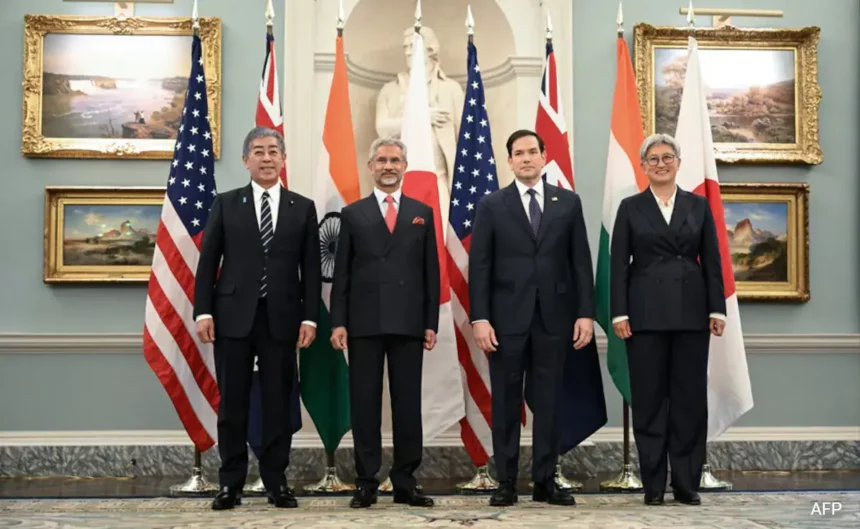
In a significant diplomatic move, the Quad nations—comprising the United States, Australia, India, and Japan—held their first ministerial meeting under President Donald Trump’s second term. The meeting, convened on the first full day in office of US Secretary of State Marco Rubio, issued a pointed warning against attempts to alter the status quo in the Indo-Pacific through coercion, implicitly addressing China’s assertive actions in the region. This marked the first such meeting since Donald Trump reclaimed the White House, underscoring the grouping’s priority in his administration’s foreign policy.
Marco Rubio hosted his counterparts—Australia’s Penny Wong, India’s Subrahmanyam Jaishankar, and Japan’s Takeshi Iwaya—in Washington, where they reaffirmed their collective commitment to a free and open Indo-Pacific. A joint statement emphasized the importance of upholding the rule of law, democratic values, sovereignty, and territorial integrity. It also firmly opposed unilateral actions to change the regional status quo by force or coercion, a direct reference to China’s aggressive stance on Taiwan and its maritime claims in the South China Sea.
The ministers confirmed plans to hold a Quad summit in India, which would mark an early visit by Donald Trump to one of the US’s closest strategic partners. India, increasingly seen as a key bulwark against China, remains central to the grouping’s focus on maintaining stability in the Indo-Pacific. Subrahmanyam Jaishankar noted the significance of the meeting occurring so soon after Trump’s inauguration, highlighting its importance in the foreign policies of all member states.
China has consistently criticized the Quad, labeling it a US-led effort to encircle the Asian superpower. The grouping, initially envisioned by former Japanese Prime Minister Shinzo Abe, gained momentum during President Joe Biden’s tenure, expanding into a leaders’ summit. During Joe Biden’s administration, Quad meetings often centered on Beijing’s military activities and territorial claims, particularly in the contentious South China Sea.
Marco Rubio, during his confirmation hearing, pledged to deter any Chinese aggression against Taiwan, the self-governing democracy Beijing claims as its own. The Republican senator reiterated the necessity of working with allies to prioritize shared strategic interests, signaling continuity in Donald Trump’s firm stance against China.
Meanwhile, plans are underway for further Quad engagements, including a potential foreign ministers’ meeting at the White House. Analysts interpret the timing of this meeting as a clear message that countering China’s growing power in the Indo-Pacific remains a top priority for the Trump administration.