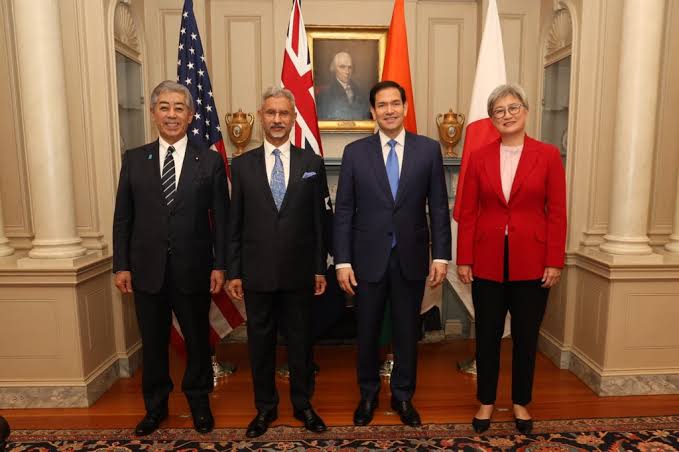
The Quad foreign ministers sharply condemned the April 22 Pahalgam terror attack in characterized terms, urging swift justice for those responsible and calling on all UN member states to cooperate. Their statement marks a strong contrast with the muted response from the China‑led SCO, and underscores growing tensions in regional counter‑terrorism diplomacy.
Quad’s Firm Condemnation of Terror
At their July 2 meeting in Washington, the foreign ministers of India, the US, Australia, and Japan delivered a forceful joint statement. They denounced the Pahalgam attack—where armed militants killed 26 civilians, including 25 Indian tourists and one Nepali—and demanded that the perpetrators, organisers, and financiers be “brought to justice without any delay.” The ministers reaffirmed their commitment to counter‑terrorism cooperation and urged all UN member states to actively support investigations
India’s External Affairs Minister S. Jaishankar emphasised the country’s right to defend its citizens and praised the Quad’s unified stance. He reaffirmed that victims must never be equated with perpetrators and underscored India’s conduct of “Operation Sindoor” in response
SCO’s Diplomatic Rift Unveiled
Just weeks earlier at the SCO defence ministers’ meeting in Qingdao, India refused to endorse the final communiqué after it omitted any mention of the Pahalgam attack. Defence Minister Rajnath Singh rejected the statement, highlighting the absence of reference to the attack and accusing some member states of harbouring double standards—pointing directly to Pakistan and China
It was the first time India and Pakistan appeared together at such a meeting after their May confrontation, but the meeting ended without an agreed joint statement due to the standoff
Singh stressed that terrorism must not be used as an instrument of state policy, calling for accountability of nations that sponsor or shelter such acts
Implications for Global Diplomacy
The contrast between the Quad’s unequivocal condemnation and the SCO’s diplomatic impasse highlights a growing rift in the global counter‑terrorism framework. UN Security Council resolutions condemning the massacre failed to directly name the accused group, TRF—linked to Lashkar‑e‑Taiba—or to stress cooperation with India, a gap critics say was influenced by Pakistan and China’s positions
With these developments, the Quad’s message emerges as a statement of principled multilateralism—refusing to yield to geopolitical pressures from states that shelter terror. It signals growing momentum for tighter international action against cross‑border terrorism, even as institutional alignments like the SCO become arenas of contention.