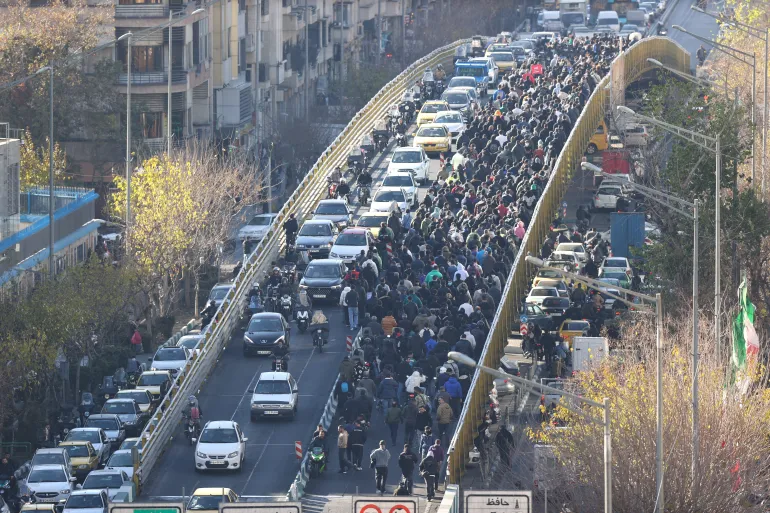
Iran has entered another turbulent phase as widespread protests erupt across multiple cities, revealing the depth of public anger over economic hardship, governance failures, and long-standing political frustrations that continue to shape daily life for millions of citizens.
The demonstrations, which began as expressions of economic despair, have rapidly expanded into a nationwide movement marked by street protests, clashes with security forces, and a renewed debate over Iran’s political and economic trajectory. What initially appeared to be limited unrest driven by rising prices and currency collapse has evolved into a broader outcry against systemic pressures that many Iranians say have eroded their livelihoods and dignity. From major urban centres to smaller provincial towns, crowds have gathered to voice grievances that have accumulated over years, underscoring the fragile relationship between the state and society in the Islamic Republic.
At the heart of the protests lies a worsening cost-of-living crisis. Inflation has surged, the national currency has lost significant value, and essential goods have become increasingly unaffordable. For many families, wages no longer cover basic needs, while unemployment and underemployment remain persistent problems. These economic realities have created fertile ground for unrest, particularly among younger Iranians and urban workers who feel locked out of economic opportunity and political influence.
The protests have also unfolded against a backdrop of political transition and uncertainty. President Masoud Pezeshkian has acknowledged the legitimacy of economic grievances while calling for calm and national unity. However, his conciliatory statements have struggled to ease tensions as security forces continue to confront demonstrators in several regions. Images and videos circulating on social media show tear gas, road blockades, and confrontations that have further inflamed public sentiment, despite efforts by authorities to control information flows.
Economic collapse and social pressure driving unrest
The immediate trigger for the protests has been Iran’s deteriorating economic situation, which has placed extraordinary pressure on ordinary citizens. Years of sanctions, fiscal mismanagement, and limited foreign investment have weakened the economy, but the recent acceleration of inflation has pushed many households to a breaking point. Food prices, housing costs, and fuel expenses have all risen sharply, while the Iranian rial has continued to depreciate, eroding savings and purchasing power.
Merchants and shopkeepers were among the first to express discontent, with market closures and strikes in key commercial districts signaling the seriousness of the crisis. As word spread, students, workers, and retirees joined demonstrations, transforming local protests into a nationwide wave of dissent. The diversity of participants has been striking, cutting across class and regional lines and highlighting how deeply economic distress is felt throughout society.
Beyond material hardship, the protests reflect a sense of social exhaustion. Many Iranians describe a feeling of stagnation, where personal effort no longer translates into security or advancement. Young people, in particular, face bleak prospects as job opportunities fail to keep pace with education levels. This disconnect has fueled frustration and resentment, especially when contrasted with perceptions of inequality and elite privilege.
Government responses have alternated between acknowledgment and enforcement. While senior officials have spoken of the need to address inflation and stabilize the economy, security agencies have moved to contain protests through arrests and crowd control measures. Human rights groups report fatalities and detentions, claims that authorities contest or downplay. Regardless of official figures, the visible presence of security forces has intensified the atmosphere of confrontation, reinforcing public skepticism about the state’s willingness or ability to implement meaningful economic reform.
The economic roots of the protests are also intertwined with broader structural challenges. Iran’s reliance on oil revenues, combined with limited integration into global markets, has constrained growth and innovation. Sanctions have restricted trade and access to financial systems, complicating efforts to stabilize prices and attract investment. For protesters, however, these macroeconomic explanations offer little comfort as daily life becomes increasingly precarious.
Political tensions, international reactions, and the road ahead
As protests have persisted, their tone has grown more political, with chants and slogans reflecting deeper dissatisfaction with governance and accountability. While economic demands remain central, many demonstrators have questioned decision-making processes and the lack of transparency in addressing national challenges. This shift has heightened tensions between protesters and authorities, who view sustained unrest as a threat to stability.
The demonstrations have also drawn significant international attention, placing Iran once again at the centre of global political discourse. Former US President Donald Trump issued sharp warnings about potential intervention if Iranian authorities violently suppress protesters, statements that were quickly condemned by Tehran as reckless interference. Iranian officials have rejected external pressure, asserting national sovereignty and accusing foreign actors of exploiting domestic unrest for geopolitical gain.
Iran has called on the United Nations to address what it describes as inflammatory rhetoric, framing the protests as an internal matter that should not invite foreign involvement. This exchange has underscored how domestic upheaval in Iran often reverberates internationally, complicating diplomatic relations and raising fears of escalation beyond the country’s borders.
Inside Iran, political leaders face a delicate balancing act. On one hand, there is recognition that economic grievances are real and widespread. On the other, there is deep concern that sustained protests could undermine authority and embolden opposition movements. President Pezeshkian’s calls for dialogue suggest an awareness that force alone cannot resolve the crisis, yet tangible policy shifts have been slow to materialize.
The protests have also revived debates about reform versus resilience within the Islamic Republic. Supporters of gradual reform argue that addressing economic mismanagement, reducing corruption, and improving governance could ease public anger without destabilizing the system. Hardliners, however, emphasize security and resistance to foreign pressure, framing unrest as part of a broader campaign against Iran’s independence.
For many Iranians, the current moment feels like a crossroads. The protests have exposed the cumulative weight of unresolved economic and political issues, while also demonstrating the population’s willingness to challenge conditions they view as intolerable. Whether this unrest leads to substantive change remains uncertain, but it has already reshaped the national conversation, forcing leaders and citizens alike to confront uncomfortable realities about the country’s direction and priorities.