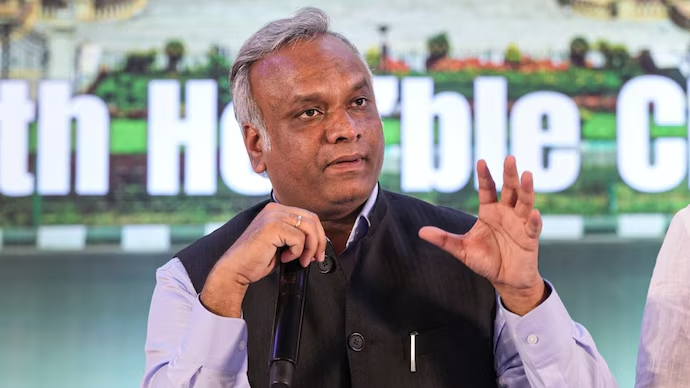
Karnataka Minister and senior Congress leader Priyank Kharge has once again raised questions regarding the funding mechanisms of the Rashtriya Swayamsevak Sangh (RSS), highlighting concerns over transparency, accountability, and financial oversight. Priyank Kharge’s comments come in response to statements made by RSS chief Mohan Bhagwat, who asserted that the organisation operates “entirely on contributions from its volunteers.” This claim, according to Priyank Kharge, raises fundamental questions about how the organisation sustains its nationwide infrastructure, manages its finances, and operates without formal registration as a legal entity. The debate underscores a growing scrutiny over the functioning of one of India’s most influential socio-political organisations, particularly regarding the sources and management of its financial resources.
Priyank Kharge, who is the son of Congress president Mallikarjun Kharge, expressed his concerns on social media platform X, questioning the legitimacy of the Sangh’s claims. He pointed out that if the RSS truly relies solely on volunteer donations, there remains a lack of clarity on how funds are collected, recorded, and disbursed across its numerous local units and regional offices. He emphasized that unlike registered charitable or religious institutions in India, the RSS lacks a formal mechanism for financial accountability, raising doubts about the transparency of contributions received from its members and the general public. Priyank Kharge’s statements come amidst growing public debate over the political and social influence of the RSS and its engagement in grassroots activities across the country.
Questions Surrounding Financial Transparency and Infrastructure Costs
Priyank Kharge questioned the operational model of the RSS, asking how it sustains its extensive infrastructure, which includes full-time pracharaks, local offices, outreach programs, training camps, and large-scale national events. He highlighted the costs involved in maintaining these activities, suggesting that they require substantial funding beyond voluntary contributions. He further raised concerns about the financial oversight of local branches, which often engage in the sale of uniforms, books, and other materials to swayamsevaks, questioning how the revenue from such activities is accounted for and whether it is included in formal financial disclosures. According to Priyank Kharge, these gaps in transparency point to systemic issues in how the organisation handles finances and ensures accountability to its members and the public.
Priyank Kharge also criticized the lack of registration, noting that while every charitable and religious institution in India is legally obligated to maintain financial records and transparency, the RSS continues to operate without formal registration despite its significant national presence and influence. He argued that this unregistered status leaves major questions unanswered regarding the source of funds, management of donations, and the legal oversight of activities undertaken across its numerous affiliated institutions and local units. Priyank Kharge stressed that in a democratic society, such a vast organisation should be held to the same standards of financial disclosure as other institutions, ensuring that public trust is maintained and legal compliance is upheld.
Mohan Bhagwat’s Defence and Historical Context
Responding to the scrutiny, RSS chief Mohan Bhagwat defended the organisation’s funding model and unregistered status during a session in Bengaluru, titled “100 Years of Sangh Journey: New Horizons.” Mohan Bhagwat stated that the RSS, established in 1925, was recognised as a “body of individuals” both legally and administratively, and argued that formal registration had never been a requirement after India gained independence. He insisted that the organisation has always operated within the framework of the law and has been recognised by the government and courts. He also cited the multiple bans imposed on the RSS by successive governments as evidence of its legitimacy and official recognition, pointing out that an organisation which faced governmental scrutiny and temporary prohibitions could not be operating outside the law.
Mohan Bhagwat elaborated that the Income Tax Department recognises the RSS as a “body of individuals,” which exempts it from taxation under Indian law. He argued that this legal status provides the organisation with the necessary framework to manage its finances, conduct nationwide activities, and maintain operational transparency within its internal mechanisms. He reiterated that the RSS has historically relied on volunteer contributions for its sustenance, emphasizing that this model aligns with its ideological commitment to selfless service and community-driven support. Mohan Bhagwat also dismissed the notion that formal registration was essential, highlighting the Sangh’s long-standing history and internal governance as sufficient for maintaining accountability within its organisational structure.
While Mohan Bhagwat defended the current financial model, Priyank Kharge and other critics maintain that the absence of a formal registration and publicly accessible financial records continues to raise questions about accountability. They argue that an organisation with such widespread influence over social and political life should be subject to the same scrutiny and transparency norms as other institutions receiving public or private donations. Priyank Kharge pointed out that large-scale programs, social campaigns, and the deployment of full-time personnel require meticulous planning and significant financial resources, which cannot be adequately verified if the organisation is unregistered.
The debate has sparked wider discussions on the role of voluntary contributions, political influence, and the need for oversight in organisations that operate on a national scale but fall outside the purview of standard regulatory frameworks. Analysts have noted that Priyank Kharge’s intervention highlights the tension between the legal framework of charitable and religious organisations and the operational realities of socio-political entities like the RSS, which wield significant power and influence across India’s political spectrum.
Furthermore, Priyank Kharge questioned whether the practice of collecting funds through local branches, sales of materials, and voluntary donations truly reflects transparency in financial management. He suggested that without public disclosure or regulatory oversight, there exists the potential for misuse or mismanagement of funds, intentionally or otherwise. The opposition perspective, as voiced by Priyank Kharge, is that accountability mechanisms are essential not only to ensure legal compliance but also to uphold public trust in institutions that have a national presence and social influence.
The discussion also touched on the broader implications of unregulated funding and organisational influence. Priyank Kharge highlighted that unlike registered NGOs or religious bodies, which are required to submit detailed accounts to the government, the RSS’s funding model and unregistered status create ambiguity regarding its income sources, expenditure, and resource allocation. He stressed that in a country where transparency in donations and financial transactions is increasingly demanded, it is reasonable to expect that an organisation with ideological and political significance maintain similar standards.
Mohan Bhagwat, however, maintained that the RSS’s century-long history, recognition by courts and government, and its reliance on volunteerism have provided it with sufficient legitimacy to operate without formal registration. He argued that successive governments have acknowledged the organisation’s presence through legal recognition, bans, and formal interactions, which collectively serve as evidence of its lawful existence. Additionally, Mohan Bhagwat emphasised that the structure of the RSS as a volunteer-driven organisation is unique and requires a different framework for funding and accountability compared to conventional institutions.
Despite Mohan Bhagwat’s defence, Priyank Kharge’s questions underscore an ongoing debate about the balance between traditional organisational structures, volunteer-based funding, and modern transparency standards. The controversy also raises important issues about how large, influential organisations should manage their financial operations while remaining accountable to both the law and the public. The questions posed by Priyank Kharge are part of a broader discourse on ensuring that organisations with significant ideological and societal influence operate transparently and responsibly, especially in a democratic context where public accountability is a key expectation.
The discussion between Priyank Kharge and Mohan Bhagwat highlights a clash of perspectives: while the RSS defends its historical methods, legal recognition, and internal mechanisms, critics demand greater transparency, oversight, and public accountability. This debate also touches upon issues of governance, regulatory compliance, and ethical responsibility for organisations that occupy a prominent position in India’s socio-political landscape. Priyank Kharge’s intervention brings into focus the importance of financial transparency in maintaining public trust and credibility, especially for an organisation that operates across multiple states and influences social and political life at large.
As the debate continues, questions regarding the adequacy of current oversight, the role of volunteer contributions, and the implications of unregistered status for large organisations remain central. The dialogue between Priyank Kharge and Mohan Bhagwat illustrates the complexities involved in balancing traditional organisational practices with contemporary expectations of transparency and accountability. Analysts suggest that the ongoing discourse may also influence public perception, legal interpretations, and future policies regarding funding practices of influential socio-political organisations in India.
Ultimately, the exchange between Priyank Kharge and Mohan Bhagwat emphasizes the importance of accountability, financial transparency, and regulatory clarity, highlighting the broader challenge of aligning historic organisational structures with modern legal and ethical standards. The controversy is likely to continue sparking debate in political, social, and academic circles, raising awareness about the need for robust mechanisms to ensure that large, influential organisations maintain credibility and public trust while operating in accordance with the law.