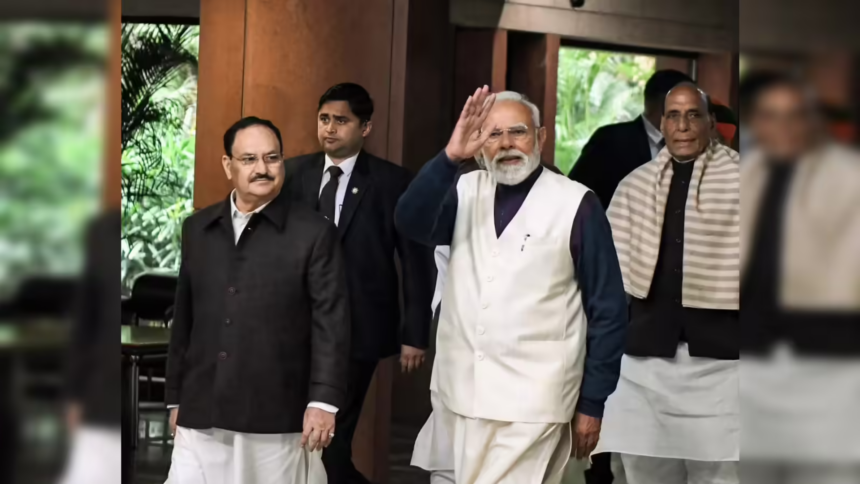
The ongoing budget session of Parliament is set to witness a key political moment as Prime Minister Narendra Modi prepares to address the Lok Sabha on the motion of thanks to the President’s address, amid an atmosphere charged with intense debate, repeated disruptions, and sharp exchanges between the treasury benches and the opposition. The Prime Minister’s reply is expected to outline the government’s vision, respond to criticism raised during the debate, and assert its political and policy priorities at a time when parliamentary proceedings have drawn sustained national attention.
Parliamentary Debate on the President’s Address and Government’s Legislative Agenda
The budget session traditionally begins with the President’s address to a joint sitting of both Houses of Parliament, a constitutional exercise that lays out the broad policy direction, achievements, and priorities of the government for the year ahead. This address is followed by a detailed debate in both the Lok Sabha and the Rajya Sabha, during which members scrutinize, support, or challenge the statements and claims made in the speech. The motion of thanks is then moved in each House as a formal expression of approval, though in practice it becomes a platform for wide-ranging political debate.
This year’s motion of thanks debate in the Lok Sabha has unfolded against a backdrop of heightened political contestation. Members from the ruling alliance have highlighted the government’s focus on economic growth, infrastructure development, welfare delivery, national security, and governance reforms. They have argued that the President’s address reflects continuity in policy-making, stability in leadership, and a commitment to inclusive development. According to them, the address encapsulates the aspirations of a rapidly transforming nation and sets a clear roadmap for legislative and administrative action during the financial year.
On the other hand, opposition parties have used the debate to raise concerns over a range of issues, including economic challenges, unemployment, inflation, social harmony, and the state of democratic institutions. Several opposition leaders have questioned the claims made in the President’s address, arguing that ground realities differ from the government’s narrative. The debate has therefore extended beyond procedural formalities, evolving into a politically charged exchange over governance, accountability, and the direction of the country.
As the debate progressed, repeated interruptions and protests by opposition members led to adjournments and delays in legislative business. The Speaker of the Lok Sabha repeatedly appealed for order, emphasizing the need to allow members to express their views within the framework of parliamentary rules. Despite these appeals, tensions escalated on multiple occasions, underscoring the increasingly confrontational tone of parliamentary politics.
Within this context, the Prime Minister’s address on the motion of thanks assumes particular significance. As per parliamentary convention, the Prime Minister responds at the end of the debate, addressing points raised by members and defending the government’s record. His reply is often seen as a summation of the government’s stance, combining political messaging with policy clarification. Supporters view it as an opportunity to reaffirm commitments and counter criticism, while critics watch closely for how contentious issues are addressed or sidestepped.
The Prime Minister’s speech is also expected to link the themes of the President’s address with the broader objectives of the budget session. While the Union Budget itself focuses on fiscal priorities, the motion of thanks debate allows the government to frame those priorities within a larger political and developmental narrative. This alignment between constitutional procedure and political communication makes the Prime Minister’s reply one of the most closely followed events of the session.
Opposition Protests, Suspensions, and Rising Political Tensions in the Lok Sabha
The debate on the motion of thanks has not been without controversy, as the Lok Sabha has witnessed repeated disruptions and strong protests from opposition members. Matters escalated when several opposition MPs were suspended from the House following incidents of disorder during the debate. The suspensions were ordered after allegations that the MPs had violated parliamentary decorum, including approaching the Chair, shouting slogans, and obstructing proceedings.
These suspensions triggered sharp reactions from opposition parties, who accused the government of suppressing dissent and using disciplinary measures to silence critical voices. Opposition leaders argued that Parliament is meant to be a forum for robust debate and that punitive actions against MPs undermine democratic principles. They maintained that raising uncomfortable questions and staging protests are legitimate forms of political expression, particularly when they believe important issues are being ignored.
Protests by suspended MPs continued both inside and outside the Parliament complex, with opposition leaders addressing the media to express their dissatisfaction. They alleged that the ruling party was unwilling to engage with criticism and was instead relying on numerical strength and procedural authority to push through its agenda. According to them, the atmosphere in the Lok Sabha reflected a shrinking space for opposition voices and meaningful debate.
The ruling party, however, defended the Speaker’s decision and maintained that maintaining order and dignity in the House is essential for the smooth functioning of Parliament. Leaders from the treasury benches argued that repeated disruptions prevent legislators from performing their constitutional duties and deprive citizens of substantive discussions on policy and legislation. They emphasized that while disagreement is a cornerstone of democracy, it must be expressed within the established rules of parliamentary conduct.
This clash over parliamentary norms has further polarized the political environment, turning procedural issues into political flashpoints. Analysts have noted that such confrontations are increasingly common in contemporary parliamentary politics, reflecting deeper divisions between the ruling establishment and the opposition. The motion of thanks debate, instead of being a relatively measured exchange, has thus become emblematic of broader tensions shaping the current political landscape.
In this charged atmosphere, the Prime Minister’s impending address is being closely watched for its tone as much as its content. Observers are keen to see whether the speech seeks to lower the temperature by appealing for cooperation and dialogue, or whether it reinforces partisan divides by sharply criticizing the opposition. Past addresses by the Prime Minister on similar occasions have combined assertive political rhetoric with appeals to national unity, making it difficult to predict the balance he will strike this time.
The timing of the address is also important, as it comes at a stage when the budget session is moving towards key legislative business. With important bills and discussions scheduled in the coming days, the smooth functioning of Parliament remains a concern for both the government and the opposition. The Prime Minister’s reply to the motion of thanks could influence the tenor of debates ahead, either by setting a conciliatory tone or by further entrenching political positions.
Beyond the walls of Parliament, the developments have attracted widespread public attention. Televised proceedings, media coverage, and social media commentary have amplified the impact of parliamentary exchanges, turning them into subjects of national conversation. Supporters and critics of the government alike are interpreting the events through their own political lenses, reinforcing existing narratives and debates.
As the Lok Sabha prepares to hear the Prime Minister’s response, the motion of thanks debate stands as a reflection of the broader dynamics shaping Indian politics today. It highlights the interplay between constitutional tradition and contemporary political contestation, demonstrating how formal procedures can become arenas for intense ideological and partisan संघर्ष. The Prime Minister’s address will therefore not only conclude a key parliamentary debate but also signal how the government intends to navigate the challenges of governance and opposition engagement in the months ahead.