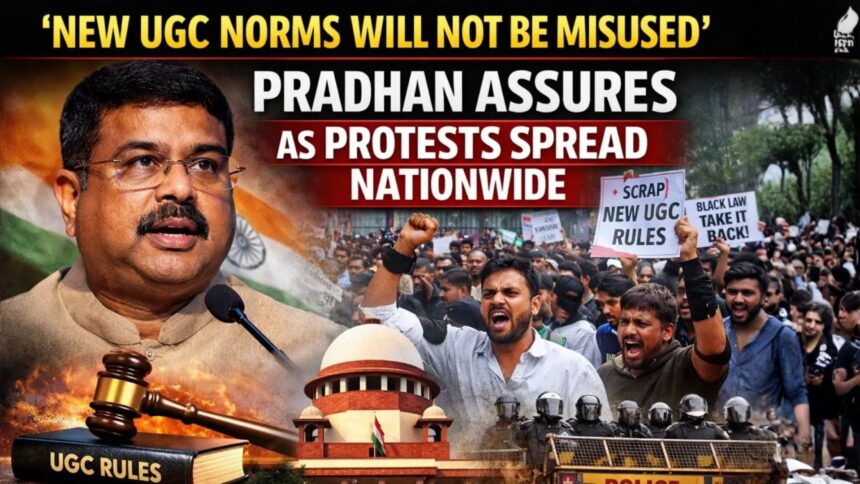
The newly notified University Grants Commission regulations have sparked widespread protests across India, placing higher education policy at the centre of a growing political and social debate. As demonstrations intensified in multiple states, Union Education Minister Dharmendra Pradhan stepped forward to assure students, teachers, and civil society that the new norms would not be misused or result in discrimination. His statement, aimed at calming rising tensions, came even as opposition mounted from general category students, youth groups, and caste-based organisations, forcing authorities to tighten security around the headquarters of the University Grants Commission in New Delhi.
Government assurance and the intent behind the new UGC norms
Addressing the controversy, Pradhan emphasised that the regulations were framed with the objective of ensuring justice, equity, and accountability within institutions of higher education. He cautioned against what he described as misinformation being circulated about the intent of the rules and stressed that adequate safeguards were built into the framework. According to the minister, the government remains committed to protecting the rights of all students, irrespective of caste or category, and would not allow the regulations to be weaponised for political or personal motives.
The UGC, echoing the minister’s position, has maintained that the new rules are not arbitrary but stem from judicial directions. In January 2025, the Supreme Court of India directed the commission to frame stronger and enforceable regulations to address caste-based discrimination in educational institutions. The directive followed petitions linked to tragic cases such as the suicide of Rohith Vemula in 2016 and Dr Payal Tadvi in 2019, which had exposed systemic gaps in grievance redressal mechanisms on campuses.
Earlier guidelines issued by the UGC in 2012 were largely advisory and lacked enforcement teeth, a shortcoming repeatedly flagged by activists and the judiciary. The newly notified regulations, according to the commission, seek to correct this by mandating clearer institutional responsibility, structured complaint mechanisms, and defined accountability. Officials argue that the rules are intended to protect vulnerable students and prevent discrimination rather than target or stigmatise any particular group.
Despite these explanations, critics remain unconvinced. Many protesters argue that the language of certain provisions is vague and could allow for misuse, potentially creating fear and mistrust on campuses. Regulation 3(c), in particular, has drawn sharp criticism for allegedly opening the door to frivolous complaints. The government has insisted that checks and balances exist to prevent such misuse, but the perception gap between policymakers and sections of the student community continues to widen.
Pradhan’s assurance that “no one can misuse the law” was therefore as much a political statement as a policy clarification. It reflected the Centre’s attempt to strike a balance between responding to judicial mandates and addressing public anxiety. However, as protests spread geographically and politically, the challenge for the government has shifted from explanation to engagement.
Protests, political fallout, and rising legal scrutiny
Even as the Union education minister sought to reassure stakeholders, demonstrations continued to intensify, particularly across Uttar Pradesh. Cities such as Lucknow, Rae Bareli, Varanasi, Prayagraj, Meerut, Sitapur, and Amethi witnessed student protests, slogan-shouting, and symbolic acts of dissent. In Lucknow, students gathered near Lucknow University chanting “black law, take it back,” while in Sambhal, traders and youth groups wore black armbands and organised a bike rally to register their opposition.
The agitation has not remained confined to student circles. Caste-based organisations, farmer groups, and sections of the trading community have also joined the protests, framing the issue as one of social justice and representation. In some areas, protesters symbolically sent bangles to upper-caste Members of Parliament, accusing them of remaining silent on an issue they believe adversely affects general category students.
The controversy has also triggered notable political resignations. In Bareilly, City Magistrate Alankar Agnihotri resigned from his post, calling the regulations “highly detrimental” and expressing moral opposition to their implementation. In Rae Bareli, Shyam Sundar Tripathi, vice-president of the BJP Kisan Morcha, stepped down, citing dissatisfaction with the new UGC framework. These resignations have added pressure on the ruling Bharatiya Janata Party, signalling unease within its own support base.
Opposition parties have seized upon the unrest to attack the Centre. Samajwadi Party leader Ram Gopal Yadav warned that the regulations could become tools for harassment and deepen existing social divisions. He argued that instead of fostering harmony on campuses, poorly framed rules risk creating an atmosphere of suspicion. Other opposition leaders and civil society groups have echoed similar concerns, demanding an immediate rollback or comprehensive review of the norms.
The matter has also moved into the legal arena. Advocate Vineet Jindal has filed a petition in the Supreme Court challenging the new regulations as discriminatory and seeking a stay on key provisions, particularly Regulation 3(c). The petition argues that while the intention to curb discrimination is laudable, the execution risks violating principles of equality and natural justice. With the court now set to examine the issue, the legal scrutiny adds another layer of complexity to an already volatile situation.
As protests continue, several groups have announced plans for a nationwide bandh on February 1, indicating that the agitation may escalate further. Universities and colleges in some regions are bracing for disruptions, while state administrations have been put on alert to prevent violence or unrest. The heightened security outside the UGC headquarters in Delhi reflects official concern that the movement could intensify if dialogue fails.
At the heart of the controversy lies a broader debate about how India’s higher education system should address caste-based discrimination without creating new fault lines. While the government insists that the regulations are rooted in constitutional values and judicial direction, protesters fear unintended consequences. The clash of narratives has turned the UGC norms into a flashpoint that extends beyond campuses into the realms of politics, law, and social identity.
As the Centre faces mounting pressure from the streets, opposition benches, and the courts, the coming weeks are likely to determine whether the regulations are amended, clarified, or defended as they stand. With nationwide protests showing no sign of abating and legal challenges underway, the debate over the new UGC norms has become one of the most significant education policy controversies in recent years.