The Karnataka legislative assembly witnessed heated debates and protests as opposition parties, the Bharatiya Janata Party (BJP) and Janata Dal (Secular) [JD(S)], strongly opposed the Congress government’s move to appoint party workers to oversee the implementation of its flagship welfare schemes. The opposition accused the ruling party of using taxpayer funds to benefit its cadre under the guise of governance and demanded the immediate dissolution of these committees.
The controversy revolves around the committees formed at state, district, and taluk levels to oversee the execution of the government’s five key welfare schemes. These schemes, which have been allocated a substantial budget of ₹51,034 crore for 2025-26, are meant to support the people of Karnataka. However, BJP and JD(S) members argue that instead of involving elected representatives, the Congress government is appointing its workers to key positions, thereby misusing public funds for political gain.
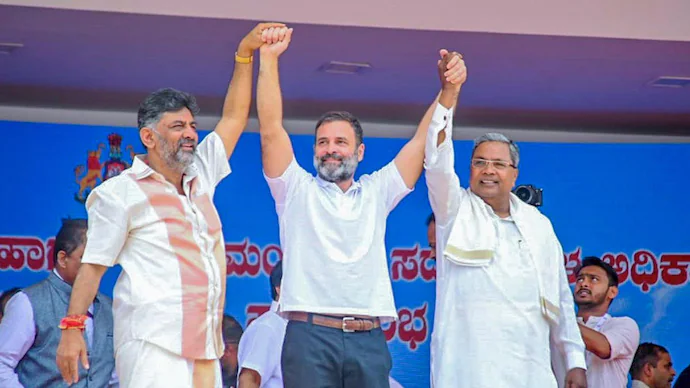
During assembly proceedings, Karnataka Deputy Chief Minister and Karnataka Pradesh Congress Committee (KPCC) President DK Shivakumar responded to the concerns but refused to make immediate changes. He stated that the issue would be reviewed in an upcoming Cabinet meeting. However, his remarks did not appease the opposition, which staged a protest in the well of the House, alleging that Congress workers were being financially rewarded through these appointments.
According to details provided by Shivakumar, district-level committee presidents receive a monthly remuneration of ₹40,000, vice-presidents ₹10,000, and members ₹1,100 per meeting, with two meetings held per month. Taluk-level committee presidents earn ₹25,000 monthly, while members receive ₹1,000 per meeting. In Bengaluru, the Bruhat Bengaluru Mahanagara Palike (BBMP) committee president is paid ₹40,000, with members earning ₹1,200 per meeting. District-level committees comprise 21 members each, while taluk-level bodies have 11 members.
Opposition leaders lambasted the arrangement, branding it an illegal and unethical use of public funds. BJP leaders, including Leader of the Opposition R Ashoka, Arvind Bellad, Sunil Kumar, CC Patil, Harish Poonja, and M Chandrappa, condemned the Congress government for sidelining legislators and government officials who traditionally oversee welfare schemes.
R Ashoka accused the Congress of diverting public funds for political gains. “If the Congress wants to support its workers, it should do so with party funds, not taxpayer money. This is a blatant misuse of public resources,” he said, alleging that nearly ₹60 crore was being allocated annually to Congress functionaries under this arrangement.
Ashoka further criticized the government’s disregard for elected representatives. “If MLAs are deemed unfit to implement welfare schemes, then disqualify us. We were elected by the people, not appointed by Congress. How can we support the finance bill when public money is being funneled to party workers?” he questioned.
Opposition members also pointed out that historically, various government committees, such as Ashraya, were headed by elected legislators. They argued that replacing them with politically appointed members was an attempt to diminish the role of opposition leaders and consolidate Congress’s hold over state welfare initiatives.
As tensions continue to escalate, the controversy highlights the growing political divide in Karnataka. While the Congress government defends its decision as a means to ensure efficient implementation of welfare schemes, the opposition sees it as a politically motivated strategy to strengthen the party’s grassroots network at the cost of public funds. The issue is expected to dominate further discussions in the assembly, with the opposition determined to challenge what it calls a “partisan misuse of governance.”