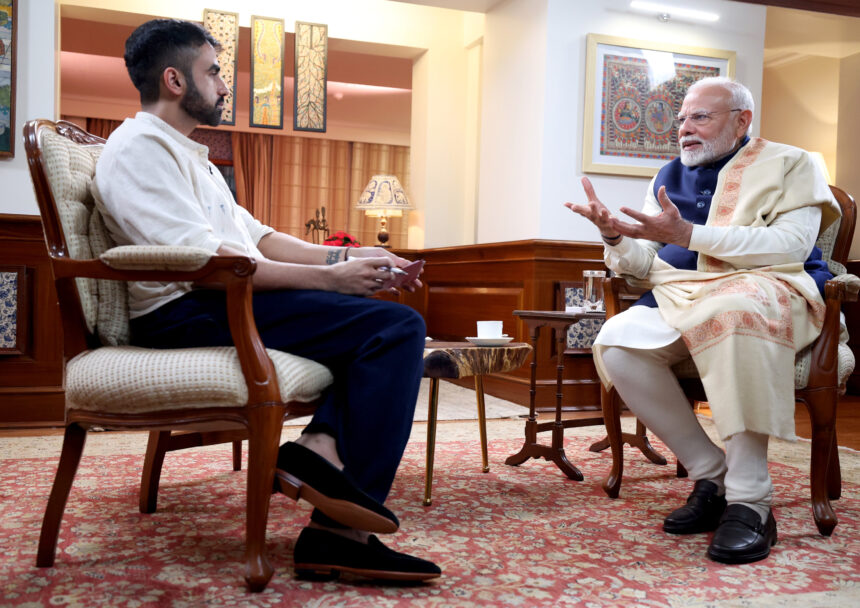
Prime Minister Narendra Modi’s recent podcast, featuring a friendly interviewer, served as a textbook example of how narratives can be set. The conversation was carefully curated with soft questions, no follow-ups, and a smooth flow designed to shape public perception. The podcast, akin to a well-scripted performance, was then amplified by media houses that meticulously crafted headlines, tweets, and tickers to present the Prime Minister’s words in the most flattering light. However, beyond the carefully presented phrases, there exists an alternate reality that remains largely unaddressed.
In one instance, PM Narendra Modi spoke about his time in the Himalayas, embracing solitude and testing his endurance. He reflected on his pursuit of a higher purpose. While such personal anecdotes are compelling, they overshadow stark ground realities. Between 2014 and 2023, 736 people lost their lives cleaning sewers and septic tanks, and an estimated 67 lakh children remain undernourished every day. Additionally, around 30 farmers commit suicide daily due to financial distress. The Prime Minister shared a childhood story of caring for a fasting Swamiji, yet today, a farmer leader has been on a hunger strike for over 100 days demanding minimum support price (MSP) rights, but remains unheard.
PM Narendra Modi also spoke about the influence of the Rashtriya Swayamsevak Sangh (RSS) in shaping his life. However, historical records show that Sardar Vallabhbhai Patel once banned the RSS, citing violent activities by its members. Furthermore, during key moments in India’s freedom struggle, the RSS notably abstained from participating, including Mahatma Gandhi’s Dandi March and Quit India Movement.
The prime minister emphasized that criticism is essential for democracy, yet his tenure has seen a tightening grip on dissent. Since 2014, he has not held a single open press conference, and parliamentary questions directed at him remain unanswered. Meanwhile, numerous journalists and activists have faced arrests under stringent laws, with convictions remaining strikingly low.
On education, PM Narendra Modi asserted that children should not be seen as trophies, yet government spending on education is merely 0.37% of GDP, significantly below the 6% target outlined in the new education policy. Reports also indicate that a significant percentage of rural students struggle with basic mathematical skills.
Additionally, unemployment among the youth remains a pressing concern. An overwhelming 80% of the unemployed population consists of young individuals, while only 40% of new workforce entrants possess formal skills. Despite promises, many graduates find themselves unemployable due to a lack of relevant training.
The podcast also addressed the 2002 Gujarat riots, with an attempt to downplay their severity. However, records show that over 1,000 people lost their lives, with many more injured or missing. The Supreme Court, in 2004, likened Narendra Modi’s leadership during the riots to that of Nero, who watched as Rome burned. The release of Bilkis Bano’s rapists by the Gujarat government only further complicates the narrative.
While the podcast sought to frame a positive image, the realities on the ground tell a different story. The discourse around governance must extend beyond carefully curated conversations to acknowledge and address the pressing challenges facing the nation today.