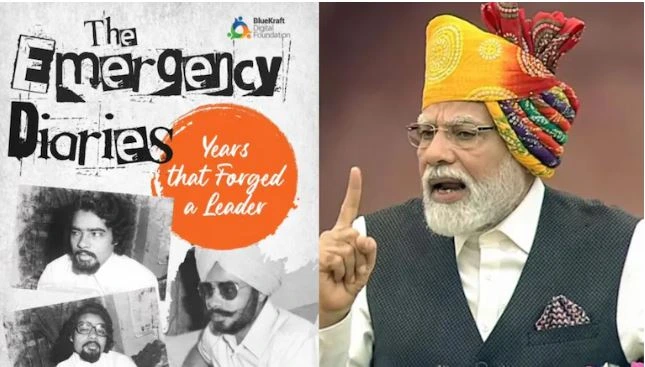
Prime Minister Narendra Modi opened up about his experiences as a young RSS Pracharak during the Emergency period, describing the anti-Emergency movement as a crucial learning phase that strengthened his commitment to democracy. His reflections come as Union Home Minister Amit Shah prepares to launch The Emergency Diaries, a book that chronicles PM Modi’s personal and political journey during those turbulent years, highlighting his fight against authoritarianism and dedication to democratic ideals.
PM Modi’s Early Political Journey and the Making of a Leader
Speaking about the Emergency, PM Modi said that he was a young RSS Pracharak at the time and that the anti-Emergency movement was a defining experience for him. It reinforced the importance of protecting India’s democratic framework and offered him the opportunity to learn from leaders across the political spectrum. PM Modi expressed his appreciation for the BlueKraft Digital Foundation, which compiled these experiences into The Emergency Diaries, with a foreword written by former Prime Minister HD Deve Gowda, himself a prominent figure in the anti-Emergency struggle.
The foundation describes the book as a groundbreaking work, shedding light on the formative years of a young man who would become one of India’s most transformative leaders. The Emergency Diaries vividly portrays PM Modi’s dedication to democratic values and pays tribute to the resilience of those who stood firm against suppression during one of India’s darkest chapters.
The Emergency: A Dark Chapter in Indian Democracy
June 25, 1975, marked the beginning of a 21-month Emergency imposed by then Prime Minister Indira Gandhi’s government. Citing threats to national security, economic instability triggered by the global oil crisis, and widespread strikes that halted production, the government suspended fundamental constitutional rights and curtailed civil liberties. The judiciary’s power to challenge the Emergency was also suspended.
PM Modi referred to this period as “the time when the Indian Constitution’s values were set aside,” with press freedom crushed and numerous political leaders, activists, students, and ordinary citizens imprisoned. He described the 42nd Amendment to the Constitution as emblematic of the excesses and attempts to undermine democratic institutions. PM Modi highlighted that the poor and marginalized bore the brunt of these repressive measures, including insults to their dignity.
The Prime Minister paid tribute to those who courageously resisted the Emergency, noting that people from diverse ideologies and regions united with the common goal of defending India’s democratic spirit. This collective resistance eventually forced the Congress government to lift the Emergency and hold general elections, which resulted in their defeat.
This narrative not only offers insight into PM Modi’s personal growth during a politically charged period but also reminds readers of the sacrifices made by many to safeguard democratic principles in India’s history. The launch of The Emergency Diaries by Amit Shah adds an important perspective to understanding the country’s political evolution during the Emergency era.