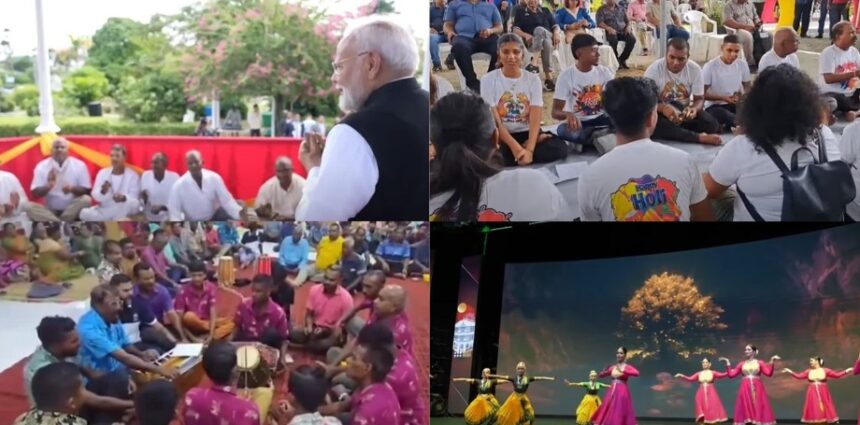
Prime Minister Narendra Modi, in his 120th episode of Mann Ki Baat on Sunday, underscored the unshakable strength of cultural roots, emphasizing that no matter how strong the storm, individuals firmly grounded in their heritage cannot be uprooted. The Prime Minister’s remarks came on the heels of his recent visit to Mauritius, where he lauded the Indian diaspora for their unwavering commitment to preserving their cultural identity across generations, despite the challenges of migration and time.
During his address, PM Modi reflected on the importance of staying connected to one’s cultural heritage, a value that he believes has been nurtured and upheld by the Indian community worldwide. He noted that even when faced with adversity, such as in the case of the indentured laborers who were taken to various parts of the world, the spirit of India had remained alive and vibrant. “Roots can withstand any storm,” he stated, underscoring the resilient nature of Indian culture as it continued to thrive in foreign lands.
The Prime Minister went on to highlight some heartwarming messages he had received through MyGov and the NaMo App, which showcased the depth of connection the Indian diaspora has with their culture. One message that particularly resonated with him was from Atharva Kapoor of Varanasi, Aaryash Leekha, and Atrey Maan from Mumbai, who shared their thoughts on the Prime Minister’s visit to Mauritius. The trio expressed their admiration for the Geet Gawai performance that took place during the event, a traditional Indian folk music performance. These sentiments were echoed by people in eastern Uttar Pradesh and Bihar, who also reflected on how watching Geet Gawai in Mauritius was an extraordinary experience that reminded them of their cultural roots.
The Prime Minister then delved deeper into the history of Indian indentured laborers, who, nearly 200 years ago, were sent to far-flung corners of the world, including Mauritius, as part of the British Empire’s colonial expansion. Despite facing uncertainty and hardship, these laborers remained deeply connected to their cultural heritage, forging a unique identity in their new homelands. Over the course of time, they not only built their lives in these distant lands but also ensured that their cultural practices and traditions were passed down to future generations. Modi’s reflections on this historical journey served as a testament to the resilience and cultural pride of the Indian diaspora.
He further shared his experiences from his visit to Guyana, where he was privileged to witness a traditional Chowtaal performance. Chowtaal, a style of folk music, has roots in Indian traditions but has adapted and thrived in various countries where the Indian community has settled. PM Modi used this example to highlight how Indian cultural expressions continue to evolve and flourish outside of India’s borders. To underscore this cultural continuity, he played an audio clip of the Phagwa Chowtaal from Fiji, which is immensely popular among the Indian diaspora there. He marveled at how this music, which many might associate with some part of India, had become an integral part of Fijian culture. Modi also shared recordings of Chowtaal performances from Suriname, another country with a significant Indian-origin population, where the music continues to evoke enthusiasm and joy, further illustrating the global spread of Indian cultural traditions.
The Prime Minister took this opportunity to acknowledge the tireless efforts of organizations that have worked relentlessly to conserve and promote Indian heritage across the world. One such example he cited was the Singapore Indian Fine Arts Society, which recently celebrated its 75th anniversary. Modi commended the society for its dedication to preserving Indian dance, music, and culture in Singapore. The Singaporean President, Tharman Shanmugaratnam, who was a guest of honor at the event, also lauded the society’s contributions to the cultural landscape of the island nation.
The Prime Minister also reflected on the continued vibrancy of Indian festivals in countries like Trinidad and Tobago, where celebrations such as Diwali and Holi are marked with immense enthusiasm. Many of the songs performed during these festivals continue to be sung in Indian languages such as Bhojpuri, Awadhi, Braj, and Maithili, ensuring that the linguistic heritage of India is kept alive even in distant lands.
PM Modi’s message was clear: the Indian diaspora, no matter where they are in the world, remains deeply connected to their cultural roots. Through their commitment to preserving and celebrating their heritage, they not only keep the spirit of India alive but also contribute to the rich cultural tapestry of the countries they now call home. The Prime Minister’s words were a heartfelt acknowledgment of the resilience, pride, and devotion of millions of Indians around the world who continue to nurture the cultural traditions that have been passed down through generations.